

Are you preparing for a Network Engineer interview? Whether you’re targeting a Junior, Senior or Expert Network Engineer role, knowing the right networking interview questions and answers before the real job interview, can make the difference between rejection and success. Our Network Engineer Interview Vaults help you prepare with real-world technical questions covering; network protocols, subnetting, routing & switching, troubleshooting scenarios etc. Practice the important questions that are asked by top companies and walk into your interview with confidence. Take control of your career growth today. Access Junior, Senior and Expert Network Engineer Interview Questions with clear answers and follow-up explanations. Explore sample questions and Download your vault with good quality now to get ready to land your next networking job.
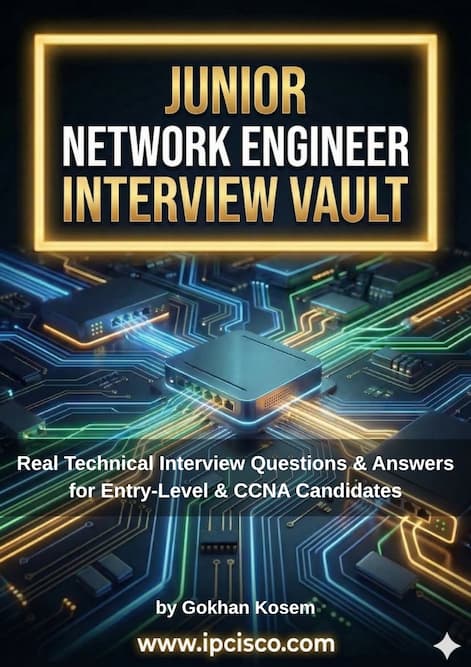
Junior Network Engineer Interview Vault
Senior Network Engineer Interview Vault

Expert Network Engineer Interview Vault
Network Engineer Interview
Are you preparing for a Network Engineer, Network Administrator, or Network Technician role? The hiring process usually starts with behavioral interviews and continues with technical networking interviews that test your real-world knowledge. In these technical interviews, hiring managers and senior engineers evaluate your understanding of key networking topics such as:
-
Network protocols
-
Routing and switching
-
Network topologies
-
IP addressing
-
Network troubleshooting
-
Automation tools
Each role requires a different level of expertise. For example:
-
L1 / Junior Network Engineer
-
L2 / Senior Network Engineer
-
Network Design Engineer
-
Wireless Network Engineer
That’s why Network Engineer Interview Questions vary depending on experience level. On this page, you’ll find carefully selected technical networking interview questions designed to help you prepare for real network job interviews. Network engineering roles are generally divided into three levels based on experience. Let’s take a quick look at each one.
Junior Network Engineers or Network Engineer Freshers are the new networkers in network world. They are typically fresh graduates or engineers with 1–2 years of experience. Junior Network Engineers generally has entry level theorical technical experience beside their no or little hands on experience on different network equipment. So, generally, to be eager to learn is a key qualification of these candidates. Here, candidates usually have:
-
Basic theoretical networking knowledge
-
Limited hands-on experience
-
Strong motivation to learn
Most Junior Network Engineer Interviews focus on computer network fundamentals.
Senior Network Engineers are experienced mid-level network professionals with 3 to 6 years of networking experience. They have both theorical and practical knowledge on various network protocols, network troubleshooting, network configurations beside hands on experience on various network equipment. Senior network engineers in this level typically have:
-
Solid theoretical knowledge
-
Strong hands-on experience
-
Real-world troubleshooting skills
Senior Network Engineer Interviews often test these skills: Network design thinking, Troubleshooting ability, Routing & switching depth, Practical scenario-based knowledge etc.
Expert Network Engineers are the most experienced, advanced network professionals with 7+ years of network experience. They have both very good theorical and practical network knowledge on various network protocols, scenarios. They possess:
-
Deep technical expertise
-
Advanced troubleshooting skills
-
Strong architecture-level knowledge
Expert-level interviews usually focus on, Complex network scenarios, Design decisions, Performance optimization, Advanced troubleshooting etc. Expert network engineers are the gurus of networking with high level network troubleshooting and problem solving capacity.
Network Engineer Interview Questions and Answers
In a Network Engineer Interview, the interviewers ask you a lot of technical questions as Network Engineer Questions. These questions can be in any lesson related to your expertise in your level. If you are a fresher in networking, your questions will be Network Engineer Interview Questions for fresher or they will ask you Jr Network Engineer Interview Questions. If you are a senior level expert, they will ask you more complex questions than basic network questions. And if you are experiences network engineer, then the questions will be mostly on network scenarios and troubleshooting activities.
As you know there are various network certifications that will show your expertise in network world. Various network vendors like Cisco, Juniper, Huawei, Nokia, HP, Checkpoint etc. provide these certifications to network engineers. So, what are the most popular network certifications? Some of the popular network certifications are Cisco CCNA, CCNP, CCIE, Juniper JNCIA, JNCIS, JNCIP, JNCIE, Nokia NRS I, NRS II, SRA, Huawei HCNA, HCIP, HCIE etc. In a Network Engineer Interview, generally the questions of these certification lessons are asked. This is independent of your certification name. The theorical parts of network lessons are similar. If you are preparing Cisco CCNA or Juniper JNCIA or Huawei HCIA, you learn network engineering basics and you can answer all the related questions in this level. So, to be successful in network engineering interviews and on Network Engineer Interview Questions, you should study these certification exams. Because, the certification exams cover all the required theorical lessons beside practical configuration lessons.
This page, CATs (Career Accelerator Tools) has prepared to help you for each level of a Network Engineering Interviews. With CATs (Career Accelerator Tools) Technical Interview Training, we are preparing you to these Network Engineer Interview Questions. We are providing, the possible real interview questions that they can ask you during a Technical Network Engineering Interview. You can select your level and then you can view the questions that you will come across in the Technical Job Interview. You can learn Network Engineer Interview Questions and Answers on this page and you can practice on them. You can also download these questions as Network Engineer Interview Questions and Answers pdf.
So, what will they ask you in a Network Engineer Interview? There are a lot of network lessons, protocols, configuration, tools etc. for example they can ask a preference number of a routing protocol, which protocols are used in multicast, usage of various network topologies, how to enable a protocol on a Cisco router, how to see a specific error on a switch port, how to subnetting, how to use automation tools etc. The questions difficulty increases with your expertise level. If you are a fresher network engineer, you should cover key points of the lessons. But if you are an expert, you should know even some specific bits of some headers, special messages of protocols, detailed configurations of each protocol.

Junior Network Engineer Interview Questions
Here are some example network interview questions from our Junior Network Engineer Interview Vault for fresh starters and junior network engineers. In the vault, you will find also “Follow up Quesions” related with the exact interview quesion and “Answer explanations” of each quesions. In Junior Network Engineer Interview Vault pdf, there will be 125 Questions, 125 Follow-up quesions (Total 250 Questions) and their explained answers. Almost each question will include a network topology or a picture related with the question. Here are some of these example network engineer interview questions.
Explain the OSI model in simple terms.
The OSI model is a 7-layer framework that describes how data moves from one device to another across a network. Each layer has a specific role, from physical transmission to application-level communication, making it easier to design, troubleshoot, and understand network operations. Psychical, Data-Link, Network, Transport, Session, Presentation and Application are OSI model layers.

What is the difference between TCP and UDP?
TCP (Transmission Control Protocol) is reliable and ensures data is delivered in order without loss. UDP (User Datagram Protocol) is faster but does not guarantee delivery, making it suitable for real-time applications like video streaming and VoIP

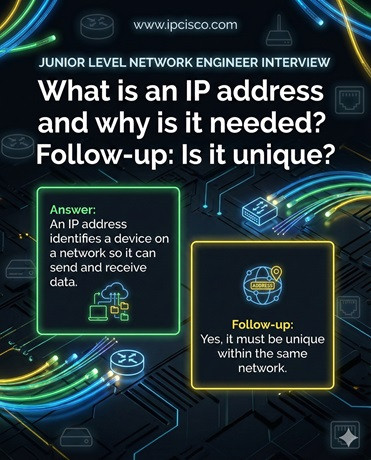
What is an IP address and why is it needed?
An IP address is a unique logical address assigned to every device on a network. It allows devices to locate each other and exchange data across local networks and the internet. It works on Layer 3.
What is the difference between IPv4 and IPv6?
IPv4 uses 32-bit addressing and supports around 4.3 billion addresses. IPv6 uses 128-bit addressing, providing an almost unlimited number of IP addresses and improving network scalability and efficiency. IPv4 uses decimal notation, while IPv6 uses hexadecimal notation. IPv4 uses broadcast traffic; IPv6 replaces it with multicast and anycast for efficiency. IPv6 has a simplified header structure, enabling more efficient routing. IPv6 supports auto-configuration (SLAAC), reducing the need for DHCP. IPv6 has built-in support for IPsec, improving native network security.

What is the main role of a switch in a network?
A network switch connects devices within a LAN and forwards data based on MAC addresses, improving network performance and reducing unnecessary traffic.

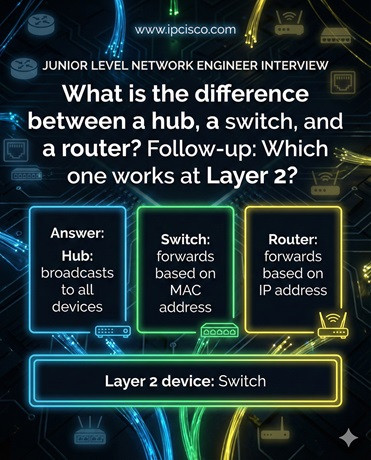
What is the difference between a hub, a switch and a router?
A hub sends incoming data to all connected devices, creating unnecessary traffic. A switch intelligently forwards data only to the correct device using MAC addresses. A router connects different networks and directs traffic using IP addresses, enabling communication between local networks and the internet.
What is DNS and why is it important?
DNS (Domain Name System) translates domain names into IP addresses so users can access websites without remembering numeric addresses.

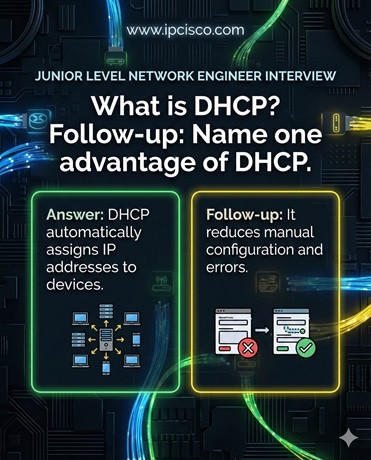
What is DHCP?
DHCP (Dynamic Host Configuration Protocol) automatically assigns IP addresses and network settings to devices, simplifying network management.
What does ping test?
The ping command tests network connectivity by checking if a device can reach another device and measuring response time. It uses ICMP packets to do this.

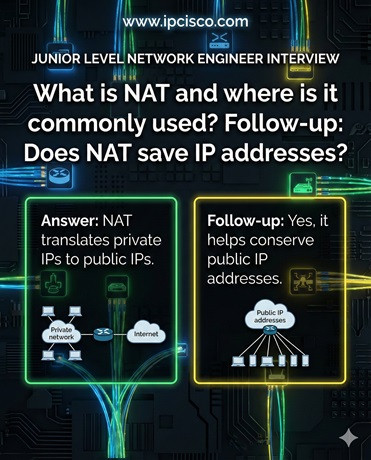
What is NAT and where is it commonly used?
NAT (Network Address Translation) is a networking technique that translates private IP addresses into a public IP address so devices can communicate with the internet. It helps conserve IPv4 addresses and improves network security by hiding internal IP addresses. NAT is commonly used in home routers, enterprise networks, and cloud environments where multiple devices share a single public IP.
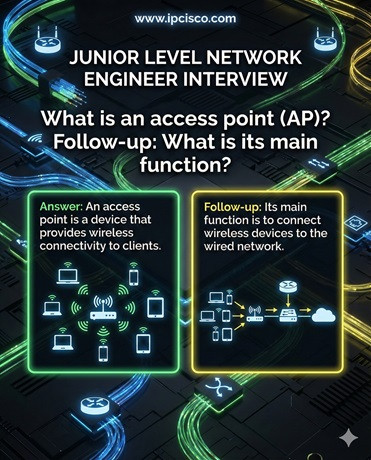
What is an Access Point (AP)?
An Access Point (AP) is a networking device that provides wireless connectivity to devices like laptops, smartphones, and IoT devices. It connects Wi-Fi users to a wired LAN and allows seamless wireless communication within homes, offices, and enterprise networks.
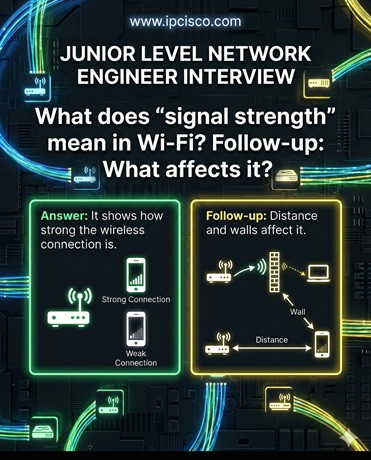
What does “signal strength” mean in Wi-Fi?
Wi-Fi signal strength indicates how strong the wireless connection is between a device and the access point, affecting speed and reliability.
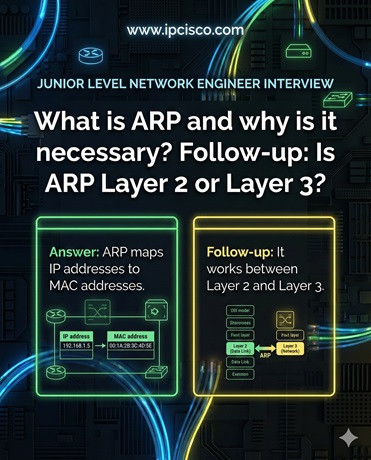
What is ARP and why is it necessary?
A default gateway routes traffic from a local network to external networks like the internet.
What is the purpose of a default gateway?
A default gateway routes traffic from a local network to external networks like the internet.

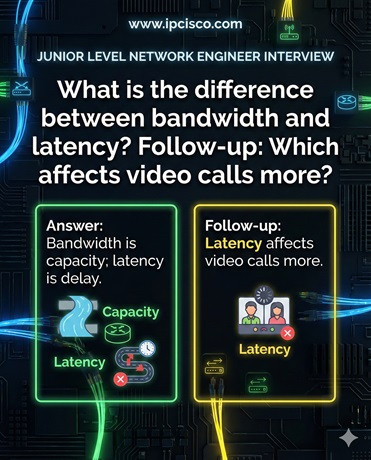
What is the difference between bandwidth and latency?
Bandwidth is the amount of data that can be transferred, while latency is the delay in data transmission.
Junior Network Engineer Interview Vault
Senior Network Engineer Interview Vault
Expert Network Engineer Interview Vault
Senior Network Engineer Interview Questions
This section contains network interview questions for experienced and senior network engineers.
Expert Network Engineer Interview Questions
This section contains network interview questions for experienced and expert network engineers.
Get Your Dream Network Role!
After preparing Network Engineer Interview Questions with Answers, what will be next? With IPCisco CATs, You will be ready for your Network Engineer Interview. You will go to your technical interview and you will be successful on it. Then, you will get your dream new role! So, do not waste your time to struggle on internet and focus on IPCisco CATS, IPCisco Network Engineer Interview Questions.

Gokhan Kosem is a Network Engineer, Instructor and the Founder of IPCisco.com with 15+ years of experience in Cisco, Nokia, Huawei, Juniper, Linux, Service Provider Networks, Routing and Switching technologies.
He has worked on the backbone networks of major service providers and network vendors including Nortel, Alcatel-Lucent (Nokia) and has extensive hands-on experience with Cisco, Huawei, Juniper and Nokia networking technologies.
He has trained thousands of networking students worldwide through IPCisco.com, Udemy, books, labs, quizzes, and educational content across multiple social media platforms.
IPCisco.com | Best Route to Your Dreams
It’s good for me
Good for me
Hi
Please assist me with Junior Network Engineer interview questions and unswers.
How can we assist you Sipho? ;)
Where is the interview questions. I can’t find questions. help me
You can click the round links above to reach questions.
I paid $29 for interview questions. Not got any questions on my mail. From where I will get already paid the amount. Help me.
Hİ Sagarika. After the payment, you can access all the interview questions in the same page. We do not send any questions with emails.
It is wonderful for me as junior Network Engineer.
Enjoy Yibah:) Good luck!
thank you for your explanation
Always welcome Ayele:) Good luck!