

Senior Network Engineer, Network Architect and advanced infrastructure roles are among the most in-demand careers in today’s IT industry. As network engineers gain experience, they move beyond entry-level roles and target senior-level positions that require real-world troubleshooting and decision-making skills. During senior network engineer interviews, hiring managers and technical leads evaluate candidates with advanced scenario-based questions, protocol-level discussions, and complex network challenges. The Senior Network Engineer Interview Vault is designed to help you succeed in these interviews with 135 real-world interview questions, 135 follow-up questions and clear answer explanations. Total 270 senior network engineer questions and answers. These are the most commonly asked L2-level networking interview questions used in real job interviews for engineers with 3+ years of networking experience. You can download the Senior Network Engineer Interview Vault PDF below.
Senior Network Engineer Interview Vault
DOWNLOAD SAMPLE SENIOR INTERVIEW VAULT PDF (10 Questions)
Senior Network Engineer Interview
Are you a network engineer with at least 3 years of experience? Then you are already a strong candidate for senior-level roles. Advancing within your current company may be straightforward, but switching companies requires one critical step: success in a Senior Network Engineer interview.
Senior interviews are not about basic knowledge anymore. They are designed to evaluate your real-world troubleshooting skills, decision-making ability and deep understanding of networking concepts. Without proper preparation, even simple questions can become challenging under pressure.
What to Expect in a Senior Network Engineer Interview
In most Senior Network Engineer interviews, you will face one or more experienced engineers or managers. Each interviewer may focus on different areas such as routing, switching, troubleshooting or network design.
The goal is not only to test your knowledge, but to understand how you approach problems, analyze scenarios, and make technical decisions.
Senior Network Engineer Interview Questions and Answers
The Senior Network Engineer Interview Vault is designed to prepare you for these real-world interview scenarios.
Inside this vault, you will find:
- Realistic interview-style questions
- Scenario-based troubleshooting cases
- Protocol-level technical questions
- Clear explanations with follow-up discussions
These questions reflect what hiring managers actually ask in interviews and help you evaluate whether your knowledge is ready for a senior-level role.
How Interview Questions Progress?
Senior interview questions typically follow a structured pattern:
- Start with fundamental concepts
- Progress into advanced scenarios
- Focus on troubleshooting and decision-making
To succeed, you should not only know the answers, but also be able to explain your reasoning clearly and confidently.
Network Engineer L2 Interview Questions
In real-world network operations, roles are generally divided into levels:
- L1: Basic monitoring and support
- L2: Advanced troubleshooting and operational responsibility
- L3: Expert-level design and complex problem solving
Senior Network Engineer roles usually align with L2 responsibilities, where critical issues are analyzed and resolved.
If you are applying for an L2 role, you should be prepared for in-depth troubleshooting questions and real network scenarios. The Senior Network Engineer Interview Vault helps you practice exactly these types of questions.
Top Senior Level Network Engineer Interview Questions
Here are some top level questions from the senior level network engineering interviews.
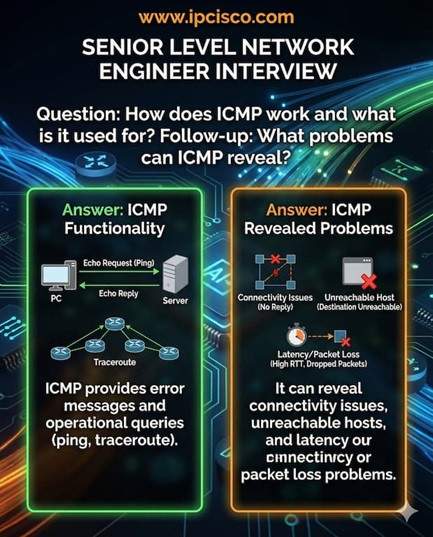
What is an IP address and why is it needed?How does ICMP work and What is it used for?
An IP address is a unique identifier used to locate and communicate with devices on an IP network. ICMP (Internet Control Message Protocol) is used for network diagnostics and error reporting (e.g., ping, traceroute). ICMP helps reveal issues like packet loss, latency, unreachable hosts/networks, routing problems and TTL expiry.
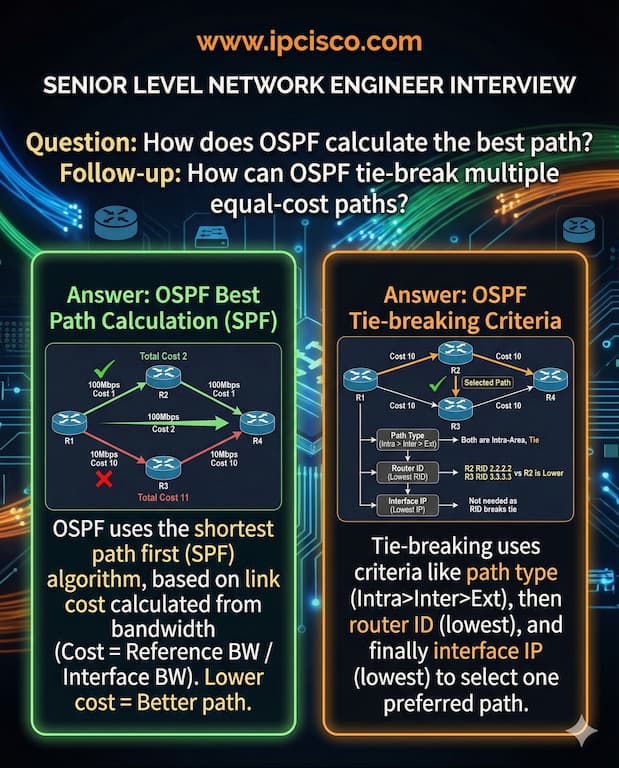
How does OSPF calculates the best path? How can OSPF ti-break multiple equal-cost paths?
OSPF calculates the best path using the Shortest Path First (SPF) algorithm (Dijkstra algorithm). It builds a topology map from LSAs and then computes the path with the lowest total cost, where cost is based on interface bandwidth.
If multiple paths have the same total cost, OSPF performs Equal-Cost Multi-Path (ECMP) load balancing and installs all best routes in the routing table. The number of equal-cost paths allowed is controlled by the maximum-paths setting.
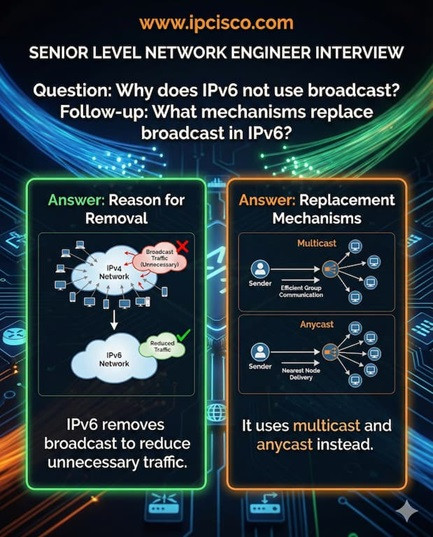
Why does IPv6 not use Broadcast? What mechanism replace broadcast in IPv6?
IPv6 does not use broadcast because it creates unnecessary network overhead by sending traffic to all nodes in a network, even when only a subset needs it. Instead, IPv6 replaces broadcast with multicast and anycast.
- Multicast sends packets only to a specific group of interested devices (used for neighbor discovery and routing updates).
- Anycast delivers packets to the nearest (best metric) device in a group of identical addresses.
This design improves efficiency, scalability and reduces unnecessary traffic compared to IPv4 broadcast communication.
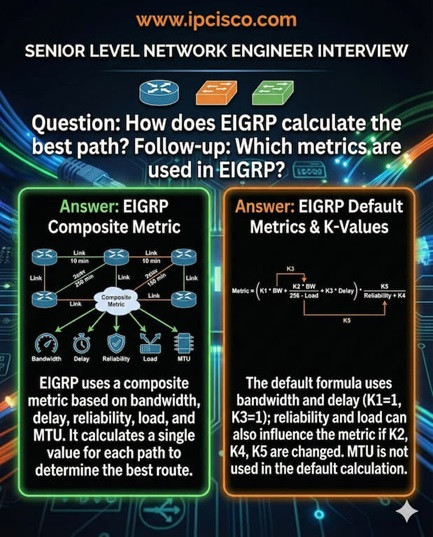
How does EIGRP calculate the best path? Which metrics are used in EIGRP?
EIGRP (Enhanced Interior Gateway Routing Protocol) calculates the best path using the DUAL (Diffusing Update Algorithm), which ensures fast convergence and loop-free routing. It selects the route with the lowest composite metric, which is mainly based on bandwidth and delay by default.
EIGRP can also consider reliability, load and MTU, but these are not used unless explicitly configured in the metric calculation formula. The best path is chosen based on the lowest total metric value and backup paths (feasible successors) are kept for fast failover in case the primary route goes down.
Most Asked Junior Network Engineer Interview Questions in Recent Years
In the recent years, some of the questions are mostly asked in the network engineering interviews. Here are some examples of these questions and their answers. Before checking the answer, you can try to answer these questions by yourself. There are also related follow up questions to go a little deeper.
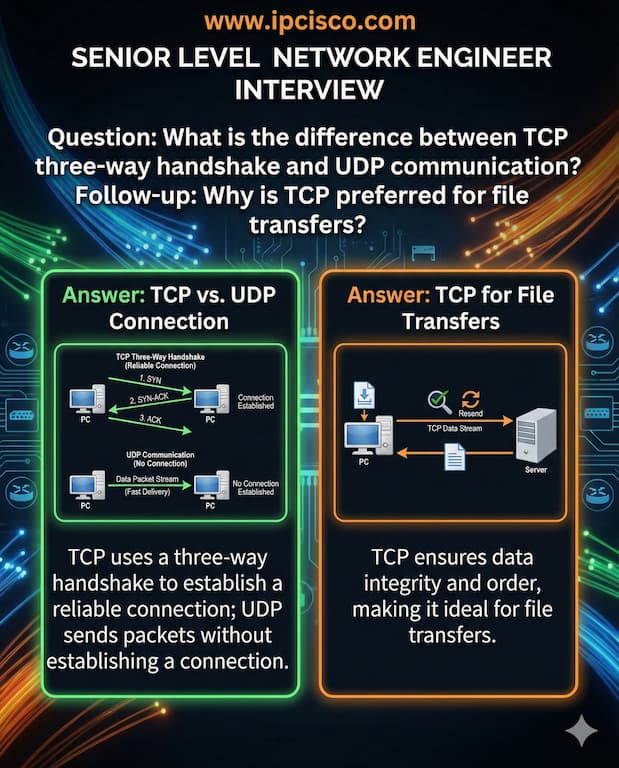
What is the difference between TCP Three-way handshake and UDP communication? Why is TCP prefered for file transfers?
TCP three-way handshake establishes a reliable connection using SYN → SYN-ACK → ACK, ensuring both sides are ready before data transfer starts. It provides reliability, sequencing, flow control, and error recovery.
UDP is connectionless and sends data without setup, acknowledgment or delivery guarantees—making it faster but less reliable.
TCP is preferred for file transfers because it ensures complete, ordered and error-free delivery of data, retransmitting lost packets and maintaining integrity, which is critical for large or sensitive files.
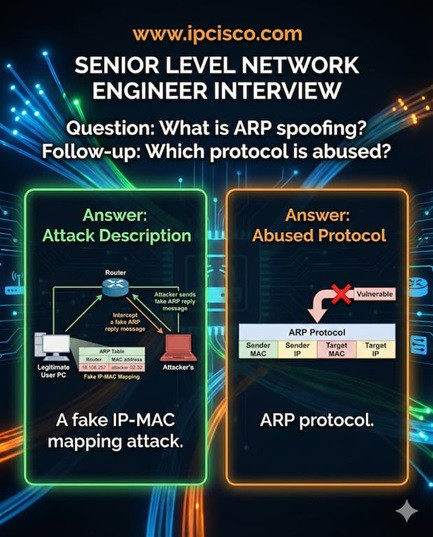
What is ARP Spoofing? Which protocol is abused?
ARP spoofing is a network attack where a device sends fake ARP messages to associate its MAC address with another host’s IP (often the gateway), allowing it to intercept or manipulate traffic (Man-in-the-Middle).
The protocol being abused is ARP (Address Resolution Protocol).
Important Network Engineer Interview Questions You Must Know
This section includes some of the most important questions commonly asked in network engineering interviews. These questions are selected to cover key topics like routing, switching, IP addressing, protocols, and troubleshooting, which interviewers frequently focus on. They are important because they test both your core knowledge and your ability to apply concepts in real scenarios. Being comfortable with these types of questions will help you respond confidently and demonstrate a solid understanding of networking fundamentals and practical skills.
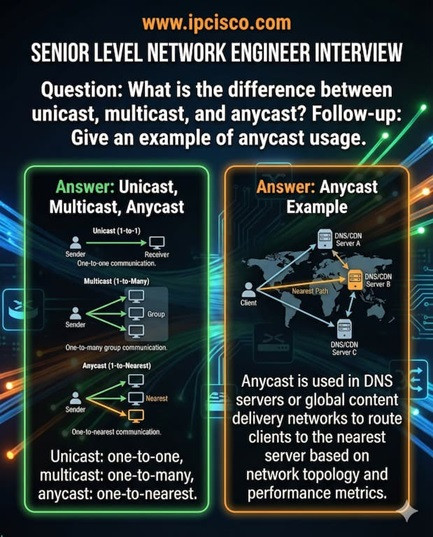
What is the difference between unicast, multicast and anycast?
Unicast, multicast and anycast define how traffic is delivered in a network:
- Unicast: One-to-one communication (one sender to one specific receiver).
- Multicast: One-to-many communication (one sender to a group of interested receivers).
- Anycast: One-to-nearest communication (one sender to the closest/optimal receiver among multiple identical destinations).
Each method improves efficiency depending on whether traffic is meant for a single host, a group or the nearest available service.
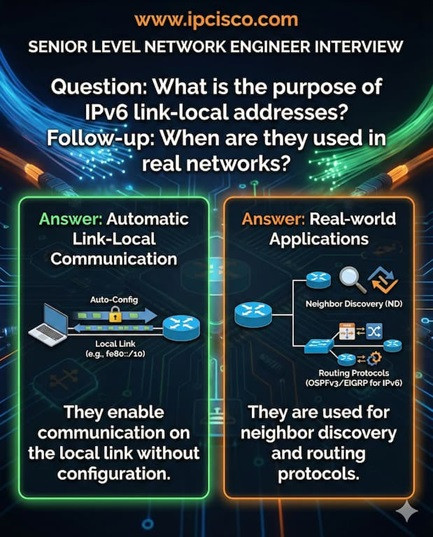
What is the purpose of IPv6 Link-Local Addresses?When are they used in real networks?
IPv6 link-local addresses are used for communication within the same local network segment (link) and are automatically assigned (typically FE80::/10 range).
They are used in real networks for neighbor discovery (NDP), router discovery, OSPFv3/EIGRP routing adjacencies and as next-hop addresses, even when global IPv6 addresses are configured. They are essential for basic IPv6 operations and do not require a router or manual configuration.
Networking Fundamentals Interview Questions for Senior Engineer Candidates
For a newbie, for a l1 network engineer candidate or for a network technician candidate, networking basics are very important in an interview. Because the most of the questions will come from the network fundamentals. In other words, from the basic of computer networking. Here are some of the examples of network fundamentals interview questions.
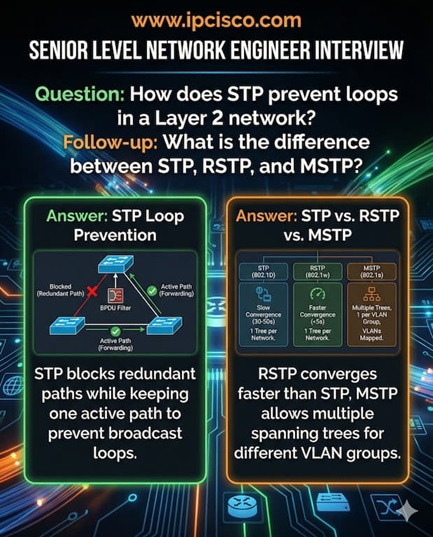
How does STP prevent loops in a Layer 2 network?
STP (Spanning Tree Protocol) prevents Layer 2 loops by creating a loop-free logical topology. It does this by electing a root bridge and calculating the best path to it, then blocking redundant links (non-designated ports) while keeping them as backups. If an active link fails, STP automatically unblocks a backup path, maintaining connectivity without causing broadcast storms or MAC table instability.
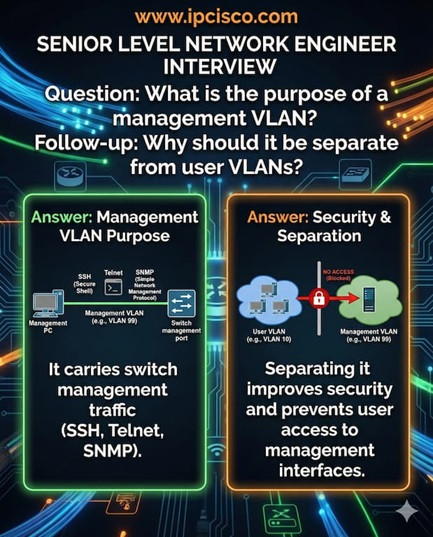
What is the purpose of Management VLAN? Why should Management VLAN be seperate from user VLAN?
A Management VLAN is used to carry network device management traffic such as SSH, Telnet, SNMP and device monitoring. It provides a dedicated and secure path for managing switches, routers and other network devices.
It should be separated from user VLANs to improve security and isolation, ensuring that end-user traffic cannot directly access or interfere with critical network management functions. This separation also enhances network stability and troubleshooting, reducing the risk of unauthorized access or broadcast impact on management services.
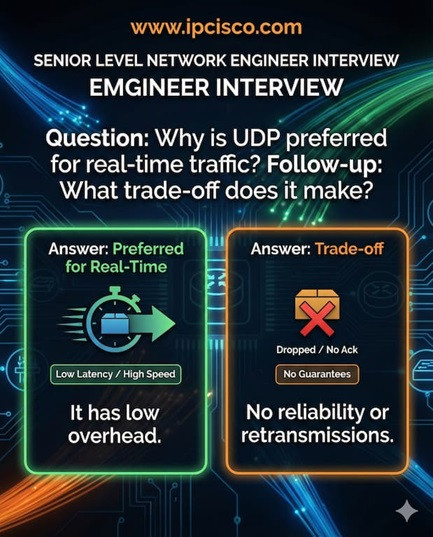
Why is UDP preferred for real-time traffic?What trade-off does it make?
UDP (User Datagram Protocol) is preferred for real-time traffic such as voice, video streaming and gaming because it is connectionless and low-latency, meaning it sends packets without waiting for acknowledgments or retransmissions.
The trade-off is that UDP does not guarantee delivery, ordering or error recovery, so packets may be lost or arrive out of order. However, real-time applications prioritize speed and minimal delay over perfect reliability, making UDP the better choice.
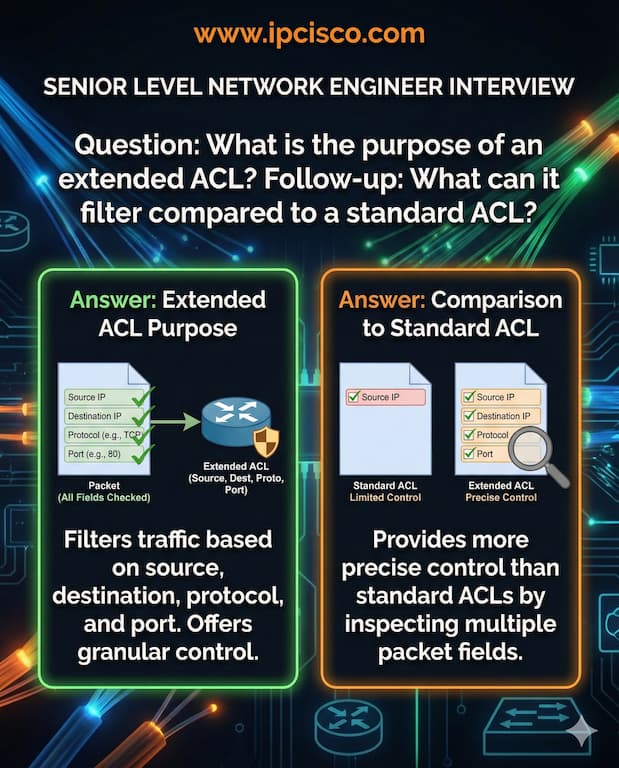
What is the purpose of an extended ACL? What can it filter compared to a standard ACL?
An extended ACL (Access Control List) is used to provide granular traffic filtering and security control in a network. Unlike a standard ACL (which only filters based on source IP address), an extended ACL can filter traffic based on source and destination IP addresses, protocols (TCP, UDP, ICMP) and port numbers.
This allows precise control over network traffic, such as permitting or denying specific applications (e.g., HTTP, SSH, FTP) and improving security by enforcing detailed policy rules closer to the traffic source.
Junior Network Engineer Interview Vault
IP Addressing & Subnetting Questions on Network Interviews
In senior network engineering interviews, IP addressing and subnetting questions go beyond basic calculations and focus on design-level understanding and real-world application. Candidates are expected to demonstrate strong knowledge of IPv4 and IPv6 architecture, efficient subnet planning, CIDR aggregation and scalable network design for enterprise and service provider environments. These questions often assess how well you can optimize address space, prevent fragmentation, support growth, and troubleshoot routing or connectivity issues related to incorrect subnetting. A senior engineer should not only calculate subnets accurately but also explain how addressing decisions impact routing efficiency, summarization, security boundaries, and overall network scalability.
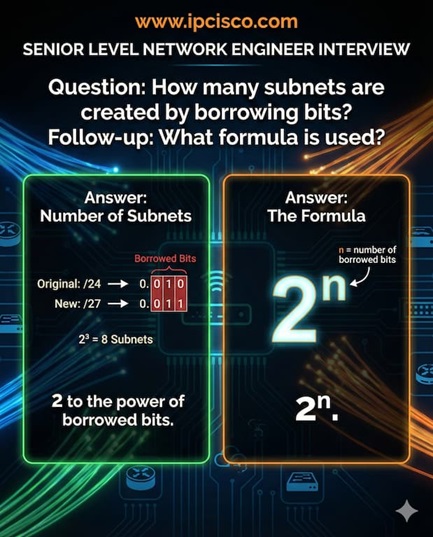
How many subnets are created with borrewing bits? What formula is used?
When borrowing bits in subnetting, the number of created subnets is calculated using the formula 2ⁿ, where n is the number of bits borrowed from the host portion. Each borrowed bit doubles the number of available subnets, allowing more granular network segmentation and efficient IP address utilization. This concept is fundamental in both IPv4 subnetting and enterprise network design, especially when planning scalable addressing schemes and route summarization.
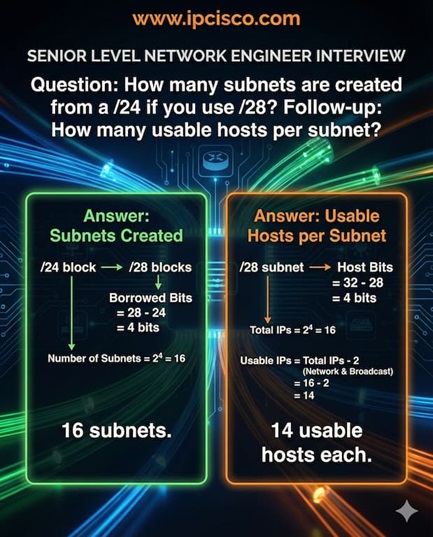
How many subnets are created from a /24 if you use /28? How many usable hosts per subnet?
A /24 network subnetted to /28 means you are borrowing 4 bits from the host portion (28 − 24 = 4).
- Number of subnets: 2⁴ = 16 subnets
- Total addresses per subnet: 2⁴ = 16 addresses (since /28 leaves 4 host bits)
- Usable hosts per subnet: 16 − 2 = 14 usable hosts (network and broadcast addresses are not usable)
So, splitting a /24 into /28 gives 16 smaller subnets, each supporting 14 usable hosts, which is commonly used for point-to-point links, small VLANs, or tightly segmented networks.
Scenario-Based Network Engineer Interview Questions
Beside theorical questions, scenario-based questions are also very important in a network engineer interview. For level 1, generally these questions are not difficult questions. But with these questions, they would like to measure that if you know the basic terms in troubleshooting and if you can use your knowledge in real life scenarios or not. Here are some basic example questions.
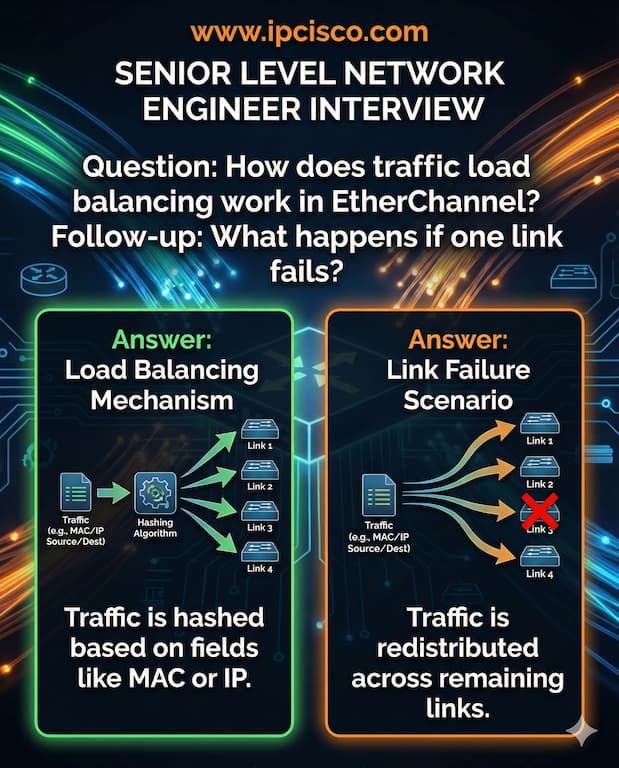
How does traffic load balancing work in EtherChannel? What happens if one link fails?
EtherChannel load balancing works by using a hashing algorithm (based on source/destination MAC, IP, or TCP/UDP ports) to distribute traffic across multiple physical links in a bundle. This ensures that traffic is efficiently shared while keeping a single flow on the same link to avoid packet ordering issues.
If one link fails, EtherChannel automatically removes the failed link from the bundle and redistributes traffic over the remaining active links, ensuring continuous connectivity with no downtime and providing redundancy.
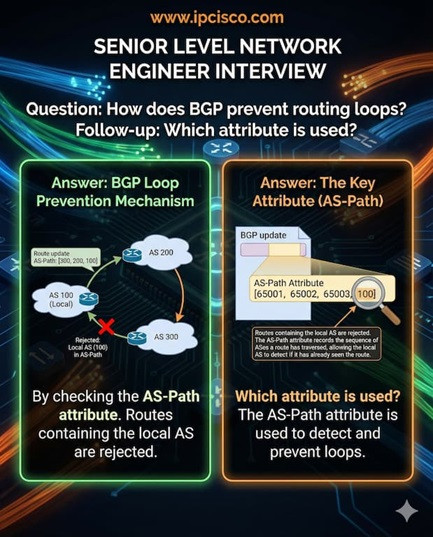
How does BGP prevent routing loops? Which attribute is used?
BGP prevents routing loops mainly using the AS_PATH attribute. Each time a route passes through an Autonomous System (AS), that AS number is added to the AS_PATH list. If a router receives a route that already contains its own AS number, it rejects it, preventing loops.
This mechanism ensures loop-free routing across different autonomous systems in the Internet by tracking the full path a route has taken.
Troubleshooting Interview Questions for Senior-Level Engineers
Troubleshooting is a core skill for senior network engineers, especially in complex enterprise and service provider environments where issues can span multiple layers and systems. In these interviews, the focus is not only on technical knowledge but also on structured troubleshooting methodology, decision-making under pressure and root cause analysis approach. Candidates are expected to demonstrate how they isolate problems systematically, prioritize impact, correlate data from multiple sources (logs, interface statistics, routing tables, monitoring tools), and quickly identify whether the issue lies in infrastructure, configuration, or application layers. The goal is to evaluate senior-level thinking: how efficiently you reduce complexity, prevent recurrence, and communicate effectively during critical network incidents.
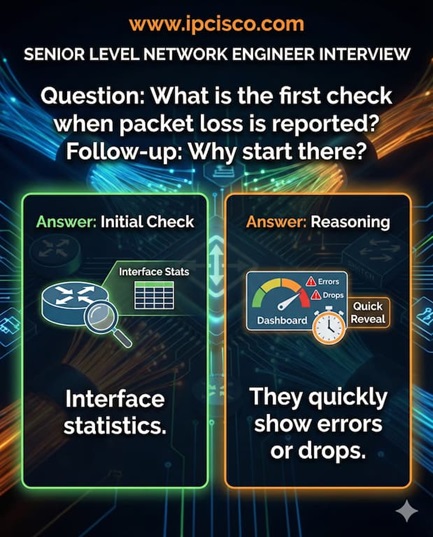
What is the first check when packet lost is reported?
When packet loss is reported, the first check is interface statistics on the affected device. Network engineers review input/output errors, CRC errors, drops, and bandwidth usage to quickly identify whether the issue is caused by congestion, physical layer problems, or misconfiguration. Interface-level counters provide the fastest initial insight and help determine if the packet loss originates from Layer 1 or Layer 2 before deeper troubleshooting in routing or higher layers.
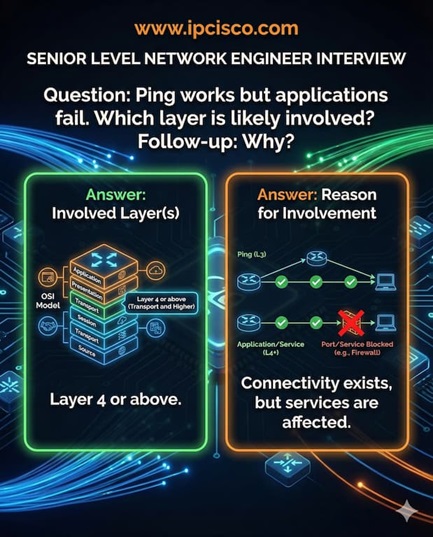
Ping works but applications fails. Which layers are likely involved?
If ping works but applications fail, the issue is most likely in the Transport, Session, or Application layers (Layers 4–7 of the OSI model). Ping uses ICMP at the Network layer, so basic IP connectivity is fine. However, applications depend on protocols like TCP/UDP, ports, authentication, DNS, or application-specific services. Failures here often indicate blocked ports (firewall or ACL), TCP handshake issues, service downtime, DNS resolution problems, or session/authentication errors. Therefore, the network is reachable, but end-to-end application communication is being disrupted above Layer 3.
Automation, SDN & Cloud Questions for Senior-Level Engineers
This section focuses on advanced topics commonly seen in senior network engineering interviews, including network automation, Software-Defined Networking (SDN) and cloud integration. These questions are designed to evaluate how well candidates understand modern network architectures, API-driven automation, controller-based networking and hybrid cloud environments. In a Senior Network Engineer Interview, it is not enough to know basic concepts; you are expected to explain how automation improves scalability, how SDN changes traditional networking models and how cloud connectivity impacts enterprise design and security. The Senior Network Engineer Interview Vault includes these scenario-based questions to assess real-world experience in modern, programmable network infrastructures.
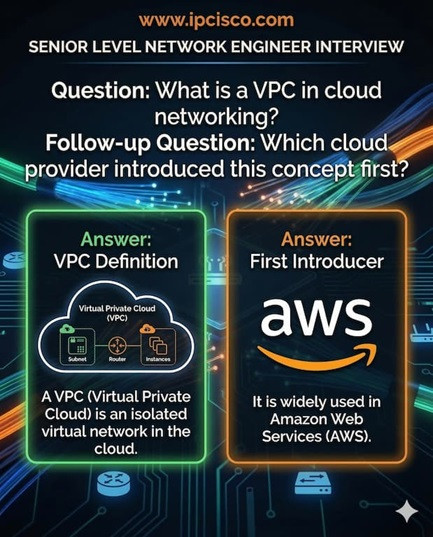
What is VPC in Cloud Networking? Which cloud provider introduced this concept first?
A VPC (Virtual Private Cloud) is a logically isolated section of a cloud environment where you can define and control your own virtual network infrastructure, including IP ranges, subnets, routing tables and security policies. It allows organizations to run resources in a secure, segmented network similar to an on-premises data center.
The VPC concept was first introduced and popularized by Amazon Web Services (AWS).
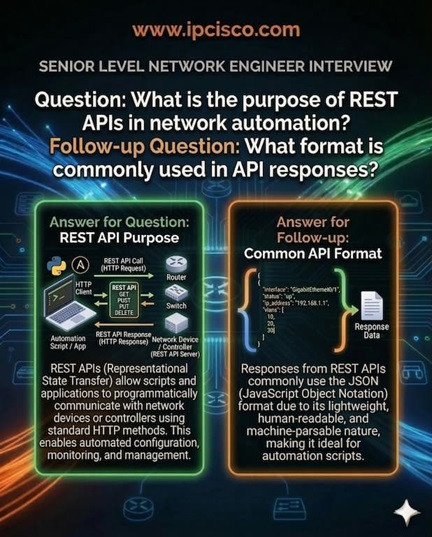
What is the purpose of REST APIs in network automation? What format is commonly used in API responses?
REST APIs in network automation are used to allow programmatic control and management of network devices, enabling tasks like configuration changes, monitoring and data retrieval without manual CLI access. They are a key part of network automation and SDN, improving speed, scalability, and consistency in operations.
The most commonly used format in API responses is JSON (JavaScript Object Notation), which is lightweight, human-readable and easy to parse by automation tools and scripts.
Get Ready for Your Next Role
By preparing with real interview-style questions, you will:
- Strengthen your technical knowledge
- Improve troubleshooting skills
- Gain confidence in interviews
- Think like a senior engineer
The Senior Network Engineer Interview Vault is available both as a downloadable PDF and as an Amazon Kindle eBook, allowing you to study anytime, anywhere.
Learn More
Would you like to learn more about network engineer salaries and career paths worldwide? Explore our related articles and continue building your networking career.
Senior Network Engineer Interview Vault

Gokhan Kosem is a Network Engineer, Instructor and the Founder of IPCisco.com with 15+ years of experience in Cisco, Nokia, Huawei, Juniper, Linux, Service Provider Networks, Routing and Switching technologies.
He has worked on the backbone networks of major service providers and network vendors including Nortel, Alcatel-Lucent (Nokia) and has extensive hands-on experience with Cisco, Huawei, Juniper and Nokia networking technologies.
He has trained thousands of networking students worldwide through IPCisco.com, Udemy, books, labs, quizzes, and educational content across multiple social media platforms.
IPCisco.com | Best Route to Your Dreams
I am Jamal Hossain. I want interview to CCNA
Hi Jamal ;) You can directly get interview questions at shop page.