

Network Engineer, Network Technician and Network Administrator roles are among the most in-demand careers in today’s IT industry. Many candidates start their journey by applying for entry-level networking positions such as Junior Network Engineer roles. During entry-level network engineer interviews, hiring managers and technical leads evaluate candidates with practical and foundational networking questions in CCNA level. The Junior Network Engineer Interview Vault is designed to help you succeed in these interviews with carefully prepared 125 real-world interview questions, 125 follow-up questions and clear answer explanations. These are the most commonly asked L1 networking interview questions used in real job interviews for 1–3 years of networking experience. You can Download Junior Network Engineer Interview Vault pdf below.
Junior Network Engineer Interview Vault
This vault helps you prepare effectively and confidently for your next network engineering interview. Especially entry level network engineering candidates are very curious about Network Technical Interview. They would like to know Network Engineer Interview Questions before the real interview. They would like to make practice on these question types to be more comfort in the real network engineer interview. With Junior Network Engineer Interview Vault, we will provide the real Network Engineer Interview Questions and Answers for freshers. You will learn these Jr Network Engineer Interview Questions and you will be familiar with the question styles of this Entry Level Network Engineer Interview.
Top Entry Level Network Engineer Interview Questions
So, what are the Network Engineer Basic Interview Questions? What will they ask to you as a fresher network engineer? What are the Entry Level Network Engineer Interview Questions? What is the most asked questions as Jr Network Engineer Interview Questions?
As a fresher, before the interview you will be curious about these Entry Level Network Engineer Interview Questions as many newbies in networking. But do not worry, the easiest technical interviews are Entry Level Network Engineering Interviews. You are at the beginning of your network career and the interviewer is conscious about your situation. So, they will ask you Basic Network Engineering Questions. For example, they can ask you TCP/IP layers, or routing protocols’ names, or how to start to configure a router, or network topology basics. Each of these questions will be the easiest network questions.
You are a fresher. So, you do not need to know every question. But you should show that you know something in networking and you are eager to learn more on network. Entry Level Network Engineer Interview Questions generally aims to learn that, you are really eager to learn network and select this path as your expertise. They do not wait to troubleshoot a complex network problem but they would like to know that you are eager to do that. If you learn the basics of networking, this knowledge will show your focus as networking and this will help you to pass this Entry Level Network Engineering Interview successfully.
Here are some top level questions from the entry level network engineering interviews.
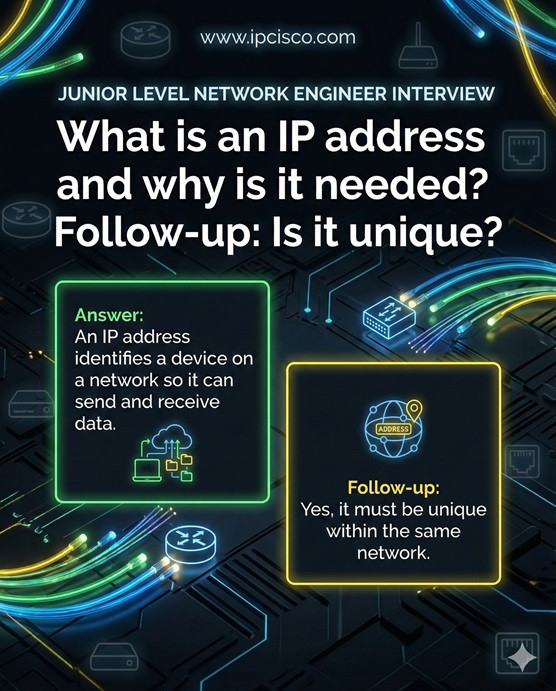
What is an IP address and why is it needed?
An IP address is a unique network identifier that allows devices to communicate with each other over the internet or a local network.
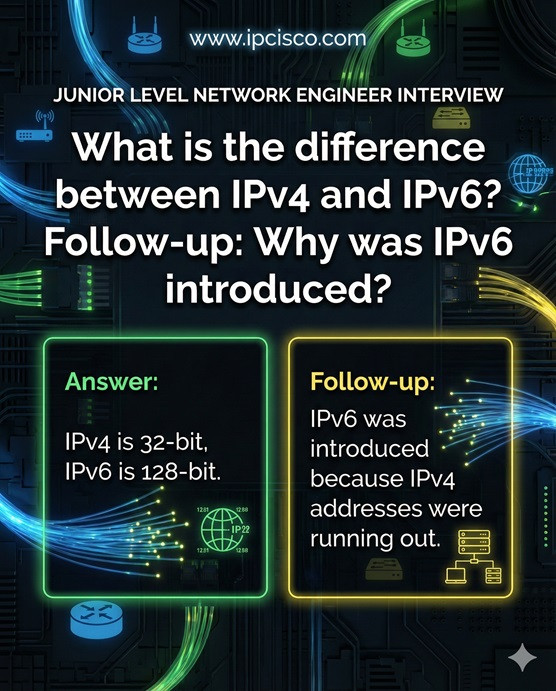
What is the difference between IPv4 and IPv6?
IPv4 uses 32-bit addresses and supports about 4.3 billion unique IP addresses, while IPv6 uses 128-bit addresses, allowing an almost unlimited number of devices to connect to the internet. IPv6 also improves routing efficiency, security, and eliminates the need for NAT in modern networks.
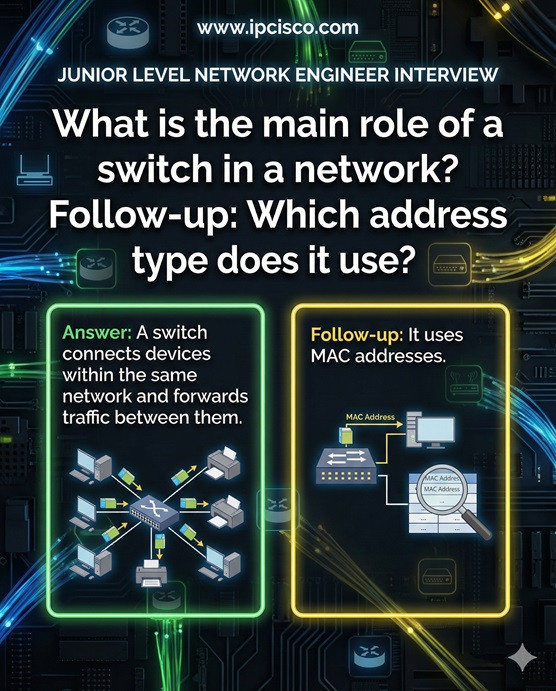
What is the main role of a switch in a network?
The main role of a network switch is to connect devices within a local area network (LAN) and intelligently forward data using MAC addresses. This improves network performance by sending data only to the intended device instead of broadcasting it to all devices.
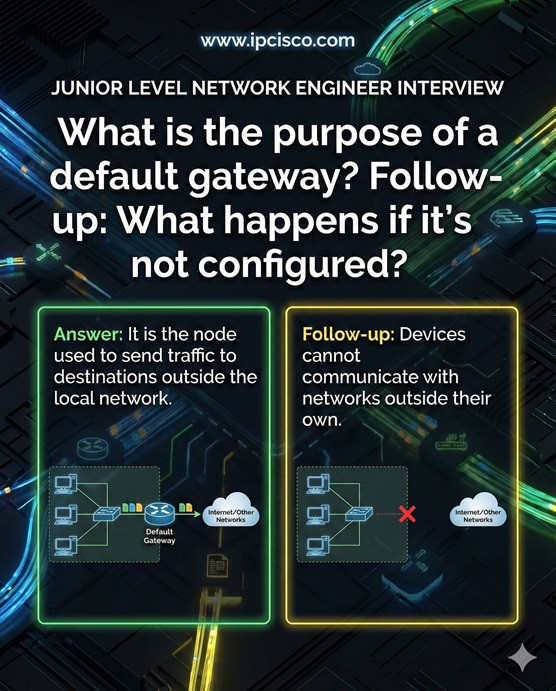
What is the purpose of a default gateway?
A default gateway is the device, usually a router, that allows devices in a local network to communicate with external networks like the internet. It acts as the exit point for all traffic that needs to leave the local subnet, ensuring proper network routing beyond the LAN.
Most Asked Junior Network Engineer Interview Questions in Recent Years
In the recent years, some of the questions are mostly asked in the network engineering interviews. Here are some examples of these questions and their answers. Before checking the answer, you can try to answer these questions by yourself. There are also related follow up questions to go a little deeper.
What is the difference between TCP and UDP?
TCP (Transmission Control Protocol) is a reliable, connection-oriented protocol that ensures data is delivered accurately and in order. UDP (User Datagram Protocol) is faster but connectionless, sending data without checking delivery. TCP is used for critical communication like web browsing and email, while UDP is preferred for real-time applications such as video streaming and online gaming where speed matters more than reliability.

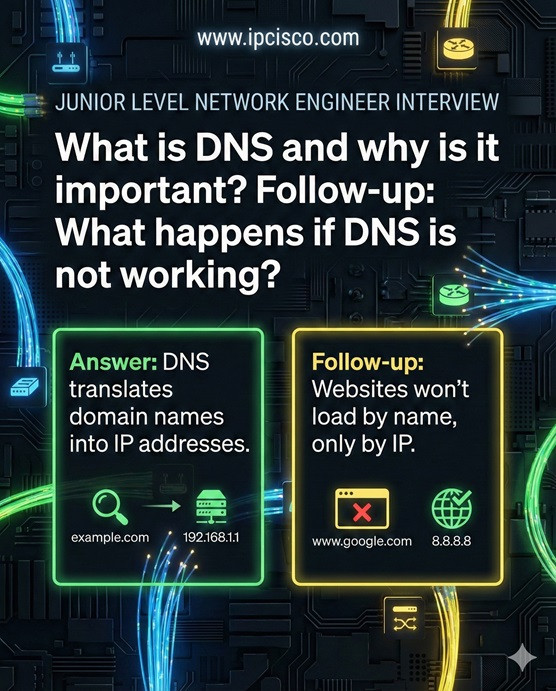
What is DNS and why is it important?
DNS (Domain Name System) converts domain names into IP addresses so users can access websites without remembering numeric addresses.
L1 Network Engineer Interview Questions You Must Know
Network Level 1 is the first level that a network engineer starts his/her career. They can work on Network Operation Center as NOC Engineer, Network Engineer L1. They can monitor systems and solve basic network problems that comes from customers. Even if a difficult problem occurs, they can escalate this problem to higher levels. Generally fresh graduate network engineers work in such roles and in these roles they learn more on networking basics. And to be accepted to such a role, they should be successful on an Entry Level Network Engineering Interview. In these interviews, interviewer or expert network engineers ask to the Level 1 Network Engineer candidate, Network Engineer Interview Questions for Freshers.
So, what will they ask you in a Network Engineer Interview for Freshers? They will ask you the basics of networking. For example, they can ask you the properties of TCP, or they can ask differences between network equipment, or they can ask how can we achieve network automation basically? Whatever they ask, if you are familiar with these network lessons, you will easily answer these questions. So, the questions on Junior Network Engineer Interview Vault are very important for you. Because, they are the real Network Engineer Interview Questions and Answers for Freshers. Here are some example to these questions:
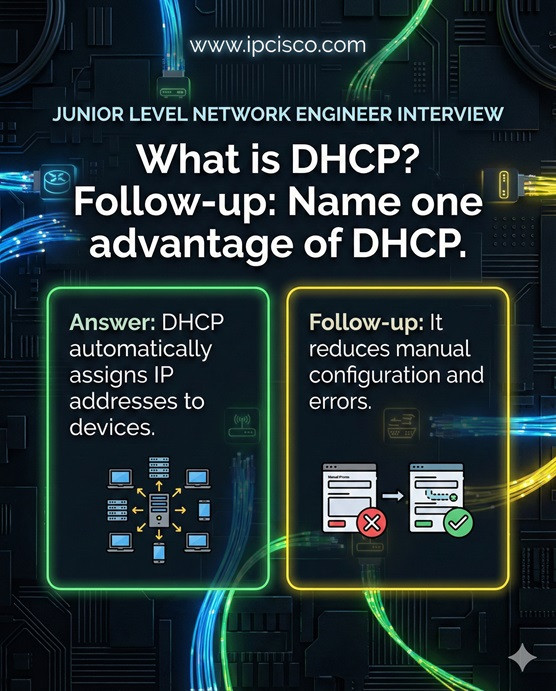
What is DHCP?
DHCP (Dynamic Host Configuration Protocol) automatically assigns IP addresses and network settings to devices on a network.
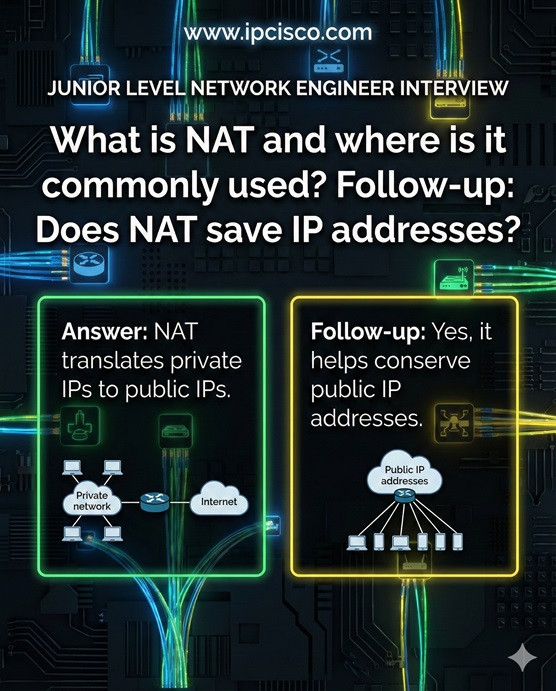
What is NAT and where is it commonly used?
NAT (Network Address Translation) converts private IP addresses into public ones and is commonly used in routers for internet access.
Networking Fundamentals Interview Questions for Beginners
For a newbie, for a l1 network engineer candidate or for a network technician candidate, networking basics are very important in an interview. Because the most of the questions will come from the network fundamentals. In other words, from the basic of computer networking. Here are some of the examples of network fundamentals interview questions.
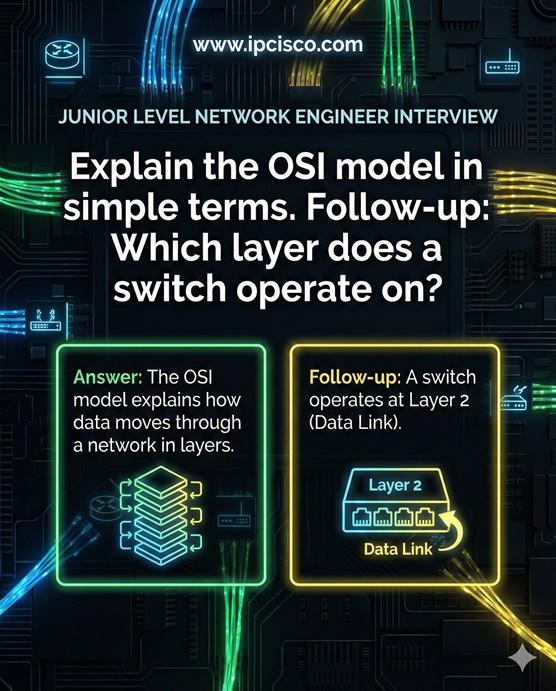
Explain the OSI model in simple terms.
The OSI model is a 7-layer reference model that explains how data moves across a network, from physical hardware to user applications. It helps network engineers understand, design, and troubleshoot communication systems by dividing networking into layers from bottom to top: Physical, Data Link, Network, Transport, Session, Presentation and Application.
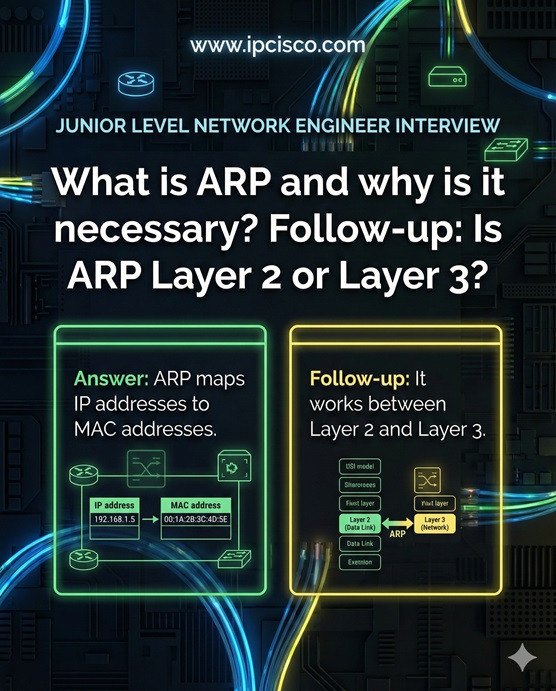
What is ARP and why is it necessary?
ARP (Addres Resolution Protocol) maps IP addresses to MAC addresses, allowing devices to communicate within a local network.
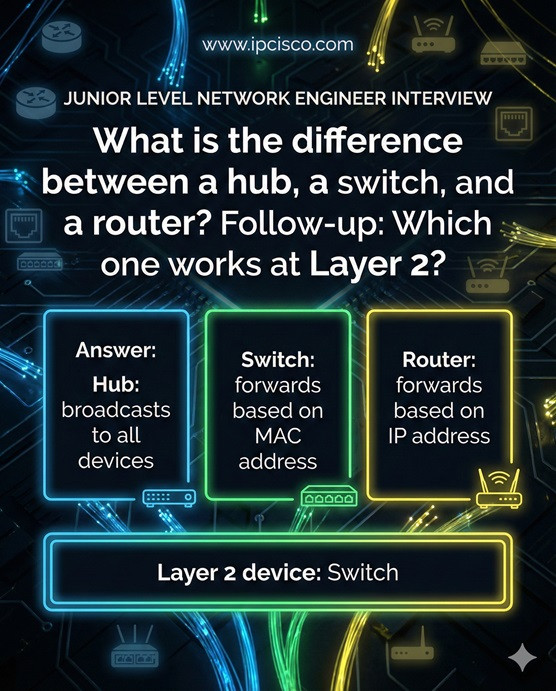
What is the difference between a hub, a switch and a router?
A hub broadcasts data to all devices in a network without filtering. A switch intelligently sends data only to the intended device using MAC addresses, improving network efficiency. A router connects different networks and directs traffic using IP addresses, enabling communication between local networks and the internet.
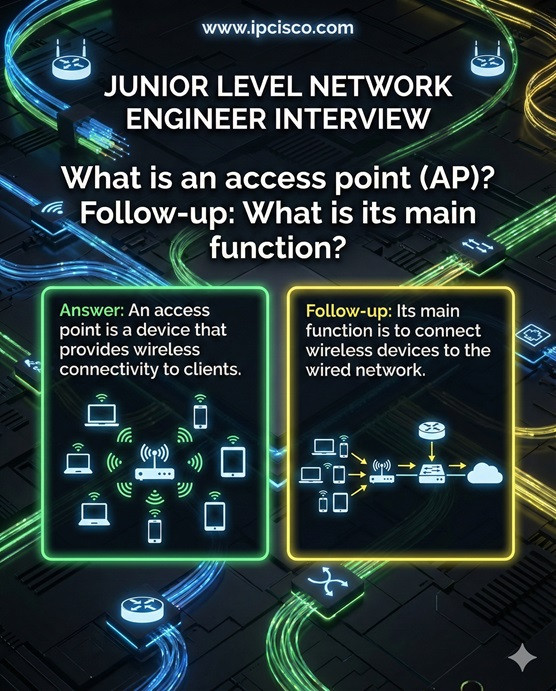
What is an access point (AP)?
An access point (AP) provides wireless connectivity by allowing Wi-Fi devices to connect to a wired network. It extends network coverage and enables smartphones, laptops, and IoT devices to access the internet without physical cables.
Junior Network Engineer Interview Vault
IP Addressing & Subnetting Questions and Answers on Interviews
In network interviews, ip addressing and subnetting are also important lessons. Here, they would like to learn your IPv4, IPv6 knowledge, ip address and calculation skills. Here are some examples on ip addressing and ip subnetting.
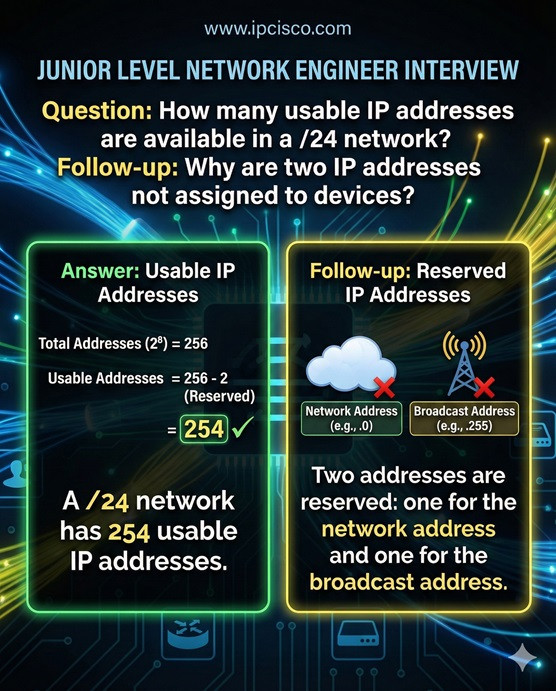
How many usable ip addresses are available in a /24 network?
A /24 network has a subnet mask of 255.255.255.0, which means the total number of IP addresses is calculated as: 2^(32−24^) = 2^8 = 256
However, in every subnet, 2 addresses are reserved: Network address (the first address) & Broadcast address (the last address)
So, the number of usable IP addresses is: 256−2 = 254 usable IP addresses.
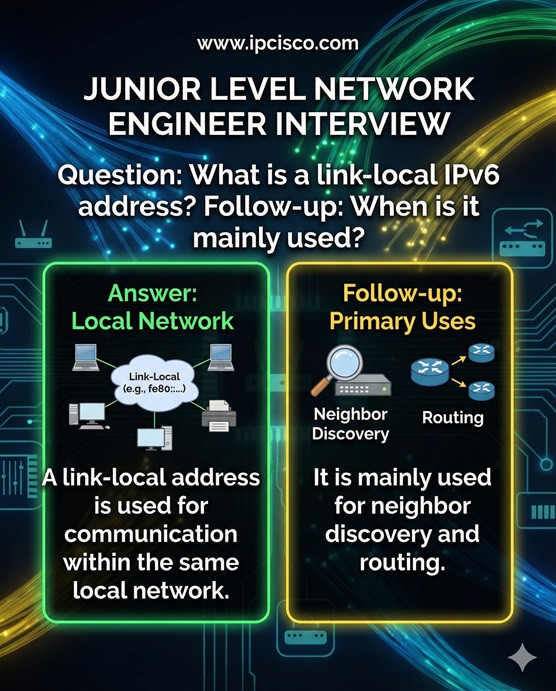
What is link-local IPv6 address?
A link-local IPv6 address is a special type of IPv6 address that is automatically assigned to every IPv6-enabled interface and is used only for communication on the same local link. It cannot be routed across different networks.
Scenario-Based Network Engineer Interview Questions
Beside theorical questions, scenario-based questions are also very important in a network engineer interview. For level 1, generally these questions are not difficult questions. But with these questions, they would like to measure that if you know the basic terms in troubleshooting and if you can use your knowledge in real life scenarios or not. Here are some basic example questions.
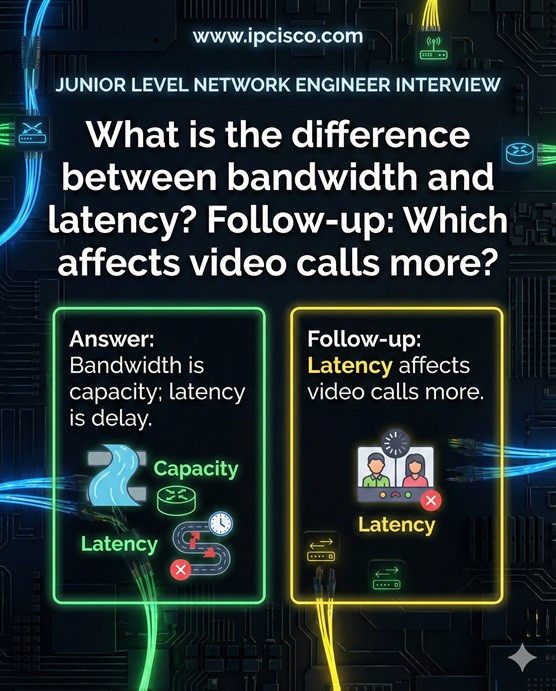
What is the difference between bandwidth and latency?
Bandwidth refers to the amount of data that can be transmitted over a network per second, while latency is the delay it takes for data to travel from source to destination. High bandwidth improves capacity, while low latency improves speed and responsiveness, especially in real-time applications.
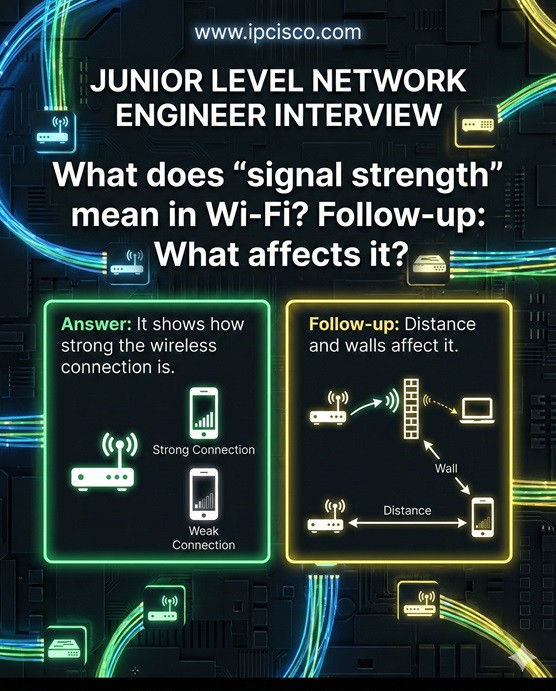
What does “signal strength” mean in Wi-Fi?
Wi-Fi signal strength refers to the quality of the wireless connection between a device and an access point. The more signal strength means better connection opportunity.
Troubleshooting Interview Questions for Entry-Level Engineers
Troubleshooting is very important for any networking job. There can be many cases, errors, emergencies during your work and in these situations, your behavior is very important. In troubleshooting interview questions, they want to measure your troubleshooting behavior and mentality. These questions are about a network problem and asks about the solution.
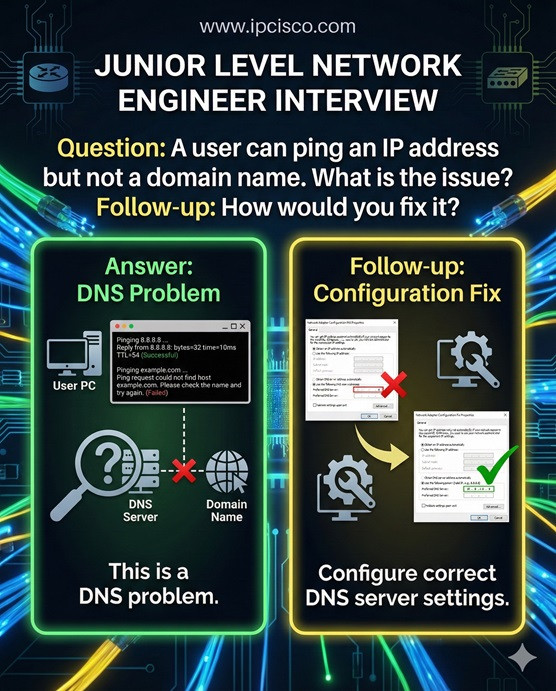
A user can ping an ip address but not a domain name. What is the issue?
If a user can ping an IP address but cannot ping a domain name, the issue is typically related to DNS resolution. This means the network connectivity is working, but the DNS server is not translating the domain name into an IP address.
Here, we can check the following:
- DNS server configuration,
- Incorrect DNS settings,
- DNS service availability,
In most cases, this is a DNS configuration or resolution problem.
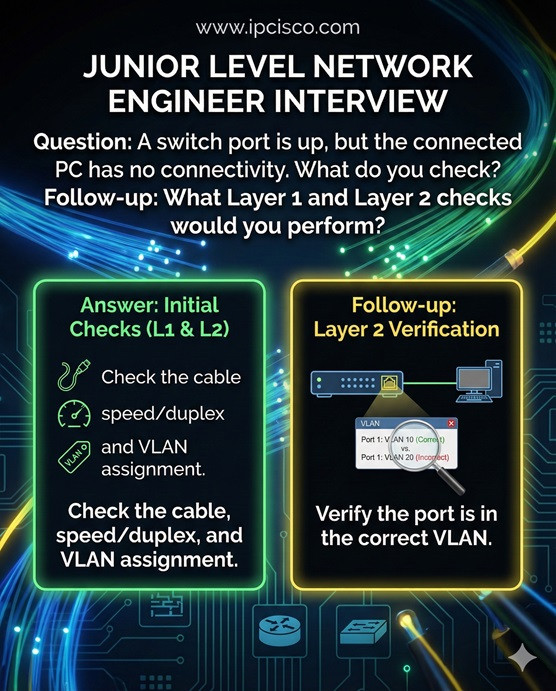
A switch port is up, but the connected PC has no connectivity. What do you check?
If the switch port status is up but the PC has no connectivity, we can check the following:
- VLAN assignment mismatch
- Incorrect IP configuration
- Disabled network adapter
- Port security restrictions
- DHCP failure
In many cases, the issue is caused by VLAN misconfiguration or missing IP address settings.
125 Real Network Interview Questions With Answers
You can find 125 important network interview questions with their follow-up questions in Junior Network Engineer Interview Vault pdf. Each question will have a related network topology or a picture and its answer explanation. If you want 125 questions, 125 follow-up question and their answer explanations, you can get Junior Network Engineer Interview Vault pdf. If you would like to have all levels, you can also get Senior and Expert Network Engineer Interview Vaults in one package.
Junior Network Engineer Interview Vault
Hi, excellent page for technical interviews!!!Grazie!!!
Thanks o lot for your kind comment Francesco! Enjoy…
Thanks for the information…I think this page is very useful…
Always welcome Mohammed ;) Enjoy!
Hi, thank you for this page! A junior network engineer should see this page before any technical interviw..!
Nice to hear these words Sergio;) Always welcome to IPCisco.com…
Very good questions! I think these will be useful for me. My interview will be this week and I hope I ll get this job…Thanks.
I hope so Andrew :) Goodl luck in your interview!
Ola! Muito útil… Thank you!
Welcome Sergio :) Enjoy…
Excellent Questions for interview! I have been asked some of these questions today. Thanks a lot!
Always welcome Kumar! Good luck!
Useful page…thsnk you…
Welcome Abhishek ;) Enjoy…
Very informative for anetwork engineering interview!
Nice to hear thes ekind words Haneen ;) Good luck!