
- COURSES
- SPECIALS
- BLOG
- MEMBERS
- SHOP
- BOOKSHELF
- ABOUT
- ENROLL HERE

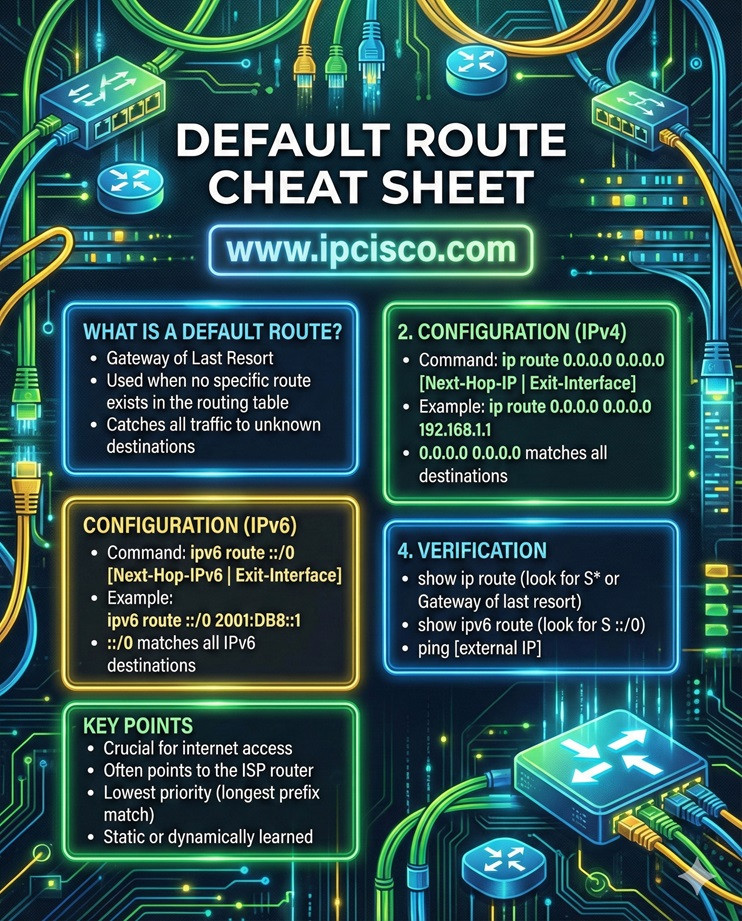
A default route is basically a route used by a router to forward packets when there is no specific route to the destination. In other words, it is the last option if there is no choice. Here, be careful not to confuse Default Route and Default Gateway. This is a common thing that network engineers confuse too much. Default route is the last option if there is no route to a destination and it is configured on routers. But Default Gateway shows the exit point to other networks and it is configured both on routers and PCs.
Default route is a common lesson for Cisco CCNA, CCNP ENCOR and CCIE Certification exams. This lesson is also asked too much in network engineer interviews as technical job interview question.
Table of Contents
Default route is configured on routers and it is stored in routing table in a router as last resort path. It is configured manually. We can give examples to these routes both for IPv4 and IPv6. Here are how to configure IPv4 and IPv6 default routes on Cisco routers.
On a Cisco router, to configure an IPv4 Default Route, we use “ip route 0.0.0.0 0.0.0.0 next-hop-ip-address” command. Here, next-hop ip address shows the place that traffic will be sent. “0.0.0.0 0.0.0.0” means select all traffic. Lest write a default route towards 192.168.1.1.
ip route 0.0.0.0 0.0.0.0 192.168.1.1
To configure IPv6 Default Route, we use “ipv6 route ::/0 next-hop-ip-address” command. Lest write an ipv6 default route towards 2001:db8:1::1.
ipv6 route ::/0 2001:db8:1::1
As summary:
The default routes are very important on a router. Because with default route, we prevent the below important cases:
First of all, it prevents packet drops if there is an unknown destination. Even there is an unknown destination, if we have a default route, the packet is sent to this destination as last resort.
Secondly, in production networks, default routes mainly used to forward the traffic to the Internet Service Providers (ISPs).
Lastly, by using default routes, routing tables are simplified. Because, in many cases, it prevents unnecessary route storage on routing table.
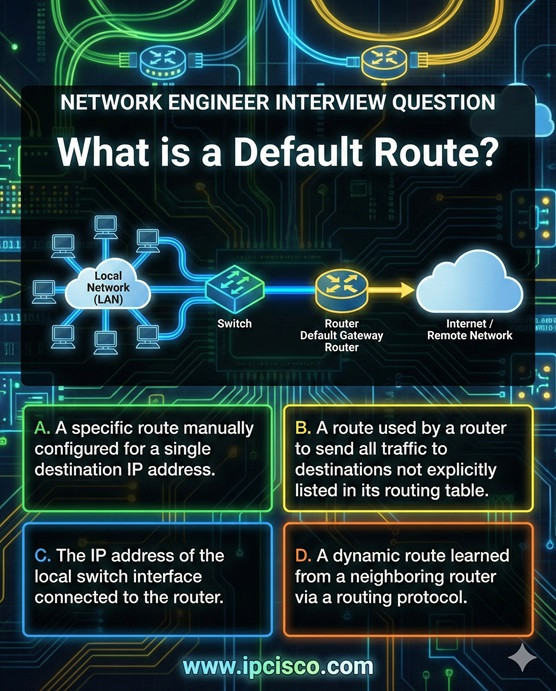
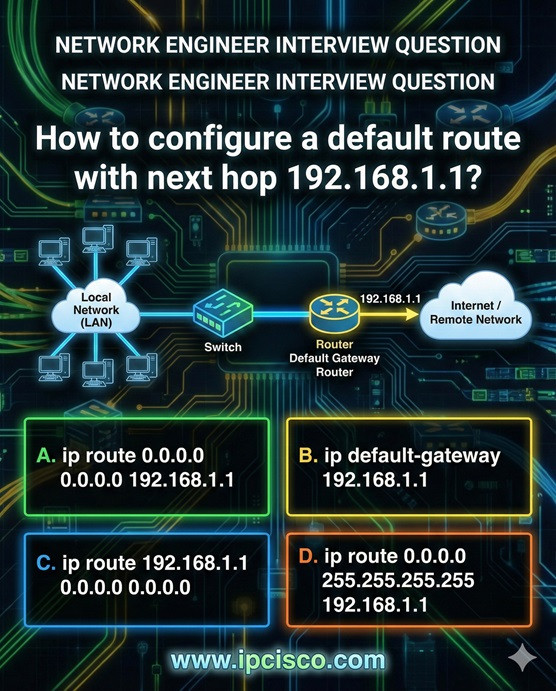
Correct Answers: 1B, 2A

Gokhan Kosem is a Network Engineer, Instructor and the Founder of IPCisco.com with 15+ years of experience in Cisco, Nokia, Huawei, Juniper, Linux, Service Provider Networks, Routing and Switching technologies.
He has worked on the backbone networks of major service providers and network vendors including Nortel, Alcatel-Lucent (Nokia) and has extensive hands-on experience with Cisco, Huawei, Juniper and Nokia networking technologies.
He has trained thousands of networking students worldwide through IPCisco.com, Udemy, books, labs, quizzes, and educational content across multiple social media platforms.
IPCisco.com | Best Route to Your Dreams







Leave a Reply