

Table of Contents
What is a Network Operating System (NOS)?
A NOS (Network Operating System) is a special software that is designed for network equipment like router, switches, firewalls etc. Different vendors have different Network Operating System for their devices. Some of them also have multiple Network Operating Systems for their device portfolio.
Normally, we use operating systems like Linux, Windows, MacOS on our PCs. These operating systems has specific command line and GUI (Graphical User Interface). Like these operating systems, NOS also provide a specific CLI and GUI.
Test Yourself With CCNA Questions and Answers!
Types of Network Operating Systems
There are diferent network operating systems based on network architecture and based on licencing model. Below, we will talk about these differet NOSs.
Based on Network Architecture
We can divide network operating systems into two based on network architecture. These are:
- Client-Server Network Operating Systems
- Peer-to-Peer Network Operating Systems
Client-Server Network Operating Systems
When we comapre NOS based on network architecture, the first NOS type is Client-Server NOS. A Client-Server NOS is a type of network operating system where a central server manages resources, security and network services. In this type of NOS, client devices request and use these services.
Peer-to-Peer Network Operating Systems
Teh second type NOS is Peer-to-Peer. A Peer-to-Peer NOS is a decentralized network model where each device can act as both a client and a server, sharing resources directly without a central server.
Based on Licensing Model
Another classification method of NOS (Network Operating System) is based on Licencing Model. There are two types:
- Proprietary NOS
- Open-source NOS
What is Proprietary NOS and what is Open-source NOS? Let’s also explain these NOS types.
Network Operating Systems
FREE DOWNLOAD Cisco IOS vs Juniper JUNOS vs Nokia SR OS vs Huawei VRP Command Cheat Sheet!
Proprietary Network Operating Systems (NOSes)
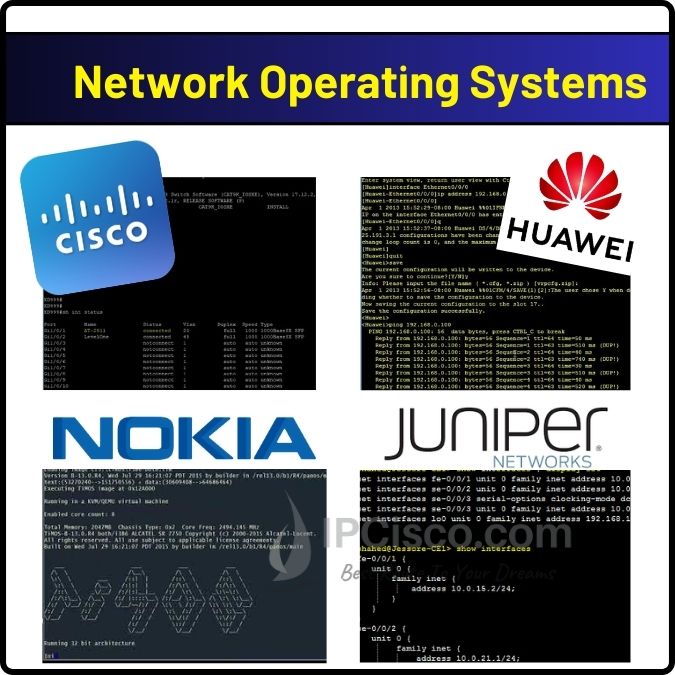
There are hardware vendors like Cisco, Juniper, Huawei, Nokia and software vendors like VMWare. The Network Operating Systems developed by these vendors are called Proprietary NOS. For example, Cisco’s IOS and IOS XR, Juniper ‘s JUNOS, Huawei ‘s VRP , Nokia’s SR OS or VMWare’s VMware NSX are Proprietary NOS examples.
Open-source Network Operating Systems (NOSes)
Open-source NOS is Network Operating System that is developed for users. With these NOS, users can do any customization without any limits. PicOS and SONIC can be good examples for these Nos type.
Modern Network Operating System Environments
In modern world, there are also new NOSes which can be classified as Modern Network Operating Systems. These mdoern NOSes are given below:
- Cloud-Based Network Operating Systems
- Embedded Network Operating Systems
- Hybrid NOS Environments
Now, let’s learn what are these mdeorn operating systems.
Cloud-Based Network Operating Systems
Cloud-based Network Operating Systems (NOS) are designed to operate in cloud environments, where network management, monitoring and control are handled remotely through cloud platforms. Instead of relying on on-premises infrastructure, these systems allow administrators to configure and manage network devices over the internet. Cloud-based NOS solutions offer high scalability, flexibility and centralized control, making them ideal for modern, distributed networks and enterprises.
Embedded Network Operating Systems
Embedded Network Operating Systems are specialized NOS designed to run on dedicated hardware devices such as routers, switches and IoT devices. These operating systems are optimized for performance, reliability, and low resource usage. Unlike general-purpose operating systems, embedded NOS are tightly integrated with hardware and provide essential networking functions like routing, switching, and security within the device itself.
Hybrid NOS Environments
Hybrid Network Operating System environments combine traditional on-premises NOS with cloud-based or virtualized network management solutions. In a hybrid setup, some network functions are handled locally on physical devices, while others are managed through cloud platforms or software-defined networking (SDN) solutions. This approach provides flexibility, scalability and better resource optimization, especially for organizations transitioning to cloud infrastructure.
Key Features of a NOS
Network Operating System has some common features. What are these NOS features? These are given below.
Resource management: The resource of the network can be managed by the help of NOS.
Resource Sharing: Data and service share with the help of various protocols like HTTP, FTP etc.
Network Security: We can prevent malicious attacks towards the network by policies, ACLs etc.
Network Monitoring and Maintenance: Network engineers can monitor the network and do the maintenance activities with the help of NOS. For example, they can see ne status of ports, they can start any upgrade process etc.
Troubleshooting: Any troubleshooting activities in a network is done with the help of Network Operating System.
Network Scalability: Network growth can be managed better with NOS.
What are the Well-known Network Operating Systems?
In networking there are many common network device vendors like Cisco, Juniper, Nokia and Hauwei. Each of these vendors has their own Network Operating System for their devices. Some of them also have multiple NOS for different devices portfolios.
For example, Cisco Systems has Cisco IOS as a NOS. Many Cisco routers and switches use this Network Operating System. Before, there were CatOS also for Catalyst series. Beside the most used NOS, Cisco IOS, Cisco also have Cisco NX-OS, Cisco IOS-XE and IOS XR. Each of these NOS types are specific for a device portfolio. For example, Cisco NX-OS is specific to Cisco Nexus series, specifically designed for datacenter usage. Even there are some common differences between these Network Operating Systems, there are also many common things like some commands.
The other network vendor, Juniper uses Juniper JUNOS as Network Operating System. The command line interface of this NOS is different than Cisco’s IOS or IOS XR etc. Similarly, Nokia has SR OS (Service Router Operating System) and Huawei has Versatile Routing Platform (VRP) operating system. Nokia 7750 SR and 7950 Service Routers use SR OS (Service Router Operating System) while Huawei NE40 devices uses Huawei Versatile Routing Platform (VRP) operating system. Nokia also have an open, extensible and resilient new NOS, SR Linux. (Service Router Linux).
NOS Versions
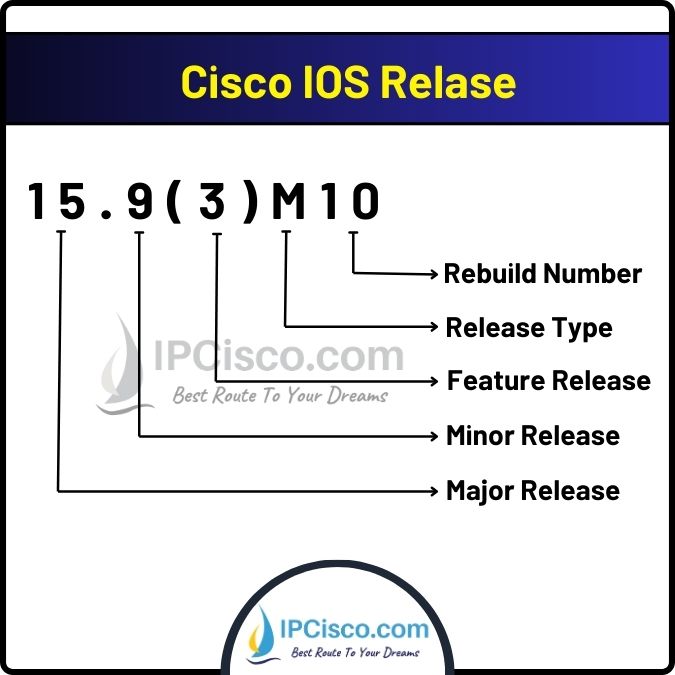
Network Operating System are updated because of new developments and enhancements. Whenever an update comes to a NOS, its version is changed. Different vendors use different notations for this version change. Here, I will show you, Cisco IOS versioning.
Cisco uses numbers and letters to inform users about its version. “a,b,c,d and e” are used letters here. The meaning of these letters are given below:
- a is the major version,
- b is the minor version,
- c is the release,
- d is the interim build number.
- e is the software release train identifier.
For today, the latest Cisco IOS release is 15.9(3)M10 that has released at August 8, 2024.
Cisco IOS Version (Internetwork Operating System Version)
Frequently Asked Questions About NOS
What is the Common Network Operating System of Each Vendor?
There are many network vendors in the world. But welk-known network vendors are Cisco, Huawei, Juniper and Nokia. These vendors have different Network Operating Systems but let’s write the most common and well-known ones. Cisco IOS, Juniper JUNOS, Nokia SR OS and Huawei VRP.
What is the Latest Cisco IOS Release?
For today, the latest Cisco IOS release is 15.9(3)M10 that has released at August 8, 2024.
What is the Difference Between Normal Operating System and Network Operating System?
Operating systems that we use daily manages the inside operations of a device like a PC. But a Network Operating System is designed for network devices to connect devices across the network, manage resources etc.
FREE DOWNLOAD Cisco IOS vs Juniper JUNOS vs Nokia SR OS vs Huawei VRP Command Cheat Sheet!


Gokhan Kosem is a Network Engineer, Instructor and the Founder of IPCisco.com with 15+ years of experience in Cisco, Nokia, Huawei, Juniper, Linux, Service Provider Networks, Routing and Switching technologies.
He has worked on the backbone networks of major service providers and network vendors including Nortel, Alcatel-Lucent (Nokia) and has extensive hands-on experience with Cisco, Huawei, Juniper and Nokia networking technologies.
He has trained thousands of networking students worldwide through IPCisco.com, Udemy, books, labs, quizzes, and educational content across multiple social media platforms.
IPCisco.com | Best Route to Your Dreams







Leave a Reply