
The informal IT arrangements that got an organization to a certain size tend to become visible only when they break. Password resets handled by whoever is available, network issues escalated to someone without the context to resolve them properly, license management living in a spreadsheet no one fully trusts. IT leaders inheriting these environments know the pattern. The gaps are never random. They cluster around the moments that matter most. The question that follows is usually framed as a hiring decision: Do we need more IT staff?
That framing made sense for decades. It makes less sense now. The choice facing most organizations today is not simply whether to grow the team, but how to allocate responsibility across human expertise and automated systems in a way that matches the actual nature of their IT workload.
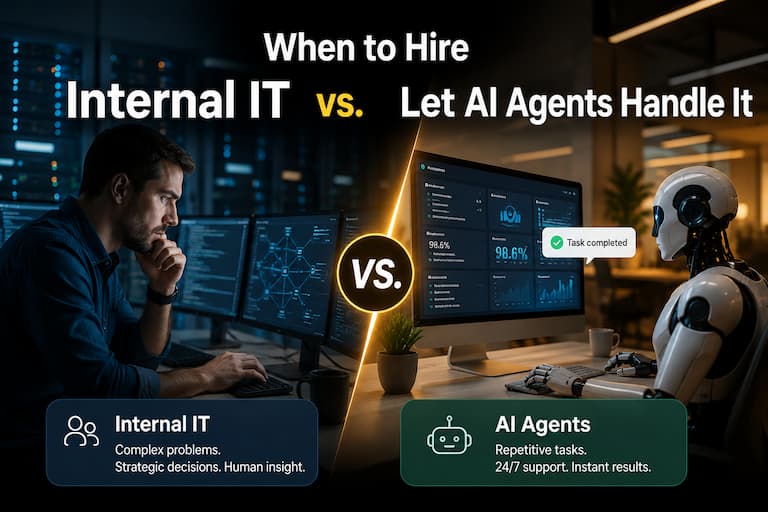
Human expertise and AI-driven automation are not interchangeable, but they are increasingly complementary in ways that significantly change the calculus of the hiring decision.
Table of Contents
What AI Agents Are Actually Good At
The honest answer to the hiring question starts with an inventory of your IT workload. For most small and mid-sized organizations, a substantial portion of that workload is repetitive, time-sensitive, and rule-based: password resets, software installation requests, connectivity troubleshooting, routine monitoring, ticket triage, and patch management. These tasks require reliability and speed more than they require judgment.
IT management software exists precisely to handle them at scale without consuming disproportionate amounts of human engineering time. Some AI agents are built specifically for this operational layer, handling high-volume, repeatable IT tasks without requiring the contextual reasoning that makes human expertise irreplaceable.
The distinction matters because it defines where automation delivers genuine value and where it reaches its limits. For organizations already investing in modernizing infrastructure with AI, the pattern is consistent: automating the repetitive operational layer does not eliminate the need for human IT capability, but changes what that capability needs to focus on.
The Case for Internal Hires
There are IT functions that AI agents handle poorly, and being honest about those limits is what makes the hybrid model work. Strategic infrastructure decisions, including choosing cloud architectures, evaluating security vendors, designing network topology, and managing a complex migration, require a contextual understanding of the business, its risk tolerance, growth trajectory, and existing technical debt.
Vendor relationships, compliance interpretation, incident response during novel or complex breaches, and the kind of institutional knowledge that makes an experienced engineer invaluable during a crisis are all firmly in human territory.
“Internal IT expertise is not optional. It is load-bearing.”
If your organization handles sensitive customer data, operates in a regulated industry, or is rapidly scaling infrastructure, that line is not rhetorical. The question is not whether to have human IT capability, but at what point the volume and complexity of your IT environment justifies a full-time internal hire rather than a managed service or fractional arrangement supplemented by automation.
The table below maps common IT decision criteria against both approaches, so the right allocation becomes clearer based on your actual environment:
| Decision Criteria | Automate | Hire Internal |
| Task is high volume and repetitive | Strong fit | Overkill |
| Requires business context and judgment | Poor fit | Strong fit |
| Failure carries regulatory or legal risk | Insufficient alone | Required |
| Resolution path is predictable | Strong fit | Unnecessary |
| Involves sensitive data oversight | Insufficient alone | Required |
| Needs vendor negotiation or relationship | Poor fit | Strong fit |
| Speed of response is the primary requirement | Strong fit | Slower |
| Situation is novel or has no precedent | Poor fit | Strong fit |
| Budget is constrained | Cost-effective | Higher fixed cost |
| Organization is scaling infrastructure rapidly | Supports but cannot lead | Required |
How Small Firms Are Navigating This
The economics look different at different scales. For smaller organizations, the case for AI-first IT operations is particularly strong. Analysis of how AI is helping small firms compete with larger ones points toward automation of operational workloads as the mechanism, not because small firms cannot afford talent, but because the volume of routine IT tasks does not justify a full-time hire. In contrast, the consequences of leaving those tasks unmanaged are real.
A ten-person company dealing with fifty IT tickets a month does not need a full-time engineer. It needs reliable, fast resolution of routine issues and a clear escalation path for the things that genuinely require human judgment.
Automated first response with human oversight for exceptions is the model that makes sense before the internal hire becomes justified by volume alone.
The Guardrails Question
Deploying AI agents for IT operations is not without governance requirements. Recent analysis of AI agent guardrails makes clear that autonomous systems operating on live infrastructure need defined boundaries, audit trails, and human review mechanisms built in from the start.
Understanding the difference between generative and predictive AI approaches is relevant for IT decision-makers evaluating which tasks are appropriate for autonomous execution and which require human sign-off.
The organizations that deploy AI agents well treat them as systems with defined operational scope rather than general-purpose replacements for human oversight. The DNS infrastructure decisions that affect enterprise domain strategy are a good example of the kind of domain-specific complexity that requires human expertise, regardless of how capable the automation layer becomes.
The hire-versus-automate question does not have a universal answer, but it has a useful framework. Automate the repeatable, time-sensitive, rule-based operational layer. Hire for strategy, complex problem-solving, vendor management, and the institutional knowledge that keeps infrastructure aligned with business direction. Organizations that treat these as competing options will underinvest in both. Those who treat them as complementary will get more from each.

Gokhan Kosem is a Network Engineer, Instructor and the Founder of IPCisco.com with 15+ years of experience in Cisco, Nokia, Huawei, Juniper, Linux, Service Provider Networks, Routing and Switching technologies.
He has worked on the backbone networks of major service providers and network vendors including Nortel, Alcatel-Lucent (Nokia) and has extensive hands-on experience with Cisco, Huawei, Juniper and Nokia networking technologies.
He has trained thousands of networking students worldwide through IPCisco.com, Udemy, books, labs, quizzes, and educational content across multiple social media platforms.
IPCisco.com | Best Route to Your Dreams