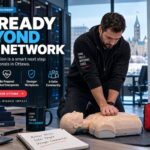


Certified professionals never really stop training. You stack your CCNA, chase a new specialization, and treat continuing education as a permanent part of the job rather than a box you check once. Professional development doesn’t have to stop at routers and switches, though. A growing number of IT professionals across the capital are completing their Coast2Coast CPR Certification Ottawa course alongside their technical credentials, treating it as one more entry in a professional development file that already runs long. It’s a short course, but the stakes involved are higher than almost any lab exam you’ll ever sit.
Table of Contents
Key Takeaways
- CPR certification is a fast, practical addition to any professional development portfolio.
- Sudden cardiac arrest is an electrical failure, not a blockage, and every minute without help matters.
- Ontario’s Occupational Health and Safety Act and WSIB set real first aid obligations for office and tech workplaces.
- Blended learning lets busy IT professionals finish theory online and train hands-on in person.
- Ottawa’s federal, defence, and telecom employers make on-site emergency readiness especially relevant.
Why Should Network Professionals Treat CPR Like Another Certification?
Think about how you already approach professional growth. You don’t wait for a system to fail before learning how to fix it. You study, practice, and certify first, and cardiac emergencies follow that same logic. Heart disease and stroke remain leading causes of death in Canada, and the Heart & Stroke Foundation has long noted that survival often comes down to how fast someone nearby responds. A CPR credential is proof you prepared for a failure scenario before it happened.
What Actually Happens During Sudden Cardiac Arrest?
A cardiac arrest is an electrical failure, not a plumbing one. The heart’s rhythm turns chaotic and stops pumping blood, and within minutes the brain starts losing oxygen, a bit like a system crash with no restart script waiting to run. Someone has to intervene manually: chest compressions and, when one is available, an AED. The Canadian Red Cross notes that survival odds drop sharply for every minute that passes without CPR or defibrillation, so the response has to come from whoever is standing closest.
A certification course typically teaches you to:
- Recognize early signs of cardiac arrest, choking, and severe bleeding
- Perform hands-only and rescue-breath CPR correctly
- Use an AED confidently under stress
- Respond to workplace scenarios, from a loading dock fall to a colleague collapsing at a desk
What Does Ontario Law Require for Workplace First Aid Training?
Ontario employers carry real obligations here, even inside office-based tech environments. Under the Ontario Occupational Health and Safety Act, and the first aid requirements enforced through WSIB, employers must keep enough trained personnel and supplies on-site, scaled to workforce size. Government offices, software firms, and network operations centres across the city fall under these rules in some form. Compliance here works like any other certification requirement: it’s a safety net, not a checkbox.
Why Does Ottawa’s Tech and Government Sector Raise the Stakes?
Ottawa isn’t a typical tech market. It’s home to federal departments, defence contractors, and a dense cluster of software and telecom firms, many working alongside government clients under strict security expectations. That mix means more shift work, more after-hours on-call coverage, and more employees in secured or semi-isolated spaces where outside help can take longer to arrive. A trained colleague nearby closes that gap in exactly the minutes that matter most.
What Should You Look For in a CPR Certification Provider?
Not every course is built the same way, so it pays to compare providers the way you’d compare exam vouchers or training vendors. Look for nationally recognized certification, genuine hands-on practice rather than a video and a quiz, and flexible scheduling that respects a demanding on-call rotation. Blended learning, meaning online theory paired with an in-person skills session, lets busy IT teams finish the classroom portion between deployments while still getting real coaching before they certify.
- Certification recognized by the Heart & Stroke Foundation or the Canadian Red Cross
- Small class sizes with real feedback on technique
- Clear renewal reminders so a certification never lapses
- Group booking options for teams training together
Choosing a course with these markers means real competence, not just another line on a spreadsheet. If you want to see how one provider structures this training, Coast2Coast First Aid & Aquatics outlines its formats and scheduling online.
About Coast2Coast First Aid
Coast2Coast First Aid & Aquatics was founded in Toronto in 2014 and has grown into a leading name in workplace safety training, holding the Top 3 Canadian Red Cross Training Partner distinction for 2023, 2024, and 2025, along with recognition as a Heart & Stroke accredited trainer. The organization has certified more than 150,000 students, maintains a 99.9% success rate, and now operates 30-plus locations across Canada and the United States. Digital certificates arrive within 48 hours of a successful evaluation, and every student gets a free 90-day skills practice retake.
If you’re looking for CPR and first aid training near Rideau Street and King Edward Avenue, or anywhere around the Sandy Hill neighbourhood near the University of Ottawa, you may reach out to the Ottawa-based training team featured above in that area.
FAQs
Do IT and office employees really need a CPR certification credential? Cardiac arrest doesn’t check job titles. IT professionals often work long, isolated hours in server rooms or on late shifts, which makes bystander readiness genuinely useful, not optional.
What does Ontario law require for first aid coverage in an office? Under the Ontario Occupational Health and Safety Act, employers must provide adequate first aid coverage based on workforce size and hazard level, with WSIB setting the specific supply and personnel requirements.
How long does a CPR certification course usually take? Many blended-learning courses split the work into a short online theory module plus one in-person skills session, often finished in a single day.
How often do I need to renew my CPR certification? Most CPR and first aid certifications stay valid for a set period, commonly around three years, though timelines vary by certifying body, so check your certificate’s expiry date directly.
What’s the difference between CPR training and a full first aid course? CPR training focuses on responding to cardiac arrest and using an AED, while a full first aid course adds skills for injuries, choking, and other situations that come up in daily workplace life

Gokhan Kosem is a Network Engineer, Instructor and the Founder of IPCisco.com with 15+ years of experience in Cisco, Nokia, Huawei, Juniper, Linux, Service Provider Networks, Routing and Switching technologies.
He has worked on the backbone networks of major service providers and network vendors including Nortel, Alcatel-Lucent (Nokia) and has extensive hands-on experience with Cisco, Huawei, Juniper and Nokia networking technologies.
He has trained thousands of networking students worldwide through IPCisco.com, Udemy, books, labs, quizzes, and educational content across multiple social media platforms.
IPCisco.com | Best Route to Your Dreams