
- COURSES
- SPECIALS
- BLOG
- MEMBERS
- SHOP
- BOOKSHELF
- ABOUT
- ENROLL HERE

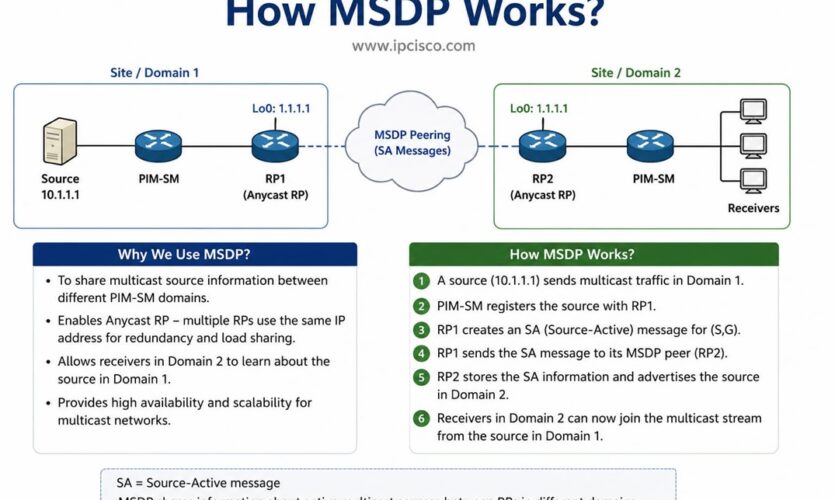
Table of Contents
Multicast Source Discovery Protocol (MSDP) is a multicast protocol used to interconnect multiple PIM-SM (Protocol-Independent Multicast – Sparse Mode) domains. With Multicast Source Discovery Protocol, we can discover information about multicast sources which are in the other PIM-MP Domains. MSDP is a protocol which has designed for IPv4. So, it is not used with IPv6.
How MSDP works and what are the benefit of this multicast protocol? Now, let’s focus on these details about Multicast Source Discovery Protocol.
To understand why we need Multicast Source Discovery Protocol, firstly let’s focus on how PIM Sparse Mode work. In a PIM-SM network a source Designated Router (DR) registers to a Rendezvous Point (RP) and a receiver DR sends Join messages to the RP. By doing this, Rendezvous Point learns all multicast source and group membership information. For small networks there is no problem, but if a large PIM-SM network is divided into multiple domains to control multicast resources, RP in one PIM-SM domain cannot obtain multicast source information in other PIM-SM domains. To do this MSDP is used.
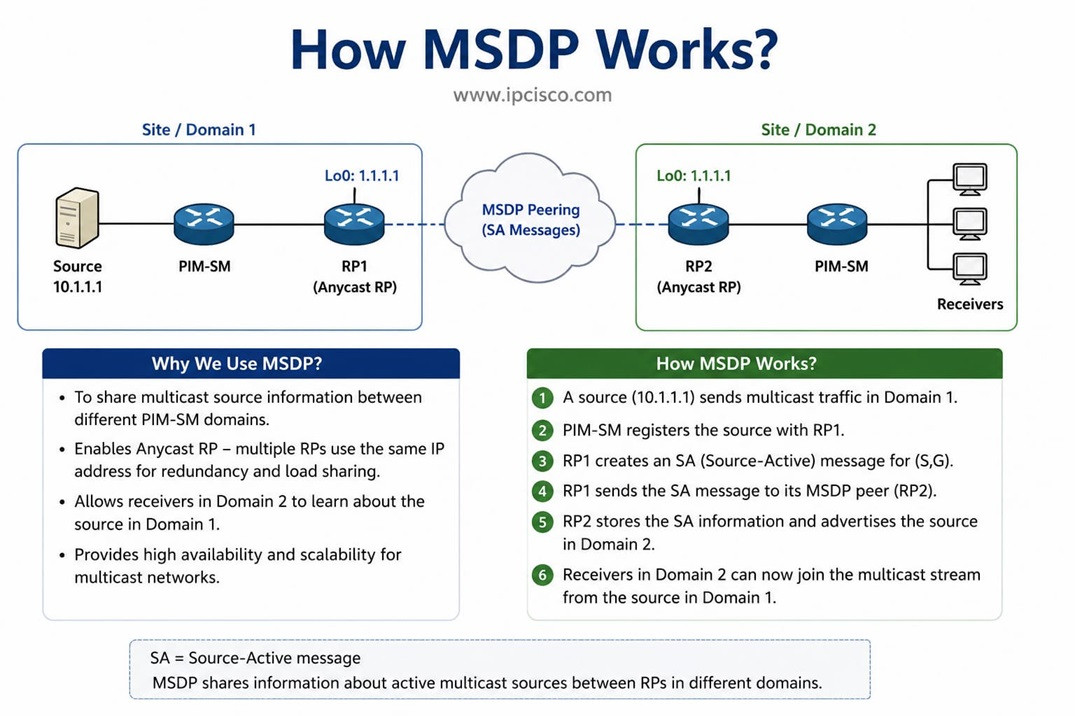
Multicast Source Discovery Protocol (MSDP)
As BGP Peers, Multicast Source Discovery Protocol routers in different PIM-SM domains establishes MSDP peering. These MSDP peers exchange Source-Active (SA) messages to share multicast source information. By doing this, the multicast users in one PIM-SM domain can receive multicast data from multicast sources in other PIM-SM domains.
Multicast Source Discovery Protocol uses Transmission Control Protocol (TCP). To establish MSDP peering to share multicast source information it uses TCP 639 port.
There are different benefits of MSDP, especially for Internet Service Providers (ISPs). Frist of all, without Multicast Source Discovery Protocol, multicast traffic is limited to one PIM-SM domain. With Multicast Source Discovery Protocol, multiple independent multicast domains can exchange multicast source information.
One of the biggest practical uses of Multicast Source Discovery Protocol is supporting Anycast Rendezvous Point (RP). Multiple RPs use the same IP address, and MSDP synchronizes multicast source information between them. This is one of the most important enterprise/service-provider uses of MSDP.
Instead of flooding multicast source information everywhere, MSDP distributes only active source information. This makes large multicast deployments more scalable.
If one RP fails, another Anycast RP can continue serving multicast clients. MSDP helps maintain multicast service continuity.
Receivers in different networks can dynamically discover multicast sources. Multicast Source Discovery Protocol uses, SA (Source-Active) messages.
Below you can find the use cases of MSDP.
Use Case Why MSDP Helps
You have learned what is Multicast Source Discovery Protocol and how it works. We have also talked about the benefits of this multicast protocol. Now, we will focus on Cisco MSDP Configuration step by step.
To enable MSDP on Cisco routers, we use “ip msdp [vrf <vrf-name>]” command globally. To configure Multicast Source Discovery Protocol peer address we use “msdp peer <peer-address> [connect-source <source-interface>]” command.
To configure an access control list (ACL) to define the filtering criteria we use “access-list <acl-number> permit <source-group>” command.
To apply the ACL as an SA filter for Multicast Source Discovery Protocol we use “msdp sa-filter in|out <acl-number>” command.
SA Hold-down Timer: Controls how long an MSDP router waits before re-advertising a multicast source after the last SA message.
SA Lifetime Timer: Determines how long an SA message remains valid before expiring.
ORP Cache Lifetime Timer: Defines how long active RP information is stored in the local cache.
Peer Timeout Timer: Specifies when an Multicast Source Discovery Protocol peer is considered down if no messages are received.
You can also check RFC 3618 for detailed Multicast Source Discovery Protocol information.
Multicast Source Discovery Protocol is used for IPv4 only.
Multicast Source Discovery Protocol is considered a legacy multicast protocol in modern networks, but it is still used in some enterprise and service provider environments, especially for Anycast RP deployments. Today, newer multicast technologies like Source-Specific Multicast (SSM) are often preferred because they are simpler and more scalable.
With Source-Specific Multicast (SSM), Bi-directional Multicast and IPv6 Embedded Rendezvous Points, there is no need for Multicast Source Discovery Protocol.

Gokhan Kosem is a Network Engineer, Instructor and the Founder of IPCisco.com with 15+ years of experience in Cisco, Nokia, Huawei, Juniper, Linux, Service Provider Networks, Routing and Switching technologies.
He has worked on the backbone networks of major service providers and network vendors including Nortel, Alcatel-Lucent (Nokia) and has extensive hands-on experience with Cisco, Huawei, Juniper and Nokia networking technologies.
He has trained thousands of networking students worldwide through IPCisco.com, Udemy, books, labs, quizzes, and educational content across multiple social media platforms.
IPCisco.com | Best Route to Your Dreams







Leave a Reply