
- COURSES
- SPECIALS
- BLOG
- MEMBERS
- SHOP
- BOOKSHELF
- ABOUT
- ENROLL HERE

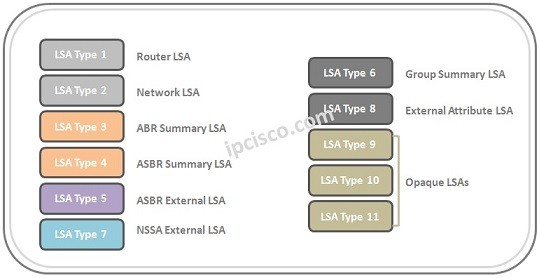
In OSPF, Link-State information, in other words, Routing information is exchanged between routers. This exchange is done with LSAs (Link State Advertisements). There are eleven different OSPF LSA types and each of them has a special purpose. Some of the OSPF LSA types are the main LSA types that are used in OSPF operations often. Let’s see all the LSA types:
Now, let’s talk about these OSPF LSA types detailly. Here, it is better to explain these LSA types with different area types and their LSA Adversisement requirements. So, the below diagram will be very useful for you.
You can also view OSPF Packet Types
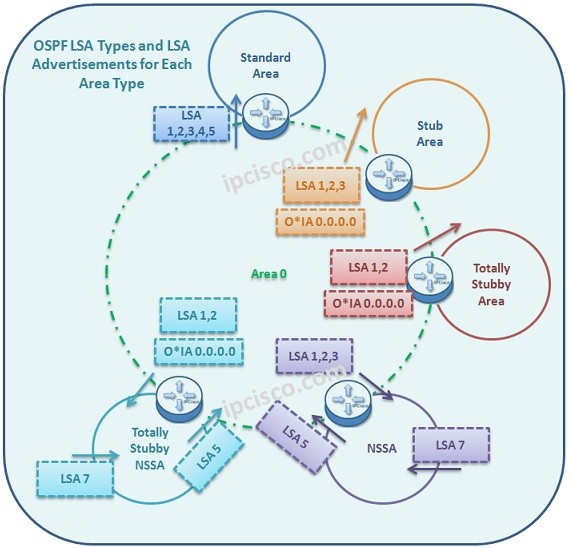
Table of Contents
Router LSA (Type 1) is the LSA type used in standard areas. The aim of this LSA type is giving information about the router. This LSA includes information like Router ID, Router interfaces, neighbors, ip addresses and cost. Router LSA can not pass ABR, so it can not reach to the other areas.
You can also reach other Cisco CCNP ENCOR lessons
Network LSA (Type 2) is the other LSA type used in standard areas. This LSA is sent by DR. The main aim of this LSA type is listing the connected routers in the segment and informing the other routers. This LSA includes information like DR, BDR IP addresses, subnet masks. Network LSA can not pass ABR, so it can not reach to the other areas.
ABR Summary LSA (Type 3) is generated by ABR (Area Border Router) to advertise one Area’s networks to other Areas. ABR Summary LSA (Type 3) includes all prefixes available in the Area.
ASBR Summary LSA (Type 4) is generated by ABR (Area Border Router) to inform its areas about how to reach the ASBR (Autonomous System Border Router). ASBR Summary LSA (Type 4) includes ASBR’s Router ID.
You can also learn Cisco OSPF Configuration
ASBR Externel LSA (Type 5) is generated by ASBR (Autonomous System Border Router) for advertising External Routes for Open Shortest Path First.
NSSA External LSA (Type 7) is generated by ASBR (Autonomous System Border Router), for advertising external routes to NSSA. Then the ABR (Area Border Router) in this area convert Type 7 LSA to Type 5 LSA, and then advertise it to other Areas.
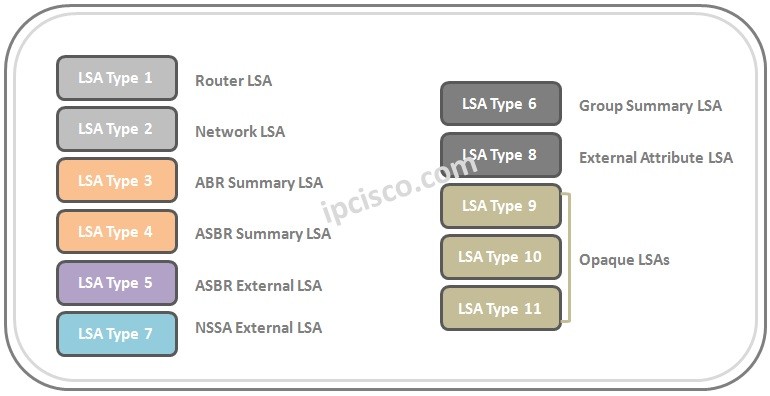
OSPF Link-State Advertisement Types (LSA Types)
There are also some other LSA types used in Open Shortest Path First. These specific LSA types are also used for specific purposes. These LSA types are:
Group Summary (Type 6) is used in Multicast. This type is not supported in some vendors.
External Attributes LSA (Type 8) is rarely used when BGP info is carried across OSPF AS.
Opaque LSAs (Type 9, Type 10, Type 11) are designated for future application specific use. For example Type 10 Opaque LSA is used for OSPF Traffic Engineering.
When you configure Open Shortest Path First as your IGP router, you will see the OSPF routes in the Routing Table. In the Routing Table there are some specific codes for these Routing informations. Let’s talk about these specific signs.
O means that, this route is propagated within the area. LSA 1 generated by all the routers in the area and LSA2 by DR.
O IA means that, this route is propagated from different area.
O E1 means that, this route is advertised externally, this is an external route to OSPF that is send from ASBR. Here, there is a special formula:
OSPF is a very important and commonly used Routing Protocol. Our OSPF Adventure is going on, so kepp on with the other lessons;)

Gokhan Kosem is a Network Engineer, Instructor and the Founder of IPCisco.com with 15+ years of experience in Cisco, Nokia, Huawei, Juniper, Linux, Service Provider Networks, Routing and Switching technologies.
He has worked on the backbone networks of major service providers and network vendors including Nortel, Alcatel-Lucent (Nokia) and has extensive hands-on experience with Cisco, Huawei, Juniper and Nokia networking technologies.
He has trained thousands of networking students worldwide through IPCisco.com, Udemy, books, labs, quizzes, and educational content across multiple social media platforms.
IPCisco.com | Best Route to Your Dreams






Leave a Reply