CCIE Enterprise Infrastructure Quiz 1

Welcome to CCIE Enterprise Infrastructure Quiz 1! In this quiz, you will find CCIE Enterprise Infrastructure practice questions on routing protocols, switching, MPLS, QoS, multicast, IPv6 and Cisco configurations. With these CCIE practice questions, you can test your knowledge, review important networking topics and prepare for your CCIE Enterprise Infrastructure certification.

CCIE Enterprise Infrastructure Practice Test 1

  CONGRATULATIONS! YOU HAVE COMPLETED CCIE Enterprise Infrastructure Practice Test 1. YOU HAVE %%SCORE%% TRUE ANSWERS OUT OF %%TOTAL%% QUESTIONS. YOUR SCORE IS %%PERCENTAGE%%. %%RATING%%  
Your answers are highlighted below.
Question 1
A Cisco switch running Rapid PVST+ receives superior BPDUs on a port configured with BPDU Guard. What happens to the port when a BPDU is received?
A
It becomes the root port
B
It enters the err-disabled state
C
It changes automatically to a trunk port
D
It becomes an alternate port
E
It enters the forwarding state
Question 1 Explanation: 
BPDU Guard places a protected port into the err-disabled state when it receives a BPDU. This helps protect the network from unexpected switches.
Question 2
A network engineer wants to monitor interface statistics and routing information from multiple Cisco IOS XE routers in near real time. Instead of repeatedly polling devices using SNMP, the engineer wants the routers to automatically stream operational data to a centralized collector. Which approach should be used?
A
Enable Syslog to send periodic interface statistics.
B
Configure Model-Driven Telemetry with gRPC-based subscriptions.
C
Configure NETCONF to continuously poll operational data.
D
Enable SPAN to forward management traffic to the collector.
E
Configure SNMP polling with shorter intervals.
Question 2 Explanation: 
Model-Driven Telemetry enables Cisco IOS XE devices to stream operational data to a centralized collector using subscription-based mechanisms. With gRPC-based telemetry, network engineers can receive near-real-time updates without repeatedly polling devices through SNMP.
Question 3
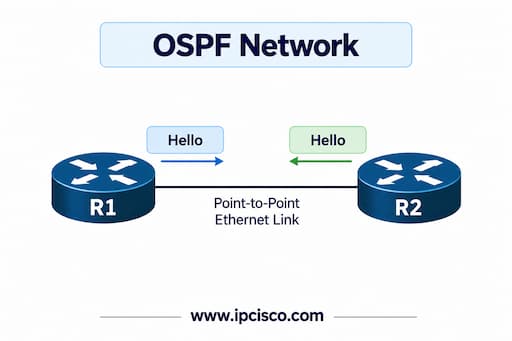
Two OSPF routers are connected over a point-to-point Ethernet link. They receive Hello packets from each other, but the neighbor relationship remains in the 2-WAY state. Which issue could explain why they do not reach FULL adjacency? ospf-neighborship-hello-packets-ccie-enterprise-infrastructure
A
Different OSPF process IDs
B
Different interface bandwidth values
C
Different interface descriptions
D
Different OSPF network types on the interfaces
E
Different administrative distances
Question 3 Explanation: 
An OSPF network type mismatch can cause unexpected adjacency behavior. On a correctly configured point-to-point OSPF link, neighbors should normally progress to the FULL state. Remaining in 2-WAY can indicate a configuration mismatch.
Question 4
A Cisco IOS XE router uses Control Plane Policing (CoPP) to protect its CPU. After a new CoPP policy is applied, OSPF adjacencies begin flapping. Interface error counters remain normal, but OSPF control packets are being dropped. Which action should the network engineer take?
A
Review the CoPP class matching OSPF traffic and adjust its policing rate.
B
Configure OSPF passive interfaces on all router links.
C
Disable CEF on the affected interfaces.
D
Increase the OSPF administrative distance.
E
Disable OSPF authentication on all interfaces.
Question 4 Explanation: 
An overly restrictive CoPP policy can drop legitimate OSPF control packets, causing neighbor adjacencies to flap. The engineer should examine the CoPP classification, drop counters and policing rate, then adjust the policy to allow legitimate routing protocol traffic.
Question 5
A Cisco router runs EIGRP for IPv6. The network engineer wants to verify which IPv6 prefixes have been installed in the routing table through EIGRP. Which command should be used?
A
show ipv6 eigrp topology
B
show ip route eigrp
C
show ipv6 protocols
D
show ipv6 eigrp neighbors
E
show ipv6 route eigrp
Question 5 Explanation: 
The show ipv6 route eigrp command displays IPv6 routes learned through EIGRP and installed in the IPv6 routing table.
Question 6
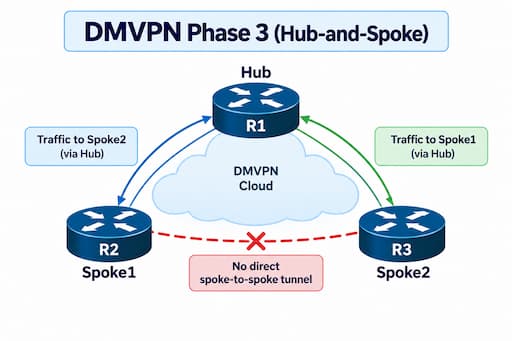
A DMVPN Phase 3 network uses a hub-and-spoke topology. Spoke1 can communicate with Spoke2 through the hub, but a direct spoke-to-spoke tunnel is not established. The hub receives traffic between the spokes but does not send NHRP Redirect messages. Which configuration should the engineer verify on the hub tunnel interface? DMVPN-question-ccie-enterprise-infrastructure
A
ip nhrp map multicast dynamic
B
ip nhrp redirect
C
ip ospf network point-to-point
D
ip nhrp shortcut
E
tunnel mode gre multipoint
Question 6 Explanation: 
In DMVPN Phase 3, the hub uses ip nhrp redirect to inform a source spoke that a more direct path may be available. The source spoke uses NHRP shortcut functionality to resolve and establish direct spoke-to-spoke forwarding. The engineer should verify that NHRP Redirect is configured and operating on the hub.
Question 7
Two routers running OSPFv3 are directly connected. Both routers have matching area IDs and Hello/Dead timers, but they fail to establish an adjacency. Which configuration mismatch can prevent OSPFv3 neighbor formation?
A
Different OSPFv3 process IDs
B
Different interface bandwidth values
C
Different interface descriptions
D
Different IPv6 link-local addresses
E
Different OSPFv3 Router IDs
Question 7 Explanation: 
OSPFv3 routers must have unique Router IDs. If two neighboring routers use the same Router ID, OSPFv3 adjacency formation can fail. Process IDs are locally significant and do not need to match between routers.
Question 8
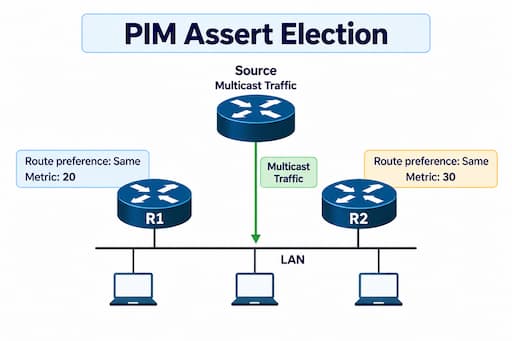
Two PIM routers forward multicast traffic onto the same LAN and trigger a PIM Assert election. Both routers have the same route preference toward the multicast source. Router R1 has a metric of 20, while R2 has a metric of 30. Which router wins the Assert election? PIM-assert-election-ccie-questions
A
R2 because it has the higher metric
B
R1 because it has the lower metric
C
Both routers continue forwarding
D
The router with the higher multicast group address wins
E
The router with the lower IP address always wins
Question 8 Explanation: 
In a PIM Assert election, the router with the better (lower) route preference wins. If route preferences are equal, the router with the lower metric wins. If both are equal, the higher IP address is used as the tie-breaker.
Question 9
An OSPF router receives external routes redistributed by an ASBR in a normal OSPF area. Which LSA type carries these external network prefixes?
A
Type 1 LSA
B
Type 3 LSA
C
Type 2 LSA
D
Type 5 LSA
E
Type 4 LSA
Question 9 Explanation: 
Type 5 LSAs advertise external routes redistributed into the OSPF domain by an ASBR. They are flooded throughout normal OSPF areas, but not into stub areas.
Question 10
A switch port configured with Root Guard receives a superior BPDU. What happens to the port?
A
It becomes the root port
B
It immediately transitions to forwarding
C
It becomes an alternate port
D
It enters a root-inconsistent state
E
It enters an err-disabled state
Question 10 Explanation: 
Root Guard prevents a designated port from becoming a root port. When the port receives a superior BPDU, it enters the root-inconsistent state and stops forwarding traffic until superior BPDUs are no longer received.
Question 11
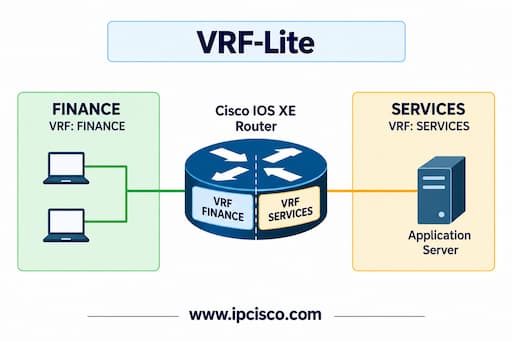
A Cisco IOS XE router uses VRF-Lite to separate the FINANCE and SERVICES networks into different routing tables. Hosts in FINANCE must access a shared application server in SERVICES, but the administrator does not want to merge the two VRFs. Which routing technique allows selected routes to be exchanged between the VRFs? ccie-enterprise-infrastructure-Cisco-IOS-XE-VRF-Lite-question
A
Policy-Based Routing Without VRF Awareness
B
VRF Route Leaking
C
BGP AS_PATH Prepending
D
Route Summarization
E
OSPF Stub Area Configuration
Question 11 Explanation: 
VRF route leaking allows selected routes to be shared between separate VRF routing tables while maintaining logical segmentation. Depending on the platform and design, this can be implemented using route-target import/export mechanisms or supported static route-leaking methods.
Question 12
Two routers use OSPF with BFD enabled. The physical interface remains up, but BFD stops receiving control packets from the neighbor. What is the expected result when the BFD detection timer expires?
A
All of them
B
BFD notifies OSPF about the failure
C
BFD automatically increases the interface bandwidth
D
OSPF waits for the normal Dead Interval
E
The routers disable OSPF authentication
Question 12 Explanation: 
BFD provides fast failure detection. When a BFD session goes down, it notifies the associated routing protocol, allowing faster convergence.
Question 13
An enterprise uses two ISPs for Internet connectivity. The administrator wants a Cisco BGP router to advertise a backup prefix to ISP-B only when a specific route learned through ISP-A is no longer present in the local BGP table. Which BGP feature should be configured?
A
BGP Conditional Advertisement using an advertise-map and non-exist-map
B
BGP Route Reflector
C
BGP AS_PATH Prepending
D
BGP Next-Hop Self
E
BGP Maximum Paths
Question 13 Explanation: 
BGP conditional advertisement uses advertise-map with non-exist-map to advertise selected prefixes when a specified route is absent from the local BGP table. This can support backup connectivity designs.
Question 14
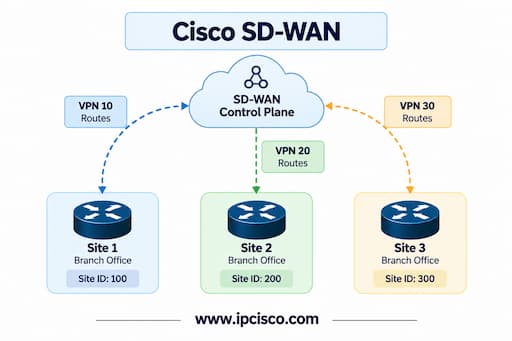
A company uses Cisco SD-WAN across multiple branch offices. The administrator wants to control which OMP routes are advertised to different sites based on VPN membership and site IDs. The policy must be applied centrally through the SD-WAN control plane. Which policy type should be used? ccie-enterprise-infrastructure-quizzes-Cisco-SD-WAN-question
A
Centralized Data Policy
B
Application-Aware Routing Policy
C
Localized Data Policy
D
Localized QoS Policy
E
Centralized Control Policy
Question 14 Explanation: 
Cisco SD-WAN Centralized Control Policies manipulate OMP routing information and TLOC advertisements. They can filter or modify routes based on criteria such as VPN IDs, site IDs and route attributes.
Question 15
Two Cisco switches are connected with two Ethernet links. SW1 uses LACP active mode, while SW2 uses LACP passive mode. What will happen if all other EtherChannel parameters match?
A
The switches will use PAgP automatically
B
EtherChannel will form successfully
C
Both interfaces will become err-disabled
D
EtherChannel will not form
E
STP will block both physical interfaces
Question 15 Explanation: 
LACP active mode initiates negotiation, while passive mode responds to LACP packets. Active and passive modes can successfully establish an EtherChannel.
Question 16
A network engineer configures a two-rate, three-color traffic policer. A packet exceeds both the Committed Information Rate (CIR) and Peak Information Rate (PIR) limits. How is the packet classified?
A
Blue
B
Yellow
C
Red
D
Unmarked
E
Green
Question 16 Explanation: 
In a two-rate, three-color policer, packets within the committed limits are green, packets exceeding the committed limits but within peak limits are yellow, and packets exceeding peak limits are red.
Question 17
Which command should be used inside a Cisco BGP route-map to set the Local Preference to 120?
A
set local-preference 120
B
set as-path 120
C
set metric 120
D
set weight 120
E
set preference 120
Question 17 Explanation: 
The set local-preference 120 command modifies the BGP Local Preference attribute. Higher Local Preference values are preferred within an autonomous system.
Question 18
How can we display OSPF neighbor adjacency state changes on a Cisco router?
A
debug ip ospf events
B
debug ip ospf adj
C
debug ip ospf database
D
debug ip ospf packets
E
debug ip ospf hello
Question 18 Explanation: 
The debug ip ospf adj command displays OSPF adjacency events and neighbor state changes. It is useful for troubleshooting OSPF neighborship problems.
Question 19
A multicast router needs to determine whether receivers on a local network are interested in traffic from specific multicast sources for a particular multicast group. Which IGMPv3 query type should it use?
A
Group-and-Source-Specific Query
B
General Query
C
Group-Specific Query
D
Membership Report
E
PIM Join Message
Question 19 Explanation: 
IGMPv3 Group-and-Source-Specific Queries allow a multicast router to check receiver interest in particular sources associated with a multicast group. This supports source-aware multicast membership management.
Question 20
An enterprise multicast network uses two Anycast Rendezvous Points (RPs) with the same RP address. The network uses PIM Sparse Mode with traditional MSDP-based Anycast RP. Which protocol allows the RPs to exchange information about active multicast sources?
A
IGMPv3
B
Multicast Listener Discovery (MLD)
C
Reverse Path Forwarding (RPF)
D
PIM Bootstrap Router
E
Multicast Source Discovery Protocol (MSDP)
Question 20 Explanation: 
In traditional MSDP-based Anycast RP deployments, MSDP exchanges Source-Active (SA) information between RPs. This allows the RPs to learn about active multicast sources registered with other RPs.
Question 21
Two Cisco routers have an eBGP session in the Established state. Router R1 receives a route from R2, but the route is not installed in the IP routing table. Which issue could prevent the BGP route from being installed?
A
The BGP neighbor uses TCP port 179
B
The routers have different BGP Router IDs
C
The BGP session uses an external AS number
D
The routers have different interface descriptions
E
The BGP next-hop address is unreachable
Question 21 Explanation: 
A BGP route requires a reachable next hop to be considered valid for route selection and installation. An unreachable next hop can prevent the route from entering the routing table.
Question 22
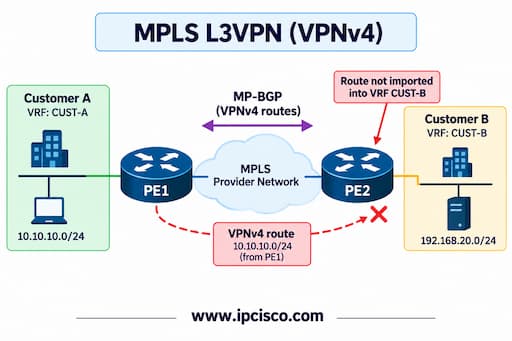
Two PE routers exchange VPNv4 routes successfully through MP-BGP. However, a route advertised by PE1 is not imported into the customer VRF on PE2. The VPNv4 route is otherwise valid. Which configuration issue is the most likely cause? MPLS-L3VPN-ccie-enterprise-infrastructure
A
Different customer-facing interface speeds
B
Different Route Distinguishers (RDs)
C
Different PE router hostnames
D
Mismatched Route Target import and export values
E
Different MPLS label values
Question 22 Explanation: 
MPLS L3VPN uses Route Targets to control VPN route import and export. If the exported Route Target does not match an imported Route Target on PE2, the route will not be imported into the destination VRF.
Question 23
A DHCP server is located in a different subnet from its clients. The router interface connected to the clients is configured with an ip helper-address pointing to the DHCP server. What is the primary function of this command?
A
Forward DHCP broadcast requests to the remote DHCP server
B
Configure the router as a DHCP server
C
Assign static IP addresses to clients
D
Disable DHCP broadcasts on the network
E
Encrypt DHCP messages between clients and the server
Question 23 Explanation: 
The ip helper-address command enables DHCP relay functionality by forwarding client DHCP requests to a DHCP server on another subnet.
Question 24
A Cisco router receives two eBGP routes to the same destination. Both routes have equal Weight and Local Preference. Route A has an AS_PATH length of 2, while Route B has an AS_PATH length of 3. Which route will BGP prefer, assuming both routes are valid?
A
Both routes are always installed
B
Route B
C
Route A
D
The route with the higher Router ID
E
The route with the higher MED
Question 24 Explanation: 
BGP prefers the route with the shortest AS_PATH when Weight and Local Preference are equal, assuming earlier best-path conditions do not distinguish the routes.
Question 25
A Cisco router experiences frequent OSPF link-state changes, causing repeated LSA generation and increased control-plane activity. The network engineer wants to control how quickly the router originates successive instances of the same LSA. Which OSPF feature should be configured?
A
OSPF LSA Throttling
B
OSPF Prefix Suppression
C
OSPF SPF Throttling
D
OSPF Passive Interface
E
OSPF Stub Router Advertisement
Question 25 Explanation: 
OSPF LSA throttling controls the timing of successive LSA originations, helping reduce excessive LSA flooding during frequent topology changes. Unlike SPF throttling, which controls the scheduling of SPF calculations, LSA throttling controls LSA generation.
Question 26
A network engineer wants to check the number of EIGRP Hello, Update, Query, Reply and ACK packets sent and received by a Cisco router. Which command should be used?
A
show ip eigrp neighbors
B
show ip eigrp topology
C
show ip protocols
D
show ip eigrp packets
E
show ip eigrp traffic
Question 26 Explanation: 
The show ip eigrp traffic command displays statistics for EIGRP packets sent and received, including Hello, Update, Query, Reply and acknowledgment packets.
Question 27
Which Cisco IOS command is used to display MPLS LDP neighbors?
A
show mpls protocol ldp
B
show ldp neighbors detail
C
show mpls ldp neighbor
D
show ldp neighbors
E
show mpls protocol ldp neighbor
Question 28
Two Cisco switches participate in the same STP instance. SW1 has a bridge priority of 4096 and SW2 has a bridge priority of 8192. Both switches have default STP configurations otherwise. Which switch becomes the Root Bridge?
A
The switch with the higher MAC address
B
The switch with the highest interface bandwidth
C
SW1 because it has the lower bridge priority
D
SW2 because it has the higher bridge priority
E
Both switches become Root Bridges
Question 28 Explanation: 
STP elects the switch with the lowest Bridge ID as the Root Bridge. The bridge priority is compared first, so SW1 wins with a priority of 4096.
Question 29
A network engineer wants to classify traffic using application information instead of only IP addresses and TCP/UDP port numbers. Which Cisco feature can be used?
A
WRED
B
NBAR
C
IP SLA
D
NetFlow Export
E
PBR
Question 29 Explanation: 
Network-Based Application Recognition (NBAR) can identify and classify traffic based on application-level information. It is useful for application-aware QoS policies.
Question 30
Which Cisco IOS configuration denies FTP control connections from any source to the 192.168.1.0/24 network using an extended ACL named ABC?
A
deny tcp 192.168.1.0 0.0.0.255 any eq ftp
B
deny tcp any 192.168.1.0 0.0.0.255 eq ftp
C
deny ip any 192.168.1.0 0.0.0.255 eq ftp
D
deny tcp any 192.168.1.0 255.255.255.0 eq ftp
E
deny udp any 192.168.1.0 0.0.0.255 eq ftp
Question 30 Explanation: 
Extended ACLs can filter traffic based on source address, destination address, protocol and port number. This entry denies TCP connections to the FTP control port (21) destined for 192.168.1.0/24.
Question 31
A Cisco router receives two BGP routes to 10.10.10.0/24 from different neighbors. Both routes are valid and have equal attributes except for Weight. Route A has Weight 200, while Route B has Weight 100. Which route will the router prefer?
A
The route with the lowest Router ID
B
The route with the highest MED
C
Route B because it has a lower Weight
D
Route A because it has a higher Weight
E
Both routes will always be installed
Question 31 Explanation: 
Cisco BGP prefers the route with the highest Weight. Weight is a Cisco-specific, locally significant attribute and is not advertised to BGP neighbors.
Question 32
A Cisco router running BGP in AS 65001 needs to present AS 65100 as its local AS to neighbor 192.0.2.2. Which command can be used?
A
neighbor 192.0.2.2 weight 65100
B
neighbor 192.0.2.2 as-override 65100
C
neighbor 192.0.2.2 remote-as 65100
D
neighbor 192.0.2.2 local-as 65100
E
neighbor 192.0.2.2 next-hop-self 65100
Question 32 Explanation: 
The neighbor local-as command allows a Cisco BGP router to present an alternate local AS number to a specific BGP neighbor. The exact AS_PATH behavior depends on the additional options configured.
Question 33
Which Cisco IOS command displays routing table changes in real time for troubleshooting purposes?
A
debug ip protocols
B
debug ip
C
debug routing
D
debug ip routing
E
debug routing-table
Question 33 Explanation: 
The debug ip routing command displays changes to the IPv4 routing table, including route additions and removals. Debug commands should be used carefully on production routers.
Question 34
Which Cisco IOS command is used under VLAN configuration mode to designate a VLAN for Remote SPAN (RSPAN)?
A
remote-span enable
B
span run enable
C
span run remote
D
remote-span
E
remote-span run
Question 34 Explanation: 
The remote-span command designates a VLAN as an RSPAN VLAN, allowing mirrored traffic to be transported between switches for remote monitoring.
Question 35
A network engineer runs show ip eigrp neighbors and notices that the SRTT value for a neighbor has increased significantly. What does SRTT represent?
A
The interval between EIGRP Hello packets
B
The time before an EIGRP route is removed from the routing table
C
The time required to establish the EIGRP adjacency
D
The time remaining before the neighbor is declared down
E
The smoothed round-trip time for reliable EIGRP packets and their acknowledgments
Question 35 Explanation: 
SRTT (Smooth Round-Trip Time) measures the estimated time required to send a reliable EIGRP packet and receive its acknowledgment. It helps EIGRP calculate retransmission timeouts.
Question 36
A service provider uses MPLS QoS to classify traffic across its backbone. Which field in the MPLS label stack entry is commonly used to carry QoS markings?
A
Label Stack Depth
B
Bottom of Stack (S) bit
C
Label Value
D
Traffic Class (TC) field
E
Time to Live (TTL)
Question 36 Explanation: 
The MPLS Traffic Class (TC) field, formerly known as the EXP bits, is commonly used for QoS classification and differentiated forwarding behavior.
Question 37
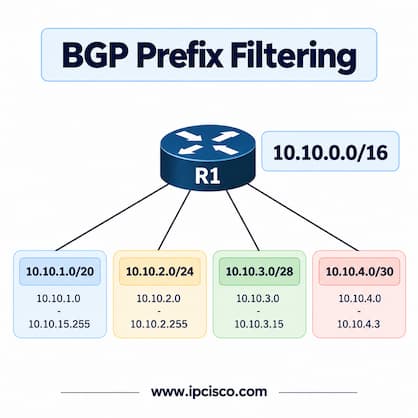
A network engineer configures the following prefix list on a Cisco router. Which IPv4 prefix will match this prefix list?
ip prefix-list FILTER seq 5 permit 10.10.0.0/16 ge 24 le 28
bgp-prefix-filtering-question-ccie-enterprise-infrastructure
A
10.10.0.0/15
B
10.10.0.0/16
C
10.10.1.0/29
D
10.10.1.0/24
E
10.11.1.0/24
Question 37 Explanation: 
The prefix list permits subnets within 10.10.0.0/16 that have prefix lengths between /24 and /28. The prefix 10.10.1.0/24 matches both conditions.
Question 38
A Cisco router uses the following QoS policy. What does the priority percent 20 command provide to the VOICE class?
policy-map WAN-QOS
 class VOICE
  priority percent 20
 class BUSINESS
  bandwidth percent 30
 class class-default
  fair-queue
A
A strict-priority queue with a bandwidth allocation of 20%
B
A maximum packet loss rate of 20%
C
A guaranteed minimum of 20% bandwidth without priority treatment
D
A DSCP marking value of 20
E
A minimum queue depth of 20 packets
Question 38 Explanation: 
The priority percent command enables Low Latency Queuing (LLQ) for the class and specifies its priority bandwidth allocation as a percentage of the interface bandwidth. During congestion, priority traffic is subject to policing according to the platform's QoS behavior.
Question 39
Which Cisco IOS command displays historical CPU utilization graphs for the last 60 seconds, 60 minutes and 72 hours?
A
show history processes
B
show cpu history
C
show history
D
show processes history
E
show processes cpu history
Question 39 Explanation: 
The show processes cpu history command displays historical CPU utilization graphs, helping network engineers identify CPU usage patterns and performance issues.
Question 40
A Cisco switch has DHCP Snooping and Dynamic ARP Inspection (DAI) enabled. A host sends an ARP packet with an IP-to-MAC mapping that does not match the DHCP Snooping binding table. What will happen on an untrusted interface?
A
The switch drops the ARP packet
B
The switch updates the DHCP binding table
C
The switch forwards the ARP packet
D
The switch converts the ARP packet into a broadcast
E
The switch disables DHCP Snooping
Question 40 Explanation: 
Dynamic ARP Inspection validates ARP packets received on untrusted interfaces against trusted binding information. Invalid ARP packets are dropped.
Question 41
A Cisco router uses EIGRP route summarization to reduce the number of routes advertised to its neighbors. However, the administrator needs to advertise one specific more-specific prefix in addition to the summary route. Which EIGRP feature allows selected routes to be advertised through the summary boundary?
A
EIGRP Leak Map
B
EIGRP Passive Interface
C
EIGRP Stub Routing
D
EIGRP Variance
E
EIGRP Maximum Paths
Question 41 Explanation: 
EIGRP leak maps allow selected more-specific routes to be advertised along with a summary route. This provides more granular reachability information while maintaining route summarization for the remaining prefixes.
Question 42
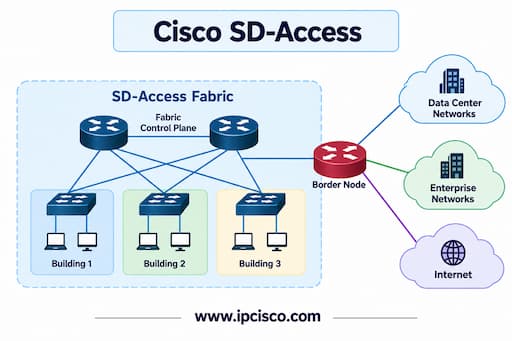
An enterprise deploys Cisco SD-Access across multiple campus buildings. Endpoints inside the fabric need to communicate with networks outside the SD-Access fabric, including the data center and traditional enterprise networks. Which fabric component provides connectivity between the fabric and external networks? ccie-enterprise-infrastructure-Cisco-SD-Access-question
A
Fabric Edge Node
B
Extended Node
C
Fabric Border Node
D
Control Plane Node
E
Wireless LAN Controller
Question 42 Explanation: 
A Cisco SD-Access Fabric Border Node connects the fabric to external networks. It exchanges routing information between the fabric and external routing domains and provides connectivity for traffic entering or leaving the fabric.
Question 43
A Cisco router uses classic EIGRP metric calculation with default K-values. Which two parameters are used to calculate the composite metric?
A
Delay and load
B
Bandwidth and delay
C
MTU and bandwidth
D
Bandwidth and reliability
E
Reliability and MTU
Question 43 Explanation: 
With default K-values (K1=1, K3=1, K2=K4=K5=0), classic EIGRP calculates its composite metric using minimum path bandwidth and cumulative delay.
Question 44
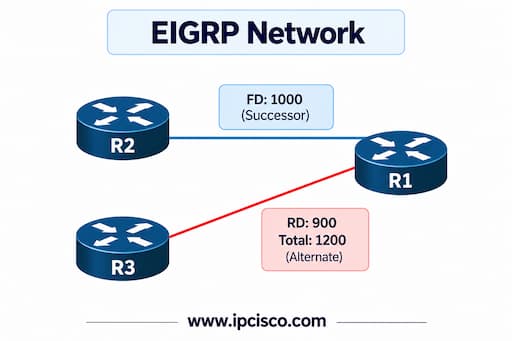
An EIGRP router has two paths to the same destination. The successor has a feasible distance of 1000. The alternate path has a reported distance of 900 and a total distance of 1200. What will EIGRP do with the alternate path? eigrp-successor-feasible-distance-question-ccie-enterprise-infrastructure (1)
A
Remove the successor from the topology table
B
Accept it as a feasible successor
C
Install it as an equal-cost route
D
Reject it because its total distance is higher
E
Start a DUAL query immediately
Question 44 Explanation: 
The alternate path satisfies the EIGRP feasibility condition because its reported distance (900) is lower than the successor's feasible distance (1000). Therefore, it can be accepted as a feasible successor.
Question 45
R1 is the active HSRP router with a priority of 120, while R2 has a priority of 100 and preemption enabled. R1 must reduce its HSRP priority by 40 when interface GigabitEthernet0/1 goes down. Which command should be configured on R1 under the HSRP interface?
A
standby 1 track GigabitEthernet0/1 40
B
standby 1 preempt delay 40
C
standby 1 track 40 GigabitEthernet0/1
D
hsrp 1 track GigabitEthernet0/1 40
E
standby 1 priority decrement 40
Question 45 Explanation: 
On Cisco IOS platforms supporting direct HSRP interface tracking, the command reduces R1's priority from 120 to 80 when the tracked interface goes down. R2 can then become active because its priority is higher and preemption is enabled.
Question 46
Two MPLS routers have established an LDP session successfully. Which command can a network engineer use on Cisco IOS to examine the label bindings learned through LDP?
A
show mpls ldp bindings
B
show ip route mpls
C
show mpls interfaces summary
D
show ip cef adjacency
E
show mpls forwarding-table
Question 46 Explanation: 
The show mpls ldp bindings command displays local and remote label bindings maintained by LDP. It helps verify label distribution between MPLS routers.
Question 47
In OSPFv3, which LSA type is used to advertise IPv6 prefixes associated with a router's interfaces within an area?
A
Type 9 — Intra-Area-Prefix LSA
B
Type 4 — Inter-Area-Router LSA
C
Type 8 — Link LSA
D
Type 5 — AS-External LSA
E
Type 3 — Inter-Area-Prefix LSA
Question 47 Explanation: 
The Intra-Area-Prefix LSA (Type 9) advertises IPv6 prefixes associated with routers and transit networks within an OSPFv3 area. Type 8 Link LSAs carry link-local information and prefixes on the local link.
Question 48
Which Cisco IOS command can be used to reset an OSPFv3 process with Process ID 1?
A
clear ip ospf 1
B
clear ospf 1 process
C
clear ipv6 ospf 1 process
D
delete ipv6 1 process
E
delete ipv6 ospf 1
Question 49
Two eBGP routers are directly connected and can ping each other. However, their BGP session remains in the Active state. Which issue could prevent the BGP session from being established?
A
Different interface descriptions
B
Different BGP MED values
C
TCP port 179 is blocked by an ACL
D
Different BGP Local Preference values
E
Different OSPF process IDs
Question 49 Explanation: 
BGP uses TCP port 179 to establish neighbor sessions. If an ACL blocks TCP port 179, the BGP session cannot be established even when IP connectivity is available.
Question 50
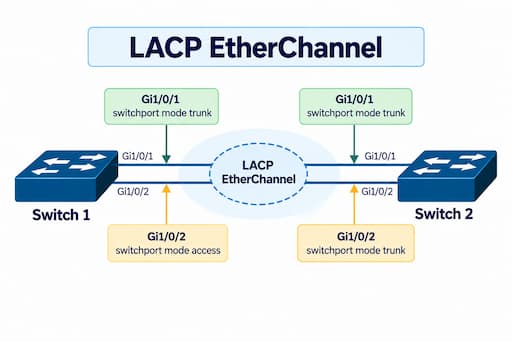
Two Cisco switches are connected through an LACP EtherChannel. One physical interface is configured as a trunk, while the other is configured as an access port. What is the most likely result? ccie-enterprise-infrastructure-LACP-EtherChannel-question
A
The EtherChannel changes automatically to PAgP
B
Both interfaces join the EtherChannel successfully
C
LACP automatically converts both interfaces into trunks
D
STP disables all VLANs on both switches
E
The interfaces fail to form a consistent EtherChannel bundle
Question 50 Explanation: 
EtherChannel member interfaces must have compatible Layer 2 configurations. A mismatch between trunk and access modes can prevent interfaces from joining the same bundle.
Once you are finished, click the button below. Any items you have not completed will be marked incorrect. Get Results
There are 50 questions to complete.
gokhan-kosem-instructor-ipcisco

Gokhan Kosem is a Network Engineer, Instructor and the Founder of IPCisco.com with 15+ years of experience in Cisco, Nokia, Huawei, Juniper, Linux, Service Provider Networks, Routing and Switching technologies.

He has worked on the backbone networks of major service providers and network vendors including Nortel, Alcatel-Lucent (Nokia) and has extensive hands-on experience with Cisco, Huawei, Juniper and Nokia networking technologies.

He has trained thousands of networking students worldwide through IPCisco.com, Udemy, books, labs, quizzes, and educational content across multiple social media platforms.

IPCisco.com | Best Route to Your Dreams