

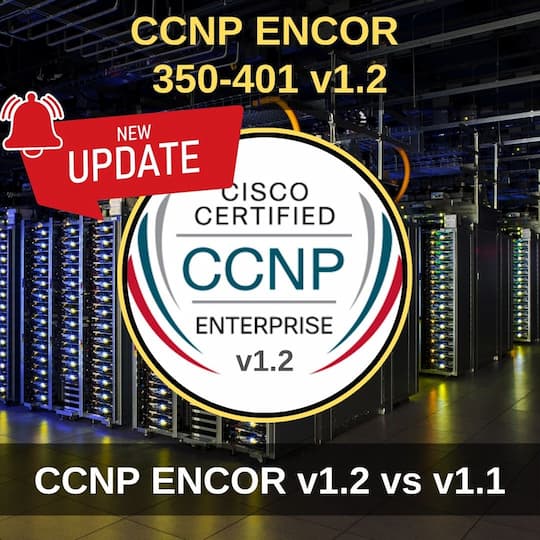
CCNP ENCOR 350-401 Exam is the required exam for CCNP ENCOR (Implementing Cisco Enterprise Network Core Technologies) or CCIE Enterprise Infrastructure Certification. Various network lessons are covered in this exam and now, these topics are updated. The latest Updated CCNP ENCOR Exam is, CCNP ENCOR 350-401 v1.2 and in this post, we will cover what is new in CCNP ENCOR v1.r Exam? We will compare it with the previous CCNP ENCOR v1.1 Exam.
You can find the the full topics of CCNP ENCOR v1.2 Exam and the summary of new topics at the end of this article.
You can enroll CCNP ENCOR Training on IPCisco CCNP ENCOR 350-401 Course Page.
Table of Contents
CCNP ENCOR 350-401 Exam Details
Before this comparison, let’s give a brief information about CCNP ENCOR 350-401 v1.2 Exam. CCNP ENCOR 350-401 Exam duration is 120 minutes and candidates reply 100 questions in the exam. The passing score is 825/100 (%82) for CCNP ENCOR 350-401 Exam. And the cost is 400 USD.
There are six common modules on CCNP ENCOR 350-401 Exam. These modules and their ratios are given below:
- Architecture – %15
- Virtualization – %10
- Infrastructure – %30
- Network Assurance – %10
- Security – %20
- Automation – %15
There are different lessons under these six modules and some of them has changed recently with CCNP ENCOR 350-401 v1.2. Here, we will focus on what are the topics of Updated CCNP Exam, what is new in CCNP ENCOR v1.2 Exam by compairing the previous CCNP 350-401 ENCOR v1.1 Exam.
Updated CCNP 350-401 ENCOR v1.2 Exam Topics
In new version of CCNP ENCOR 350-401 Exam, some of the previous lessons has changed, some new lessons has added and some of them are removed. In this new CCNP version, updated CCNP ENCOR v1.2, which topics are changed and which ones are remaining? What are the newly added topics and which topics are removed? Let’s check all the updated ccnp lessons and then learn these changes module by module.
- 1.0 Architecture
-
- 2.1 Describe device virtualization technologies
- 2.1.a Hypervisor type 1 and 2
- 2.1.b Virtual machine
- 2.1.c Virtual switching
- 2.1 Describe device virtualization technologies
-
- 2.2 Configure and verify data path virtualization technologies
- 2.2.a VRF
- 2.2.b GRE and IPsec tunneling
- 2.2 Configure and verify data path virtualization technologies
-
- 2.3 Describe network virtualization concepts
- 2.3.a LISP
- 2.3.b VXLAN
- 2.3 Describe network virtualization concepts
- 3.0 Infrastructure
- 6.0 Automation and Artificial Intelligence
Changes With CCNP 350-401 ENCOR v1.2
Architecture Module Changes
In this table, you can find a comparison between updated CCNP ENCOR v1.2 and old CCNP ENCOR v1.1. Here, “2-tier, 3-tier, fabric and cloud designs”, “Redundancy, FHRP and SSO”, “Control/data planes and traditional campus interoperability” topics remain same. The changes are given below:
| ENCOR v1.2 | ENCOR v1.1 |
|---|---|
| Cisco Catalyst SD-WAN solution | Cisco SD-WAN solution |
| Interpret QoS configurations | Interpret wired and wireless QoS configurations with detailed policy/components. |
| Significantly reduced | Larger wireless design coverage. |
| Removed/reduced | Included in Architecture domain. |
| More general QoS interpretation | More detailed wired/wireless split. |
| Leaner and more focused | Broader architecture coverage. |
Virtualisation Module Changes
This module has remained mostly unchanged. Cloud-integrated enterprise networking is slightly more emphasized.
Infrastructure Module Changes
In this module, wireless infrastructure topics has removed. Layer 2 topics, Layer 3 protocols , IP services topics remain also. Multicast coverage expanded significantly.
| ENCOR v1.2 | ENCOR v1.1 |
|---|---|
| Wireless infrastructure topics removed from the blueprint. | Wireless section included Layer 1 RF fundamentals, AP modes, antenna types, roaming, WLAN troubleshooting and wireless segmentation. |
| RPF check, PIM SM, IGMP v2/v3, SSM, bidir PIM and MSDP. | RPF check, PIM and IGMP v2/v3. |
Network Assurance Module Changes
In this module, Cisco DNA Center renamed to Catalyst Center, AI-powered workflows added, troubleshooting scope mostly unchanged. The given changes below are done.
| ENCOR v1.2 | ENCOR v1.1 |
|---|---|
| Cisco Catalyst Center | Cisco DNA Center. |
| Traditional and AI-powered workflows explicitly mentioned. | Traditional configuration, monitoring and management workflows only. |
| AI-powered analytics & assurance understanding expected | No direct AI-powered workflow emphasis. |
Security Module Changes
In security module, wireless topics including 802.1X, WebAuth, PSK and EAPOL 4-way handshake included and NAC related topics (Network access control with 802.1X, MAB and WebAuth) has removed. The below changes has done.
| ENCOR v1.2 | ENCOR v1.1 |
|---|---|
| Network security design section trimmed and simplified. | Broader network security design coverage including NAC methods. |
| Focus shifted toward infrastructure hardening and high-level security design. | More detailed NAC and wireless authentication coverage. |
Automation and Artificial Intelligence Module Changes
In this module, automation emphasis increased, Cisco platform names updated, orchestration concepts remain but vendor-specific tools (Chef, Puppet, Ansible, SaltStack) removed from blueprint wording.In Automation and Artificial Intelligence module, the below changes has done.
| ENCOR v1.2 | ENCOR v1.1 |
|---|---|
| Compare agent vs. agentless orchestration tools | Compare agent vs. agentless orchestration tools such as Chef, Puppet, Ansible and SaltStack. |
| Cisco Catalyst Center | Cisco DNA Center |
| SD-WAN Manager | vManage |
| Interpret REST API responses using Cisco Catalyst Center and RESTCONF. | Interpret REST API responses using Cisco DNA Center and RESTCONF. |
| Focus shifted toward orchestration concepts rather than memorizing vendor tools. | Specific orchestration products explicitly mentioned. |
In this post, we have learned what is new in CCNP ENCOR v1.2 Exam, updated CCNP ENCOR v1.2 topics by comparing this new version with the previous version CCNP ENCOR v1.1 Exam topics. If you would like to prepare for CCNP ENCOR v1.2, you can follow IPCisco CCNP ENCOR 350-401 Course.

Gokhan Kosem is a Network Engineer, Instructor and the Founder of IPCisco.com with 15+ years of experience in Cisco, Nokia, Huawei, Juniper, Linux, Service Provider Networks, Routing and Switching technologies.
He has worked on the backbone networks of major service providers and network vendors including Nortel, Alcatel-Lucent (Nokia) and has extensive hands-on experience with Cisco, Huawei, Juniper and Nokia networking technologies.
He has trained thousands of networking students worldwide through IPCisco.com, Udemy, books, labs, quizzes, and educational content across multiple social media platforms.
IPCisco.com | Best Route to Your Dreams





Leave a Reply