

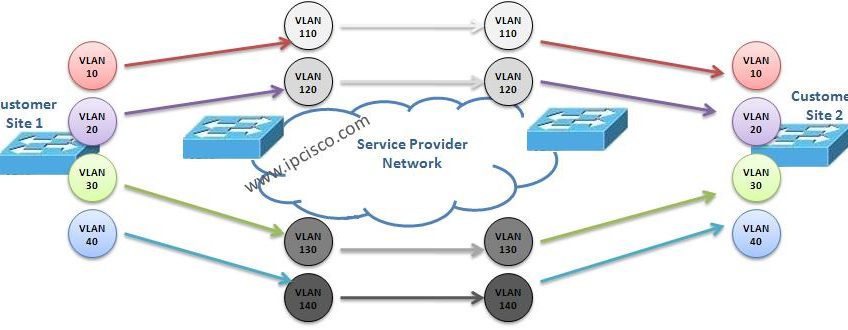
In the different locations of the customer, the same VLAN tag means the same. But there is a service provider network between the customer locations. Customers and the Service Provider use different VLAN tags in their networks. So, here there must be VLAN mapping or in other words VLAN translation must be done in the edge of the network.
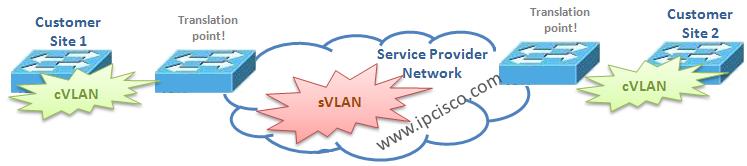
This two diffferent network’s VLANs are mentioned as C-VLAN and S-VLAN . C-VLAN is the customer VLAN and S-VLAN is the service provider VLAN.
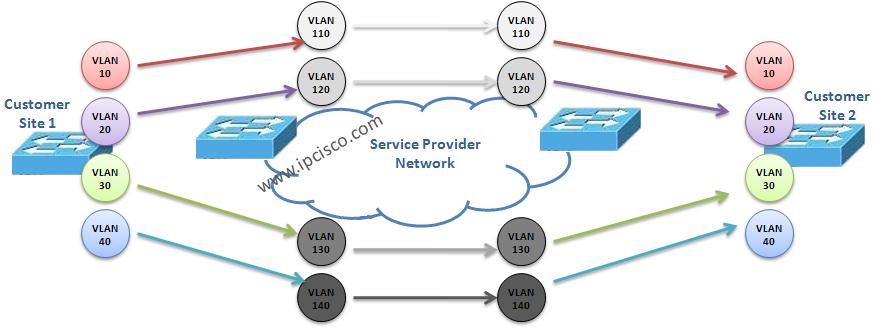
In different vendors, VLAN mapping is defined with different words. VLAN mapping term is used with Cisco configuration, VLAN translation is used for Juniper configuration.
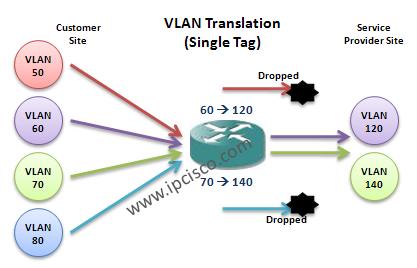
In this article, we will check the translation of one VLAN to another VLAN for diffferent vendor’s configurations. This can be mentioned as swapping an incoming VLAN tag with a new VLAN tag.
Other VLAN Mapping Lessons :
VLAN Mapping (VLAN Translation) – Part 1
VLAN Mapping (VLAN Translation) on Cisco IOS – Part 2
VLAN Mapping (VLAN Translation) on Juniper JUNOS – Part 3
Other VLAN Lessons :
VLAN – Part 1
VLAN – Part 2 (VLAN Assignments and VLAN Port Types)
VLAN – Part 3 (VLAN Frame Tagging Protocols, ISL and Dot1.q)
VLAN – Part 4 (How to Configure Cisco VLANs)
VLAN – Part 5 (Packet Tracer VLAN Configuration Example)

Table of Contents
gokhankosem
Gokhan Kosem is a Network Engineer, Instructor and the Founder of IPCisco.com with 15+ years of experience in Cisco, Nokia, Huawei, Juniper, Linux, Service Provider Networks, Routing and Switching technologies.
He has worked on the backbone networks of major service providers and network vendors including Nortel, Alcatel-Lucent (Nokia) and has extensive hands-on experience with Cisco, Huawei, Juniper and Nokia networking technologies.
He has trained thousands of networking students worldwide through IPCisco.com, Udemy, books, labs, quizzes, and educational content across multiple social media platforms.
IPCisco.com | Best Route to Your Dreams



Leave a Reply