

Table of Contents
How to Configure vBond Orchestrator?
vBond Orchestrator comes with a factory default configuration at the beginning. So, to enroll to the Cisco SD-WAN, it needs to be configured a little. This is the initial configuration of Cisco vBond. After this initial configuration, for full configuration, the templated in the vManage NMS can be used and the full configuration of vBond can be installed. In this lesson, we will focus Cisco vBond Initial Configuration.
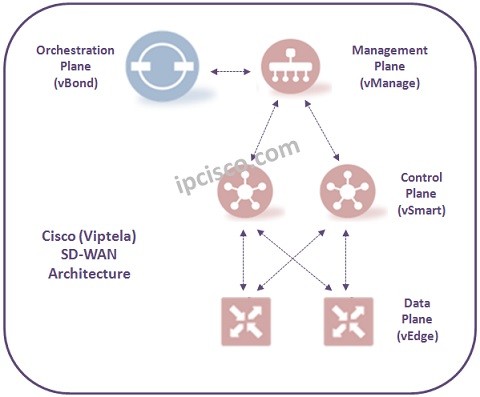
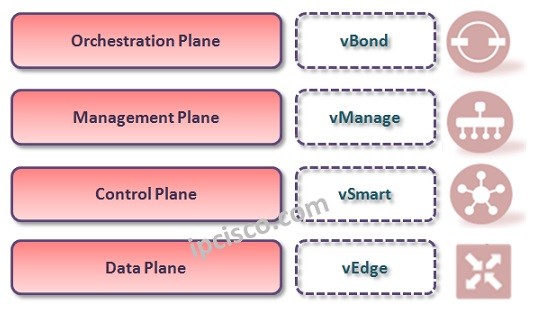
Cisco SD-WAN Architecture
Now, let’s focus on Cisco vBond and see How to Configure vBond Orchestrator initially in Cisco SD-Wan Architecture.
Connecting Cisco vBond Orchestrator
Firstly, we will connet our vBond device and then we will login with the default login credentials. The default credentials of Cisco (Viptela) devices are give below:
User : admin
Password : admin
To change this default password for admin user as “xxxxxx”, you can use “user admin password xxxxxx” command.
Configuring System Name and IP Address
To enter the configuration mode, we will use “config” command on Cisco (Viptela) device. We will change our system name as “Our_vBond” and we will set System IP address as 1.1.1.1. System IP address is also used to communicate with vManage NMS in Cisco SD-Wan Architecture.
vBond# config
vBond(config)#system host-name Our_vBond
Our_vBond(config)# system-ip 1.1.1.1
Configuring vBond IP Address
vBond IP address must be a Public IP address that is used on Internet.This is because, all the network equipments in Cisco SD-Wan Architecture must reach vBond Orchestrator. Here, we will append “local” keyword to this ip address configuration. This “local” keyword sets our device works as only vBond. Because, at the beginning, our Cisco (Viptela) device is in the vEdge catagory.
We will use 100.100.100.5 ip addres as an example here.
Our_vBond(config)# vbond 100.100.100.5 local
Configuring VPN 0 Interface
VPN 0 interface is used to connect Internet or other WANs. Here, the IP prefix that we will use, should includes vBond IP address. Firslty, we will create the interface. Our interface name will be “Our_VPN_Interface”.
Our_vBond(config)# vpn 0 interface Our_VPN_Interface
Our_vBond(config-interface)# ip address 100.100.100.1/24
Our_vBond(config-interface)# no shutdown
You can check also SD-WAN Verification Commands to verify this configuration in Cisco SD-WAN Architecture.
Here, we can also use IPv6 addresses. At that time, we will use “ipv6 address” instead of “ip address” command.
Saving Initial vBond Configuration
To save Cisco vBond configuration, we will use “commit” command. We can also use “commit-and-quit” command to exit from the configuration mode.
Our_vBond(config-interface)# commit-and-quit
Verfication of Initial vBond Configuration
To verify our Initial vBond Configuration, we can use “show running-config”.
Our_vBond # show running-config
system host-name Our_vBond
gps-location latitude 92.457896
gps-location longitude 45.1274575
system-ip         1.1.1.1
organization-name "IPCisco"
clock timezone Istanbul
vbond 100.100.100.5 local
... vpn 0
interface Our_VPN_Interface
ip address 100.100.100.1/24
no shutdown
You can check also SD-WAN Verification Commands to verify this configuration in Cisco SD-WAN Architecture.


Gokhan Kosem is a Network Engineer, Instructor and the Founder of IPCisco.com with 15+ years of experience in Cisco, Nokia, Huawei, Juniper, Linux, Service Provider Networks, Routing and Switching technologies.
He has worked on the backbone networks of major service providers and network vendors including Nortel, Alcatel-Lucent (Nokia) and has extensive hands-on experience with Cisco, Huawei, Juniper and Nokia networking technologies.
He has trained thousands of networking students worldwide through IPCisco.com, Udemy, books, labs, quizzes, and educational content across multiple social media platforms.
IPCisco.com | Best Route to Your Dreams






Leave a Reply