

IS-IS Protocol uses L2 encapsulation Ethernet 802.3/802.2. It do not use Ethernet II. Ethernet II is used for IP traffic.
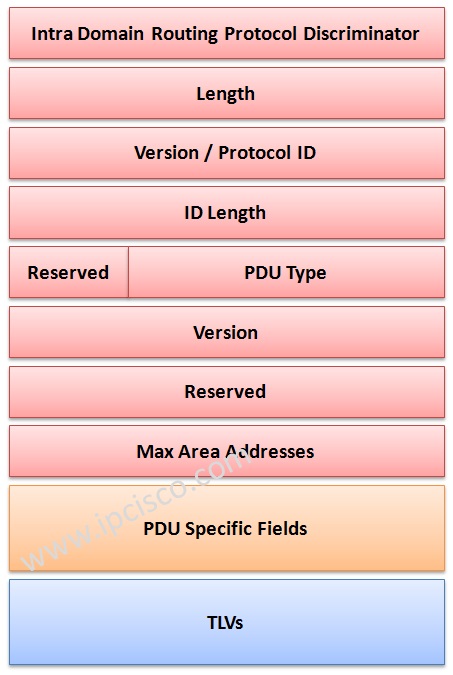
IS-IS Protocol exchanges protocol information by using Link-State PDUs (Protocol Data Units).
There are four types of PDU packets in IS-IS Protocol.
These IS-IS packets are :
– IS-IS Hello PDU (IIH)
– Link State PDU (LSP)
– Partial Sequence Number PDU (PSNP)
– Complete Sequence Number PDU (CSNP)
In IS-IS PDUs there is a TLV (Type, Length, Value) field. According to the need, these fields are added to the PDUs. This TLV field makes IS-IS extendable and it is the major advantage of IS-IS over OSPF. There are several TLVs in IS-IS packets. IS-IS Header always same, but according to the type of the packet, added TLV fields change.
TLVs are maximum 256 bytes and they contains sub-TLVs.
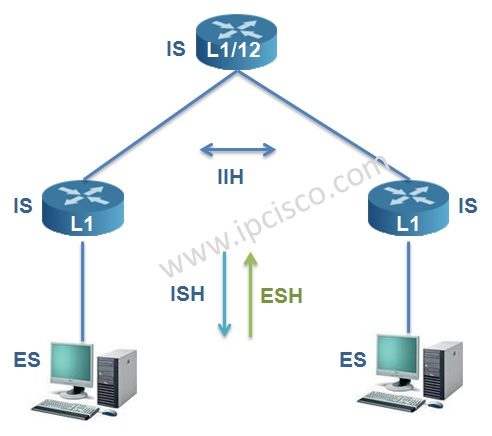
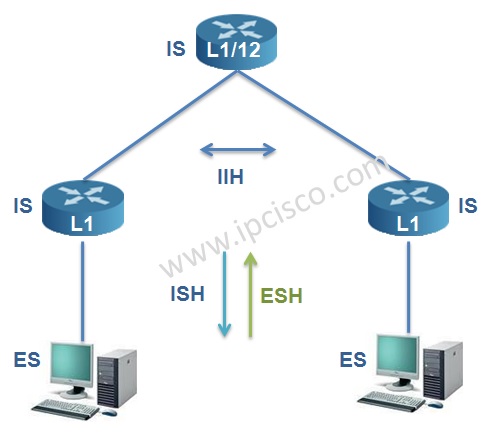
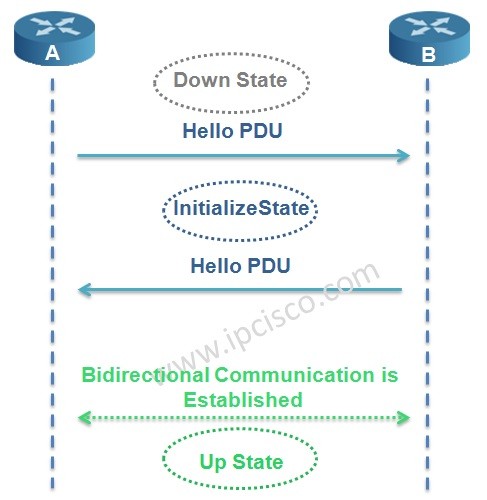
IS-IS discovers the IS-IS neighbours and IS-IS adjacency via Hello PDUs. DIS election is also done with this PDUs.
There are three types Hello PDUs in IS-IS Protocol:
ESH -> ES sent to IS
ISH -> IS sent to ES
IIH -> Between two ISs
IS-IS Hello interval is 10 seconds and the dead interval is 30 seconds by default.
In IS-IS Hello packet, 6 types of data can be included with TLVs. These are:
– Area Addresses TLV
– Padding TLV
– IP Interface Address TLV
– Authentication Information TLV
– Protocols Supported TLV
– Intermediate System Neighbors TLV
For more information about IS-IS TLVs, you can check Intermediate System-to-Intermediate System (IS-IS) TLVs article on Cisco Website.
IS-IS LSPs are like LSAs in OSPF and contains many information about the neighbour ISIS Routers and links. They are flooded periodically in IS-IS network. L1 and L2 PDUs use different formats LSPs are stored in IS-IS LSDBs. Seperate datababses are used for L1 and L2 LSPs. Each LSP has sequence number that shows its version.
In LSPs, below TLVs are supported:
– Area Addresses TLV
– Originating LSP Buffer Size TLV
– Intermediate System Neighbors TLV
– End System Neighbor TLV
– Authentication Information TLV
– Prefix Neighbor TLV
– Protocols Supported TLV
– IP Interface Address TLV
– IP Internal Reachability Information TLV
– IP External Reachability Information TLV

The other articles on IS-IS Protocol are below:
Routing With IS-IS Protocol – Part 1
Routing With IS-IS Protocol – Part 2 (IS-IS Addresses)
Routing With IS-IS Protocol – Part 3 (IS-IS Packet Types)
Routing With IS-IS Protocol – Part 4 (IS-IS Adjacency)
Routing With IS-IS Protocol – Part 5 (IS-IS versus OSPF)

Gokhan Kosem is a Network Engineer, Instructor and the Founder of IPCisco.com with 15+ years of experience in Cisco, Nokia, Huawei, Juniper, Linux, Service Provider Networks, Routing and Switching technologies.
He has worked on the backbone networks of major service providers and network vendors including Nortel, Alcatel-Lucent (Nokia) and has extensive hands-on experience with Cisco, Huawei, Juniper and Nokia networking technologies.
He has trained thousands of networking students worldwide through IPCisco.com, Udemy, books, labs, quizzes, and educational content across multiple social media platforms.
IPCisco.com | Best Route to Your Dreams






Leave a Reply