
- COURSES
- SPECIALS
- BLOG
- MEMBERS
- SHOP
- ABOUT
- ENROLL HERE

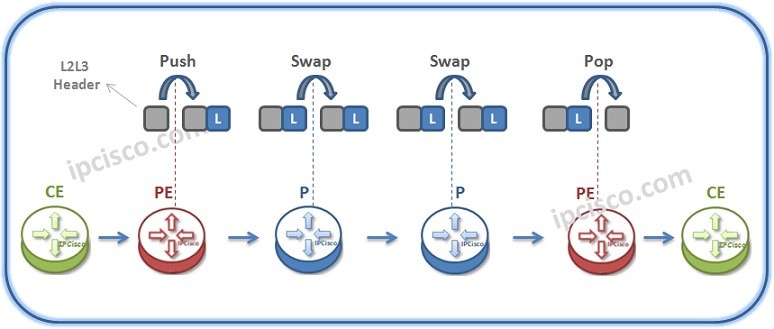
Table of Contents
MPLS Technology uses different routers for different roles. There are some common router types that are in these roles. The names of these routers are changing in different vendor naming, but the main role is same. These common routers are given below:
C Routers and CE Routers are the routers that is located at the Customer Network. These routers are unaware of MPLS.
PE Routers are the border routers between the Customer Network and the Service Provider MPLS Network. The starting and the ending points of MPLS are these routers.
P Routers are the Service Provider backbone routers. It is the network that the main MPLS Label swapping takes place.
In MPLS Network, for MPLS Label Switching there are some common jobs that is done with different routers. Here, PE and P routers are used for these common jobs. CE Router is in Customer side, so it is unaware of MPLS Label Switching.
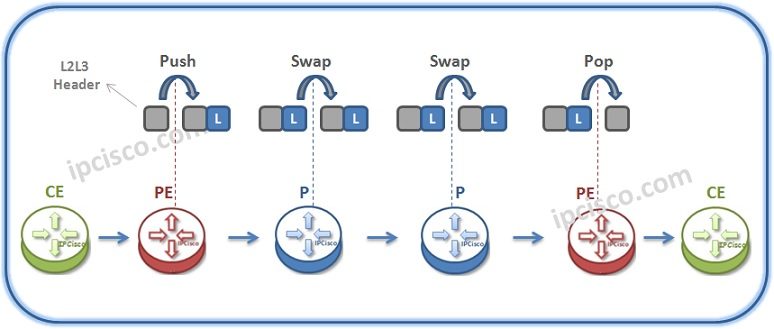
Mainly, there are three common jobs for MPLS Label Switching. These are:
You can also check MPLS VPN Labelling Lesson.
If you would like to learn more about MPLS, you can follow the lessons of Nokia MPLS Training.
Push is the process of Label addition between the L2 and L3 Header of the traffic packet. In other words, locating label to the packet and MPLS starting point is here. Push process is done by PE Routers. PE takes the packet from Customer and with MPLS Label, PE makes this packet an MPLS packet.
Swap is the process of label swapping in MPLS network. The backbone routers of the Service Provider is responsible from this job. Labels are swapped between these P Routers, through the LSP (Label Switch Path) that is built between border PE Routers.
Pop is the process of the label exit. The last label that comes from swapping is removed with this process. And the pure traffic is sent to the customer. Pop process is done at PE routers. But sometimes, this can be changed and before the PE router, at the last P Router, Pop process is done. This specific process is called PHP (Penultimate Hop Popping).
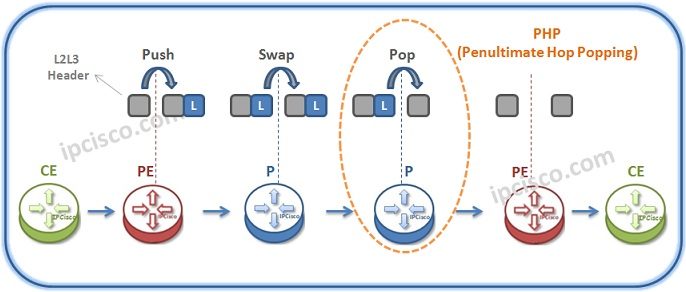
Push process is done in iLER. It is the entrance, ingress point of the label.
Pop process is done in eLER. It is the exit, egress point of the label.
LSP (Label Switching Path) is a virtual path that the data transmission done on it. It is a label series that belongs to the routers from source through destination. The below shape shows what is LSP:
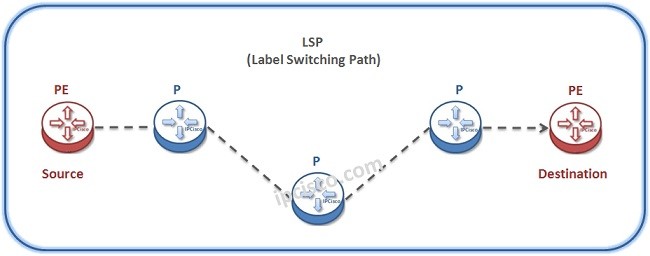
Here if orderly the labels of the routers are 100,200,300,400 and 500, the LSP will be 100-200-300-400-500 for the above shape.
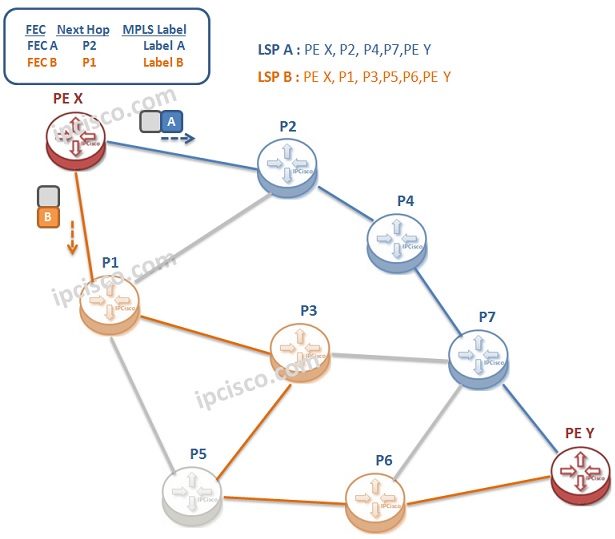
Forwarding Equivalence Class (FEC) is the name of a traffic group that are treated similar in the MPLS network. By traffic group I meant that, a group of IP packets. There are many FECs defined in MPLS networks. All the prefixes in these FECs, go through the same MPLS routers, use same MPLS traffic engineering parameters etc.
As you can see, below, there is an example MPLS network and there are two LSPs defined in this network. There are also two FEC. These FECs are using different LSPs as you can see. They prefer different next hope and get different labels. But each prefix in the same FEC, use the same next hop and label.
Other Basic MPLS Lessons:





Leave a Reply