
- COURSES
- SPECIALS
- BLOG
- MEMBERS
- SHOP
- BOOKSHELF
- ABOUT
- ENROLL HERE

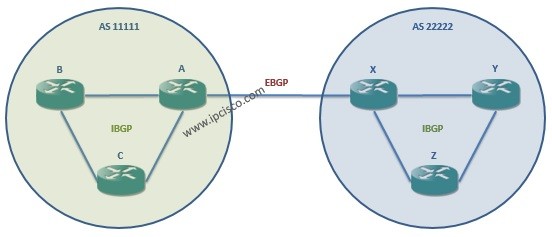
In this lesson we will focus two types of BGP: Internel BGP (iBGP) and External BGP (eBGP). We will learn what is Internal BGP (iBGP) and What is External BGP (eBGP)? We will compare iBGP vs eBGP to learn their difference. We will learn IBGP Full- Mesh topology, IBGP Route-Reflector Topology and IBGP Confederations topology.
In the below BGP topology, you can see iBGP and eBGP.
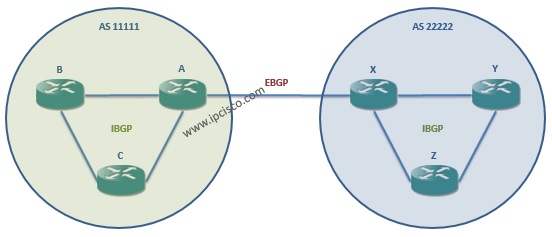
Internal BGP (iBGP) and External BGP (eBGP)
Table of Contents
Internal BGP (iBGP) is the Border Gateway Protocol which is used in the same Autonomous System (AS). Here, the BGP neighborship is established with the peer which is in the same Autonomous System.
In Internal BGP topology, IBGP peers do not need direct connection. But, there must be some Routing Protocol (IGP) that runs and allows the two neighbors to reach one another.
The Routes learned from the internal peers (iBGP peers), must not sent back to other internal peers. It can only sent to the external peers (eBGP peers).
Internal BGP peers must be full mesh. But you can get over this full mesh, by two other feature of BGP. These features are AS Confederations and Route Reflectors.
AS-PATH and NEXT-HOP attributes must not updated when passing updates to internal BGP peers.
iBGP peers are dependent on the underlying Routing Protocol (IGP) of the AS to connect peers together.
Now Let’s check the iBGP topologies.
In this topology, all the routers used in IBGP must be connected together as mull mesh. This type of configuration is difficult to configure and complex. In this type of configuration, adding one router to the topology is also difficult, because you need to update all routers on IBGP topology for this router.
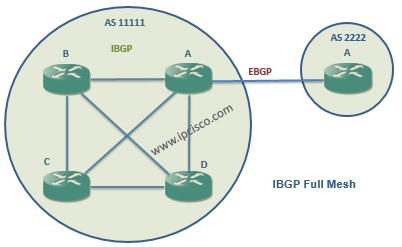
Internal BGP (iBGP) Full-Mesh Topology
In this type topology, there is a Route Reflector(RR). And all of the IBGP routers connected to this Route Reflector only. This type of topology is easy to configure, so it is ofen used on many servis providers’ core. Generally in these servis provider networks, there are two route reflectors supplementary.
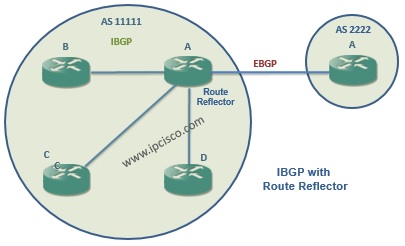
Internal BGP (iBGP) Route-Reflector Topology
With confederations you can partition the whole autonomous system into subASs. In these subASs, private AS numbers are used. These numbers are from 64512 to 65534.
Here, the routers in each confederation must be full mesh. But the topology between the subASs do not need to be full mesh. They will be cBGP peer. cBGP is confederation BGP. And the characteristic of this type of BGP is mix of IBGP and EBGP.
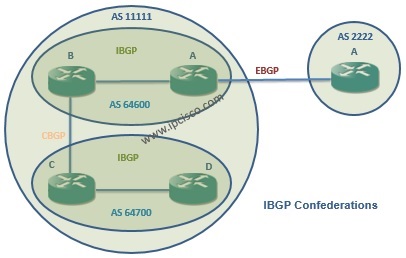
Internal BGP (iBGP) Confederations Topology
External BGP is BGP which is used between different autonomous systems. Here, External BGP (eBGP) peers have direct connection to the other peer.
Any BGP routes learned from external peers, can be updated to all other peers.
When sending an update in External BGP, AS-PATH and NEXT-HOP attribute is modified.
Sending router adds local AS number to the AS-PATH and sets NEXT-HOP to its local IPv4 address.
In eBGP, by default the neighbor must be maximum one hop away. But this can be also by passed by “ebgp-multihop” command.. Internal BGP (iBGP) has no hop restriction.

Gokhan Kosem is a Network Engineer, Instructor and the Founder of IPCisco.com with 15+ years of experience in Cisco, Nokia, Huawei, Juniper, Linux, Service Provider Networks, Routing and Switching technologies.
He has worked on the backbone networks of major service providers and network vendors including Nortel, Alcatel-Lucent (Nokia) and has extensive hands-on experience with Cisco, Huawei, Juniper and Nokia networking technologies.
He has trained thousands of networking students worldwide through IPCisco.com, Udemy, books, labs, quizzes, and educational content across multiple social media platforms.
IPCisco.com | Best Route to Your Dreams







Leave a Reply