- COURSES
- SPECIALS
- BLOG
- MEMBERS
- SHOP
- BOOKSHELF
- ABOUT
- ENROLL HERE

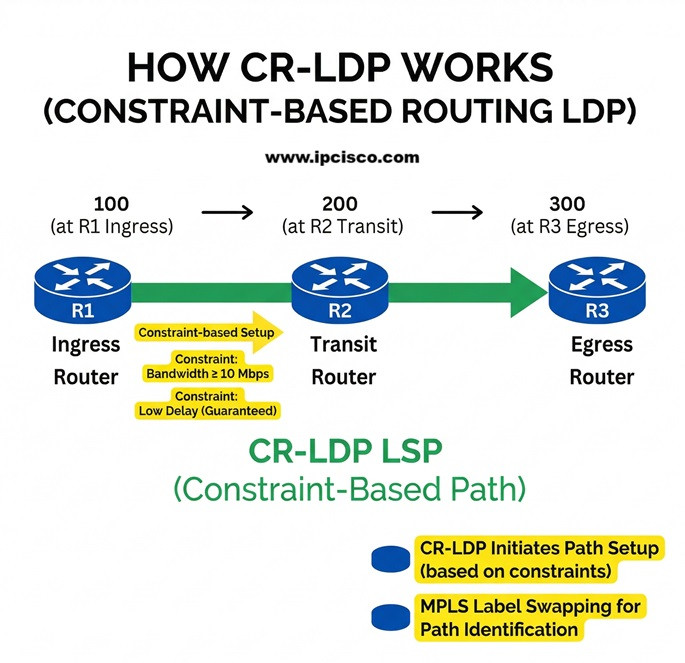
Table of Contents
CR-LDP (Contraint-Based Routing LDP) is an extension of LDP (Label Distribution Protocol) and with these extensions, Contraint-based Routing is supported on LDP. It is used in MPLS networks to establish Label Switched Paths (LSPs) based on specific constraints, such as bandwidth, delay or policy requirements. In MPLS networks, Contraint-Based Routing LDP allows routers to create Traffic-Engineered paths instead of just following the shortest path. In other words, Contraint-based Routing brings Traffic Engineering(TE) mechanism to the LDP.
Basic MPLS Lessons:
CR-LDP LSP (Constraint-Based Path)
Contraint-based Routing is the routing which in which the routing process is done according to some constraints. Both QoS-based routing and policy-based routing belong to Contraint-based Routing. As you know these routing include QoS constraints or policy constraints.
We have learned what is CR-LDP basically. How about its mechanims? How CR-LDP Works? Here, firstly the ingress router defines constraints like minimum bandwidth. Then, Contraint-Based Routing LDP signals a path through the MPLS network that meets these constraints. Routers along the path allocate labels. Lasltly, a Label Switched Path (LSP) is created based on those requirements.
This mechanism provides the optimum path selection. With Contraint-Based Routing LDP, we do not select the shortest path but we can select the path that;
Both CR-LDP and RSVP-TE are used for MPLS Traffic Engineering, but RSVP-TE is the modern and widely used protocol, while Contraint-Based Routing LDP is obsolete. below, you can find the comparison table of CR-LDP vs RSVP-TE.
| Feature | CR-LDP | RSVP-TE |
|---|---|---|
| Protocol Type | Extension of LDP | Extension of RSVP |
| Transport | TCP | IP (Protocol 46) |
| Traffic Engineering | Yes | Yes (Advanced) |
| Resource Reservation | Limited | Strong |
| State Type | Hard State | Soft State (Refresh) |
| Usage | Obsolete | Widely Used |
The additional TLV parameters are new for Contraint-Based Routing LDP:
Value		Parameter
-----		---------
821		LSPID
822		ResCls
503		Optical Session Parameters
800		Explicit Route
801-804		ER-Hop TLVS
810		Traffic Parameters
820		Preemption
823		Route Pinning
910		Optical Interface Type
920		Optical Trail Desc
930		Optical Label
940		Lambada Set
For more information about LDP, T-LDP and CR-LDP, check the related following RFCs:
Basic MPLS Lessons:

Gokhan Kosem is a Network Engineer, Instructor and the Founder of IPCisco.com with 15+ years of experience in Cisco, Nokia, Huawei, Juniper, Linux, Service Provider Networks, Routing and Switching technologies.
He has worked on the backbone networks of major service providers and network vendors including Nortel, Alcatel-Lucent (Nokia) and has extensive hands-on experience with Cisco, Huawei, Juniper and Nokia networking technologies.
He has trained thousands of networking students worldwide through IPCisco.com, Udemy, books, labs, quizzes, and educational content across multiple social media platforms.
IPCisco.com | Best Route to Your Dreams