
- COURSES
- SPECIALS
- BLOG
- MEMBERS
- SHOP
- BOOKSHELF
- ABOUT
- ENROLL HERE

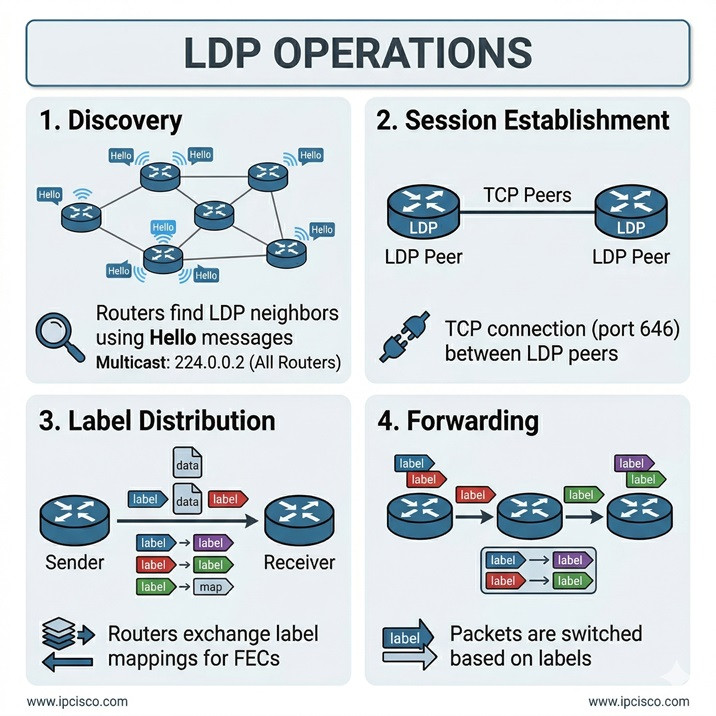
LDP (Label Distribution Protocol) is one of the two label exchange protocols of MPLS. The other is RSVP (Resource Reservation Protocol). And there is also one more, Cisco specific protocol, TDP (Tag Distribution protocol). In this article, we will talk abbout the LDP. And the examples will be also for Alcatel-Lucent Service Routers (7750, 7450 etc.).
There are 3 types LDPs. These are:
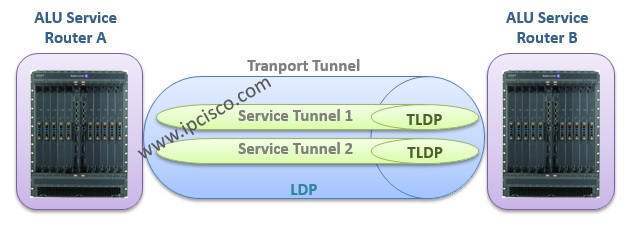
Link LDP is used to establish MPLS Transport Tunnels. But, TLDP is used for MPLS Service Tunnels. Lets explain it more detailly.
Think about MPLS VPNs. For MPLS we need to establish an MPLS Transport Tunnel through the core network (P routers) between PE routers. This is established via Label Distribution Protocol. Inside this MPLS Transport Tunnel, we carry specific customers traffic. In Alcatel-Lucent terminalogy, this is called different customer services. So, this different customers’ traffic is carried in different MPLS Service Tunnels in Transport Tunnels. And these MPLS Service Tunnels are established via TLDP, between PE routers, for VPLS and VPWS services(L2 VPN Services). For VPRN (L3 VPN Service), MP-BGP is used instead of TLDP. For this lesson also check Tunnel Structure article.
Contraint-based Routing LDP (CR-LDP) is the extension of LDP that will provide traffic engineering mechanism to Label Distribution Protocol. As you know pure LDP has no traffic engineering mechanism.
Table of Contents
For Link LDP, all the directly connected neighbours need to establish LDP session each other. This must be a full mesh topology. Firstly LDP Adjacency must be done, then the LSP Session must be established. By doing this, the label distribution can be done for all the routers.
LDP Operations – How LDP Works
To create and maintain LDP there are 4 processes. These are:
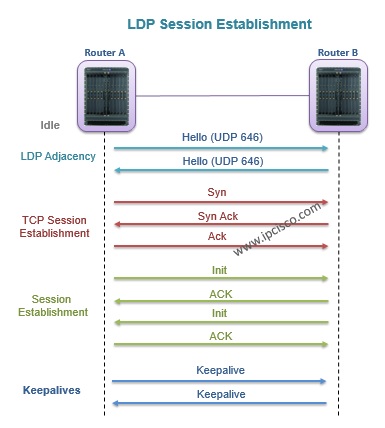
The Peer Discovery is the first process and it is done via Hello Messages. We can call this process also LDP Adjacency. Hello messages are sent each other with the peer parameters.
Hello Messages use UDP port 646. Session establishment, Label Management and Notification use TCP port 646. Hello messages send every 5 seconds by default. This can be changed. Even the configured Hello time values are different, LDP neighbour discovery is done. The lower Hello value is used.
After the Hellos are sent each other, the LDP adjacency is established.
After LSP adjacency, Init messages are sent each other. This messages use TCP 646 port. In this messages, the Session Parameters are sent. Then Keepalive Messages are sent each other and the LSP Session is established. Keepalive Messages are still sent after the LDP Session Establishment.
There are 4 categories of LDP messages :
For Label Distribution Protocol, firstly a routing protocol configuration must be done between the peers or a static configuration must be used. Basically the points must be reach eachother. This is generally done by a routing protocol(IGP).
Label Distribution Protocol relies on routing protocol (IGP). This means that it is dependant to routing protocol (IGP). It sends the label according to choose of routing protocol. If a problem occurs because of routing protocol, the network needs to be wait for the convergence of IGP. LDP is easy to configure bu IGP depandancy is the weakness of this protocol.
Quick Summary – LDP (Label Distribution Protocol)
• Purpose: MPLS label distribution for best-path routing
• Type: Hop-by-hop label signaling protocol
• Label Binding: Unsolicited downstream (default behavior)
• Path Control: No traffic engineering support
• Routing Dependency: Uses IGP (OSPF / IS-IS)
• LSP Type: Automatic LSP creation
• Resource Reservation: Not supported
• Complexity: Simple and widely used
• Use Case: Basic MPLS backbone forwarding
• Operation: Label swap based forwarding
Other Basic MPLS Lessons:

Gokhan Kosem is a Network Engineer, Instructor and the Founder of IPCisco.com with 15+ years of experience in Cisco, Nokia, Huawei, Juniper, Linux, Service Provider Networks, Routing and Switching technologies.
He has worked on the backbone networks of major service providers and network vendors including Nortel, Alcatel-Lucent (Nokia) and has extensive hands-on experience with Cisco, Huawei, Juniper and Nokia networking technologies.
He has trained thousands of networking students worldwide through IPCisco.com, Udemy, books, labs, quizzes, and educational content across multiple social media platforms.
IPCisco.com | Best Route to Your Dreams




Leave a Reply