
- COURSES
- SPECIALS
- BLOG
- MEMBERS
- SHOP
- ABOUT
- ENROLL HERE

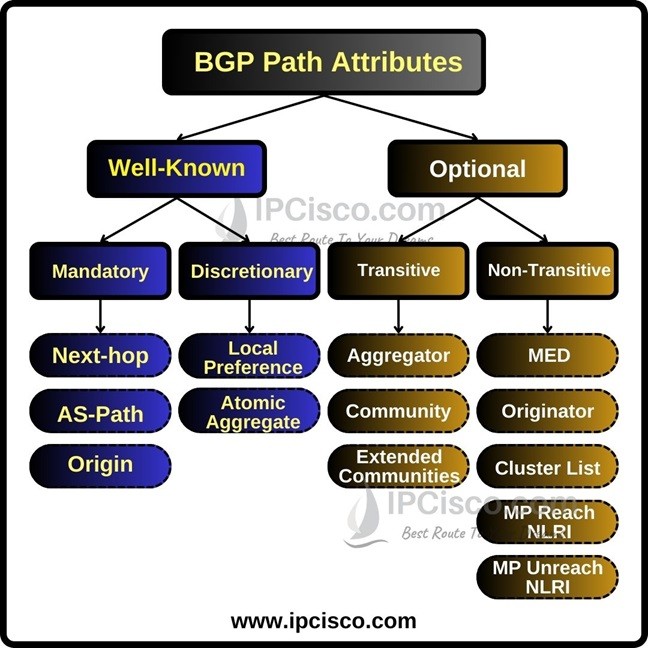
Table of Contents
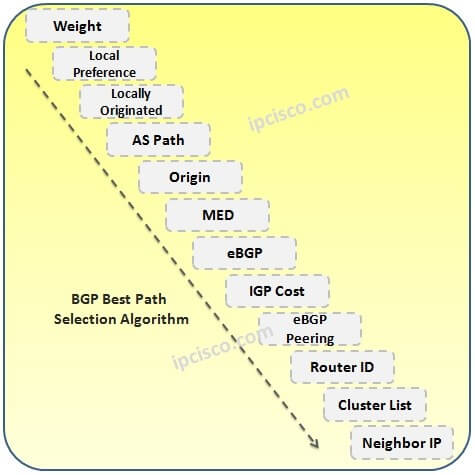
BGP uses BGP Path Attributes to determine the Best Path to a destination. According to BGP Best Path Algorithm, BGP Path Attributes are used to determine the BGP Best Path selection.
With these Path Attributes, network administrators can manage the BGP Traffic and determine way of the BGP traffic flow.
You can also test yourself on BGP Quizes Section for your BGP Path Attribute knowledge.
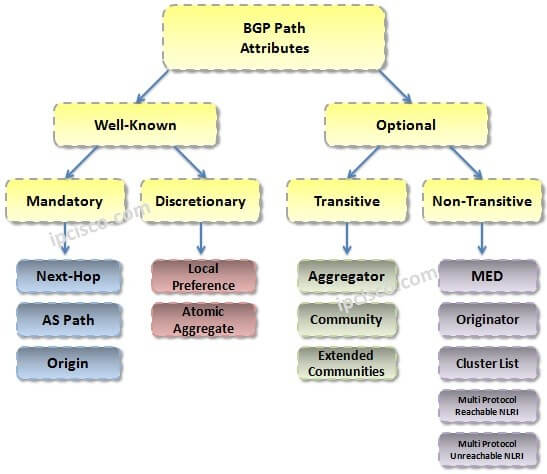
BGP Path Attributes divide into two groups. These classes are Well-Known and Optional path attributes. These two groups divide also into two subgroups again. These four BGP Path Attribute sub groups are:
Well-Known BGP Path Attributes are supported on all BGP software implementations. In other words, Well-Known BGP Attributes must be recognized by all BGP routers. They ensure that every router can properly understand and process routing information, making communication between different autonomous systems reliable and consistent. There are two types of Well-known BGP attriubtes:
Well-Known Mandatory Path Attributes are must be included in every BGP Update Message. BGP Well-Known Mandatory Attributes are:
Well-Known Discretionary Path Attributes may or may not appear in BGP Update Message, it is optional. Well-Known Discretionaty Attributes are:
Optional BGP Path Attributes, may or may not be supported by all BGP implementations. In other words, optional attributes are not required to be recognized by all BGP routers and are mainly used for implementing routing policies and optimizations. They provide additional control over path selection and traffic flow without being essential for basic BGP operation. There are two types of BGP Optional Path Attributes:
Optional Transtive Attributes are sent in an update message, but not recognized by the receiver, it should be passed on to the next AS. Optional Transtive BGP Attributes are:
Optional Non-transtive BGP Path Attributes may or may not be supported too, but if it received, it is not required that the router pass it on. It may safely and quietly ignore the optional attribute. Optional Non-transtive BGP Attributes are:
There is also one extra important BGP Path Attribute. This attribute is, Cisco Proprietary, BGP Weight Attribute. BGP Weight Attribute is only used on Cisco router and it is the first step of BGP Path Selection algorithm for Cisco devices. To learn the details of BGP Weight attribute, you can check BGP Weight lesson.
You can also test yourself on BGP Quizes Section for your BGP Path Attribute knowledge.
The names and categories of these BGP Path Attributes were really confusing for me too:) To make this information more permanent for you, lets make an analogy.
Well-known Mandatory: A famous (recognized) stage actor acts in all the stages of a theater play (Included in all BGP Update messages).
Well-known Discretionary: A famous (recognized) stage actor plays and acts in some stages of a play (may or may not include in BGP update messages)
Optional Transitive: A new stage actor is accepted as a player and send to other plays.
Optional Non-transitive: A new stage actor ignored and not advertise to other plays.
We will discuss these BGP Path Attributes detailed and with Configuration examples in the following posts as our previous lesson, BGP Configuration on Packet Tracer.
As you know routing protocols have Administrative Distance (AD) values for preferability. And different vendors have different Administrative Distance (AD) values for the same routing protocols. This is also valid for BGP.
By the way “Administrative Distance (AD)” term is used in Cisco terminology. For Juniper, Nokia and Huawei, instead of Administrative Distance (AD), “Preference” is used.
Some main vendors and BGP AD(Preference) Values are below:
In Cisco routers two AD values used for BGP. For the routes learned outside the AS (eBGP routes) this value is 20, while the AD for iBGP and locally-originated routes is 200.
In Juniper and Alcatel-Lucent routers the Administrative Distance phrase changes to Preference value.
In Juniper routers Junos OS uses the same preference value for both EBGP and IBGP. This value is 170. However, difference between vendors has no operational impact because Junos OS always prefers EBGP routes over IBGP routes.
Preference value is also 170 in Alcatel-Lucent routers.
Lastly, for Huawei, Preference values are 255 for both EBGP and IBGP.
Some BGP attributes are mandatory because they provide the essential information needed for routing to work correctly, such as the route’s origin, path, and next hop. Without them, BGP cannot:
Some BGP attributes are optional because they are used for routing policies and optimization rather than basic operation. They allow network administrators to control traffic flow and path selection, but BGP can still function properly even if these attributes are not present.






Leave a Reply