
- COURSES
- SPECIALS
- BLOG
- MEMBERS
- SHOP
- BOOKSHELF
- ABOUT
- ENROLL HERE

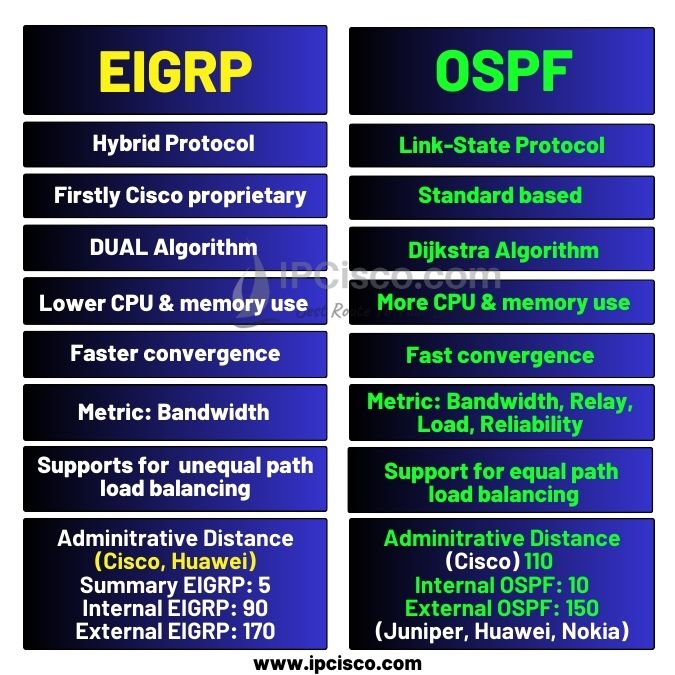
Table of Contents
We use routing protocols to calculate routes to a destination dynamically. There are various routing protocols that we use for this purpose. In this Cisco CCNP Lesson, we will focus on two of these routing protocols: EIGRP (Enhanced Interior Gateway Routing Protocol) and OSPF (Open Shortest Path First). We will compare these routing protocols and we will learn the differences of EIGRP vs OSPF. In other words, we will compare advanced distance vector vs link state protocols.
EIGRP is a Hybrid protocol or it is an advanced distance vector protocol. On the other hand, OSPF is a Link-State protocol. Here we will compare these two different dynamic routing protocols.
So, what are the differences of EIGRP and OSPF? Here are the details of this comparison. You can also view Link State vs Distance Vector Protocols lesson.
First of all, let’s start with the similarities of these two protocols. They are both dynamic routing protocol, we have talked about above. We can add one more thing about it. These routing protocols are both intradomain routing protocols. In other words, their routing domain is instradomain. What is instradomain?
Intradomain means the inside of the routing domain. For example, it is the routing domain inside of a company. Another term is interarea and this means the area between different intradomains. Both OSPF and EIGRP are used inside the domain as intraarea and if we need to connect two domains, we use BGP (Border Gateway Protocol) as interarea routing protocol.
Both of these routing protocols can be used in middle sized companies to large companies. This means that several hundreds of routers can be routed by using one of these protocols, OSPF or EIGRP.
Both of these protocols are not difficult to configure. Their configuration and management are simple.
Now, let’s focus on the differences of these routing protocols.
First of all, EIGRP is a Hybrid protocol and OSPF is a Link-State Protocol. Hybrid protocol means it support both some of the characteristics of Distance-Vector protocols and Link-Stete protocols.
EIGRP (Enhanced Interior Gateway Routing Protocol) has developed by Cisco and previously it was Cisco proprietary. On the other hand, OSPF (Open Shortest Path First) is a standard based routing protocol and it is IETF standard.
EIGRP vs OSPF Comparison
The default administrative distance or default preference of these two protocols are different for different vendors. For EIGRP, there are three different preference values for Cisco. This is also true for Huawei devices:
Summary EIGRP: 5
Internal EIGRP: 90
External EIGRP: 170
On the other hand, OSPF default preference values are different in different network vendors. For Cisco, OSPF administrative distance is 110. For Juniper, Huawei and Nokia routers, the default OSPF preference has two values:
Internal OSPF: 10
External OSPF: 150
The route calculation algorithms are also different for OSPF and EIGRP. EIGRP uses DUAL Algorithm for route calculations while OSPF uses Dijkstra Algorithm.
EIGRP needs lower CPU and memory, OSPF need more CPU and memory than EIGRP.
EIGRP supports unequal path load balancing. OSPF do not support this feature. OSPF support equal cost load balancing.
The convergence time of EIGRP and OSPF are similar, they are fast. But if we compare their speed, EIGRP is faster than OSPF.
OSPF uses Bandwidth as metric while EIGRP use Bandwidth, Relay, Load, Reliability as metric.
EIGRP supports unequal path load balancing while OSPF supports equal path load balancing.
These two parameters work differently. An OSPF Process ID is locally significant, so neighboring OSPF routers do not need to use the same Process ID. In contrast, EIGRP routers must use the same Autonomous System (AS) number to form an EIGRP neighbor relationship. Here ism an example:
R1(config)# router ospf 10
R2(config)# router ospf 20R1 and R2 can still become OSPF neighbors.
R1(config)# router eigrp 100
R2(config)# router eigrp 200
R1 and R2 cannot become EIGRP neighbors because the AS numbers do not match.
R1(config)# router eigrp 100
R2(config)# router eigrp 100
R1 and R2 can form an EIGRP neighbor relationship.

Gokhan Kosem is a Network Engineer, Instructor and the Founder of IPCisco.com with 15+ years of experience in Cisco, Nokia, Huawei, Juniper, Linux, Service Provider Networks, Routing and Switching technologies.
He has worked on the backbone networks of major service providers and network vendors including Nortel, Alcatel-Lucent (Nokia) and has extensive hands-on experience with Cisco, Huawei, Juniper and Nokia networking technologies.
He has trained thousands of networking students worldwide through IPCisco.com, Udemy, books, labs, quizzes, and educational content across multiple social media platforms.
IPCisco.com | Best Route to Your Dreams







Leave a Reply