
- COURSES
- SPECIALS
- BLOG
- MEMBERS
- SHOP
- BOOKSHELF
- ABOUT
- ENROLL HERE

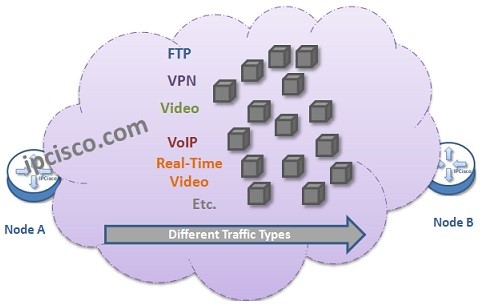
Table of Contents
This is the most ask questions by Network Engineers, especially the Newbies, What is QoS? What does QoS stands for? It is also an important lessons of CCNA and CCNP Trainings. Quality of Service is the general name of a concept , which is used to optimize networks with different priority levels (traffic prioritization) to different applications and provide improved services for these appliations on these networks. From the view point of customer, with QoS, users get a better network performance without drops, packet loss reduction, reduce unaccepted delays etc. From the view point of your Service Provider company, with Quality of Service, you can use your networks more efficient. With optimized network bandwidh and with a best network performance.
You can also view the QoS related lessons:
After answering what is QoS question, now let’s focus on some terms, QoS Enemies in QoS. QoS (Quality of Service) adjusts some important QoS Enemies for the traffic mainly. With this adjustments, networks become more efficient.
These important Quality of Service enemies are given below:
You can test your knowledge on All Network Questions Page!
So, what are these terms?
Packet Loss : Losing the packets along the path.
Delay : The time taken from one point to the other along the path.
Jitter : Variable Delay in packet transfer.
There are various types of traffics like real-time voice, data, streaming video etc. All of these traffic types need different QoS adjustments. Some of these traffics are very senstive to delay, some of them are not. Another is senstive to packet loss, for the other, packet loss is not too important.
As you know, voice is a real-time traffic. When you talk with another people, the vioce data is created at that time interactively by you and this traffic needs to reach to the other end in a very short time. If this is not achieved, then it is not possible to communicate with the person at the other end. So, voice traffic is senstive for delays. Beside, your voice data must not have a variable delays, jitter. Because, this also makes the communication worst. Lastly, for a good communication, your sentences need to be clear without any loss. All your talking need to be heared at the other end. This makes voice traffic also packet loss senstive.
Quality of Service can be implemented with different Service Models. There are three main QoS Service Models. These QoS Service Models are given below:
Best Effort is the simplest Service Model. It is also known as a model without Quality of Service. In other words, thi sis the model that there is no QoS Adjustments.
In this model, all the traffic are seem similar. So, all the behaviours are same to all types of traffics. The only parameter is the time. In Best Effort traffic, always the first come packets, are sent firstly.
Integrated Services is the second QoS Model in which, applications requests Quality of Service from the network’s control plane. With an explicit signalling, Integrated Services QoS instruct the network that it need Quality of Service. In other words, it requests a reservation. For this explicit signalling, RSVP (Resource Reservation Protocol) is used. After this request, it gets specific QoS parameters associated to that traffic and after the confirmation, the data is sent.
Differentiated Services (DiffServ QoS) is the third QoS Model. In this model, there is no prior reservation technique. In Differentiated Services Model, the network classifies the different types of traffic into groups. After that it marks these groups with DSCP Marking. All the groups are behaved with different Quality of Service values. There is no explicit signalling before the data sent in Differentiated Services. And Differentiated Services is implemented per hop. Differentiated Services uses DS Feilds in ToS (Type of Service) field.
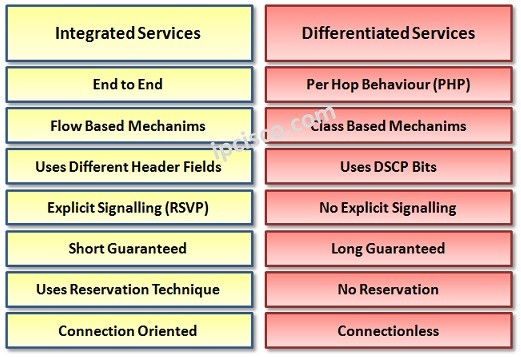
There are some differences between Integrated Services and Differentiated Services. Below, you can find a comparison table for Integrated Services vs Differentiated Services.
| Aspect | IntServ | DiffServ |
|---|---|---|
| Model | Per-flow QoS | Class-based QoS |
| Scalability | Not Scalable | Scalable |
| Guarantee | Strict (hard QoS) | Relative (soft QoS) |
| Resource Reservation | Yes (Uses RSVP) | No |
| State in Routers | Maintains per-flow state | Stateless core |
| Complexity | High | Lower |
| Marking | Not required | Uses DSCP |
| Real-world Usage | Rare | Very common |
We use Quality of Service for variety of aims related with network performance. With QoS, we aim to control: Bandwidth (Throughput), Delay (latency), Jitter, Packet loss.
Best-Effort is the default network behavior. Here, there is no prioritization and no delivery guarantee.
There are 5 Quality of Service mechanisms. These are:
Classification is the process of identifying traffic based on IP address, Port number, Protocol, Application etc.
Marking is the process which sets a value in the packet header to indicate packet priority. There are 2 common marking types. These are:
DSCP is a field in the IP header used to classify traffic into different priority levels in DiffServ model. With DSCP, for example EF (Expedited Forwarding) is used for Voice traffic, AF classes are used for Different priority levels.
CoS (Class of Service) is a QoS marking used in Layer 2. It uses 3-bit field (values 0–7).
Different traffic types need Quality of Service configurations. These traffic types are:
A QoS policy defines how traffic is handled using: Class-maps, Policy-maps and Service-policies.
Queuingin QoS determines how packets are stored and sent during congestion. There are different queuing methods. These are:
Low Latency Queuing (LLQ) is a queuing technique which provides a strict priority queue for delay-sensitive traffic like voice.

Gokhan Kosem is a Network Engineer, Instructor and the Founder of IPCisco.com with 15+ years of experience in Cisco, Nokia, Huawei, Juniper, Linux, Service Provider Networks, Routing and Switching technologies.
He has worked on the backbone networks of major service providers and network vendors including Nortel, Alcatel-Lucent (Nokia) and has extensive hands-on experience with Cisco, Huawei, Juniper and Nokia networking technologies.
He has trained thousands of networking students worldwide through IPCisco.com, Udemy, books, labs, quizzes, and educational content across multiple social media platforms.
IPCisco.com | Best Route to Your Dreams





Leave a Reply