
- COURSES
- SPECIALS
- BLOG
- MEMBERS
- SHOP
- BOOKSHELF
- ABOUT
- ENROLL HERE

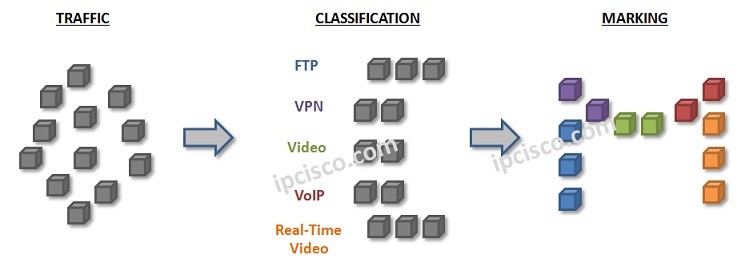
Table of Contents
To use Quality of Service for a traffic, firstly traffic need to be identified. With this identification, traffic types are classified and then they are marked with an understandable way by the network. This process is basically called “QoS Classification and Marking“. Another important mechanisms are Qos Traffic Policing and QoS Traffic Shaping. We will talk about this in the next lesson.
The identification mechanism used by QoS can be divide into two important process. These process are :
Now, let’s go a little deeply on QoS Classification and Marking, and talk about these two important QoS Process more.
You can download Various Cheat Sheets on Special Pages!
There are carious of traffic types in a network. These traffic types can be data, voice, video streaming etc. Without QoS, all these traffic types are behaved similarly. But behaving similarly to all the traffic types is not a proper way. Because, different traffic types need different threatments.
For example, voice traffic must be fast but security is in the second plane for voice traffic. Beside, pure data, ftp can be slower than a voice traffic.
Because of the fact that different types of traffics need different threatments, first of all we need to categorize the type of our traffic. Identifying and categorizing the type of the traffic is called “Classification”. After this process, we know that, we have a voice traffic, or video, or what else.
QoS Classification Process can be done by checking the different fileds of a packet. There are fields that shows the traffic types in a packet like IP Precedence, DSCP. Beside, incoming interfaces, source and destination addresses can also be used for Classification.
QoS Classification is done close to the source. This is because, early determination of the type and threat as required through the network.
After classification, traffic type determination must be showed also in the packet. To do this, a field in a packet header is changed. This changes explains that, the packet is belong to a specific type of traffic. The name of this process is called “Marking”. It is also called “Data Marking“ or “Coloring”.
QoS Classification Process is a must before Marking Process. Because, you can not mark something about its characteristic without knowing what is it.
Data Marking can be done in different levels with different field changes. With this changes, the traffic is quickly recognized anywhere in the network.
In Layer 2, in Ethernet Header, Class of Service field is used for Data Marking (Data Coloring).
In Layer 2.5, in MPLS Header, Type of Service (Experimental) field is used for Data Marking (Data Coloring).
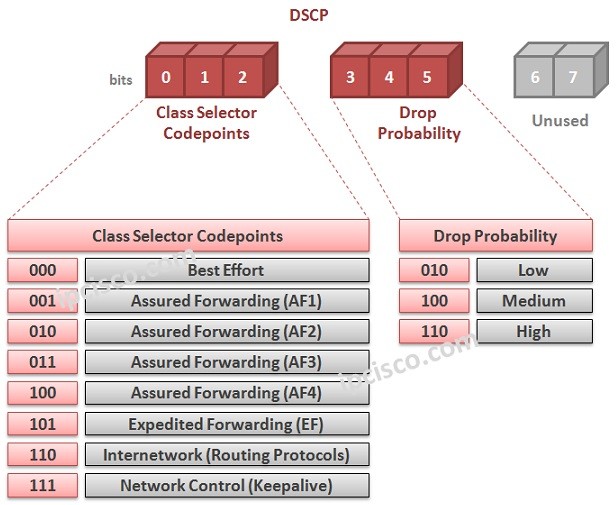
In Layer 3, in IP Header, Type of Service IP Precedence and DSCP fields are used for Data Marking (Data Coloring).
In Upper Layers, NBAR and Deep Packet Inspection are used for Data Marking (Data Coloring).
Layer 2 marking, CoS is mainly used inside LANs used in VLAN-tagged Ethernet frames (802.1Q). It uses 3-bit field (Values from 0 to 7).
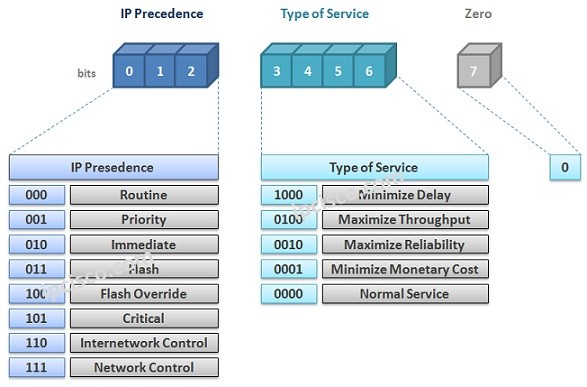
Layer 3 marking, DSCP, is used in IP packets. It uses 6-bit field to create possible values from 0 to 63. DSCP works across the entire network. Used by routers and Layer 3 switches
In Cisco CCNA and CCNP ENCOR Certification Courses, Traffic Classification and Marking is an important QoS Lesson.
When traffic moves between Layer 2 and Layer 3, mapping is required. In other words we need to map CoS to DSCP.
| CoS | DSCP |
|---|---|
| 0 | CS0 (0) |
| 1 | CS1 (8) |
| 2 | AF21 (18) |
| 3 | AF31 (26) |
| 4 | AF41 (34) |
| 5 | EF (46) |
| 6 | CS6 (48) |
| 7 | CS7 (56) |
Classification and marking are two improtant process for QoS (Quality of Service). While Classification is used to identify the traffic, Marking is used to assign priority. Another difference is about action. Classification match packets while Marking set QoS value. The other difference is about results. With Classification we group traffic into classes. With Marking, packets are labeled.
As a summary:
In classicification process, traffic can be classified based on the below parameters:
There are two common marking methods. The first one is CoS (Class of Service) which works on layer 2. The other one is DSCP (Differentiated Services Code Point) which works for layer 3.
We use DSCP to prioritize traffic across the network with DiffServ QoS model. By doing this we provide consistent end-to-end QoS.
We use Class of Service (CoS) in switches to prioritize traffic. It is mainly used in Local Area Networks, on VLAN tagged Ethernet frames (802.1Q).
Re-marking is changing the QoS value of a packet as it moves through the network. For example an access switch can marks the traffic and according to another policy, core router re-mark the traffic again.
Layer 2 (CoS) marking scope is local area network while Layer 3 (DSCP) marking scope is End-to-end. Switches use Layer 2 marking while routers use Layer 3 marking. Layer 2 marking uses 3 bits and layer 3 marking use 6 bits.
In Cisco devices, the below common tools are used for classification.
NBAR is a Cisco feature that classifies traffic based on application-level information, not just ports.

Gokhan Kosem is a Network Engineer, Instructor and the Founder of IPCisco.com with 15+ years of experience in Cisco, Nokia, Huawei, Juniper, Linux, Service Provider Networks, Routing and Switching technologies.
He has worked on the backbone networks of major service providers and network vendors including Nortel, Alcatel-Lucent (Nokia) and has extensive hands-on experience with Cisco, Huawei, Juniper and Nokia networking technologies.
He has trained thousands of networking students worldwide through IPCisco.com, Udemy, books, labs, quizzes, and educational content across multiple social media platforms.
IPCisco.com | Best Route to Your Dreams






Leave a Reply