
- COURSES
- SPECIALS
- BLOG
- MEMBERS
- SHOP
- BOOKSHELF
- ABOUT
- ENROLL HERE

Table of Contents
Network Cabling is an important part of computer networking. In this lesson, we will focus on one of the important lessons of computer networking: Fiber optic cabling. Here, we will learn the details of latest fiber optic cables. We will learn both single mode fiber optic cable types and multimode fiber optic cable types. After this lesson, you will also know the jacket colors of each fiber optic cable type.
Complete CCNA 200-301 v1.1 Course
A Fiber Optic cable is a network cable which transmits data via light signals over glass fiber. It provides high performance, high bandwidth, high speed and low data loss. Fiber optic cables can be used both for short and long distances. As you know, we can use twisted pair copper cables for short distances. But fibers can be used between very long distances.
Fiber optic cables are also secure cables. They have resistant to the electromagnetic interference. There are many layers in a fiber optic cable that saves the data towards such effects. Electromagnetic interference is high in copper twisted pair cables.
There are various types of fiber optic cables. We will talk about these types in the following lines.
Test Yourself With CCNA Practice Questions!
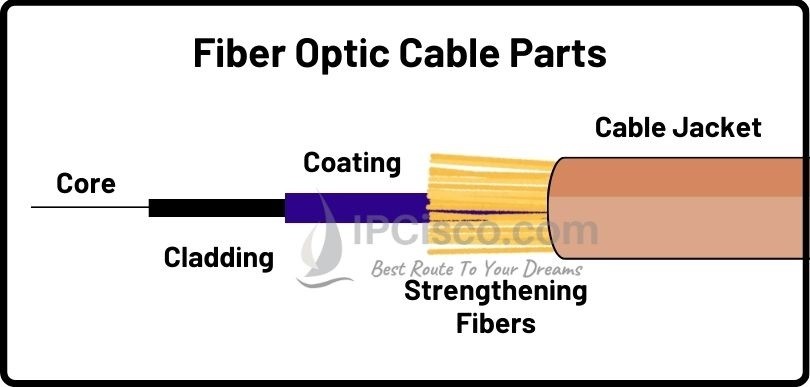
A fiber optic cable consists of some different parts. With these parts, it provides a secure data transfer via light signals. What are the parts of a fiber optic cables? These fiber optic cable parts are given below:
Fiber Optic Cable Anatomy
Core is responsible for transporting the light signals.
The Cladding surrounds the core. It contains and reflects the light.
The coating is the protector. It protects the core.
Strengthening part prevents the cable from stretching or breaking if it is subjected to tension.
Cable jacket protects the cable from any forces that can damage the cable.
Fiber optic cables can be terminated with different connector types depending on the network application, cable type and required connection density. The most commonly used fiber optic connectors include LC, SC, ST, FC and MPO/MTP. Today, LC connectors are the preferred choice for enterprise networks and data centers because of their compact size and compatibility with SFP transceivers. For a detailed comparison of these connector types, see our Networking Connectors guide.
The most common fiber optic connectors include:
Other specialized fiber optic connectors, such as MU, MT-RJ, E2000 and DIN connectors, are also available for specific networking and telecommunications applications.
In networking, we use both fiber optic and copper cables. But there are important advantages of using fiber optic cables if we compare with especially copper cables. So, what are the advantages of fiber optic cables? The advantages of using fiber optic cables are given below:
We can divide fiber optic cables into two main types. In other words, there are two fiber optic cable types. These are: Single Mode Fiber Optic Cable and Multimode Fiber Optic Cable. What ar ethe differences between single mode and multimode fiber optic cables? When we use single mode fiber optic and when we use multimode fiber optic cables? In this part we will see the details of both fiber optic cable types and we will learn different types of each fiber optic type.
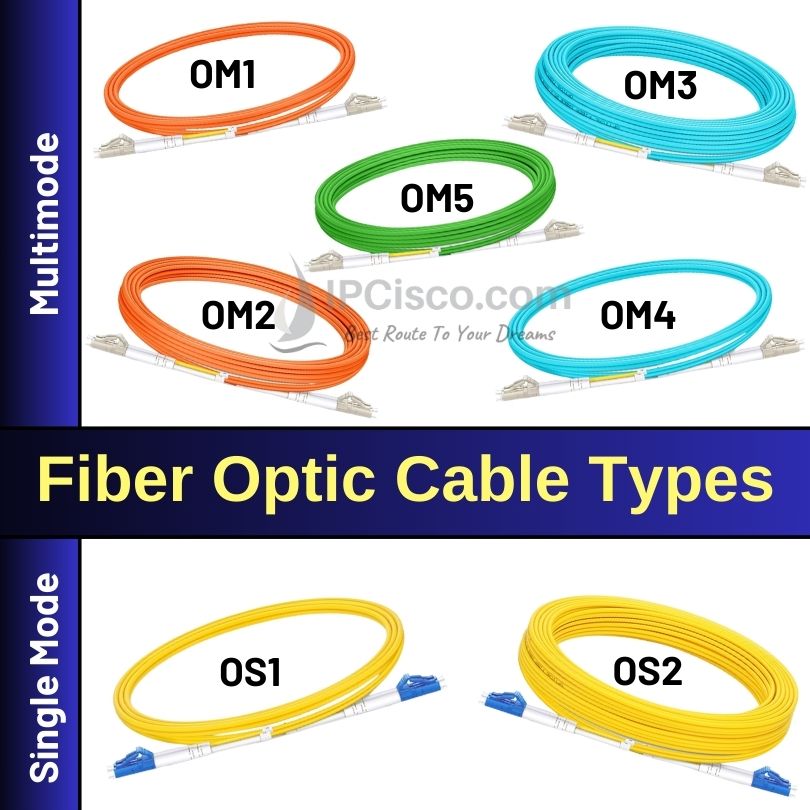
Standard jacket colors used to identify single-mode (OS1/OS2) and multimode (OM1–OM5) fiber optic cables
Single Mode Fiber Optic Cable is the fiber optic cable that is generally used for long distances up to 100km. A single fiber optic cable has narrow core diameter. It allows single angle of light waves.
The bandwidth of a single mode fiber optic cable is high. Its cable cost is low but it has high electronic cost.
Single Mode Fiber optic cable uses laser technology.
It is hard to terminate single mode fiber cable if we compare it with the termination of a multimode fiber optic cable.
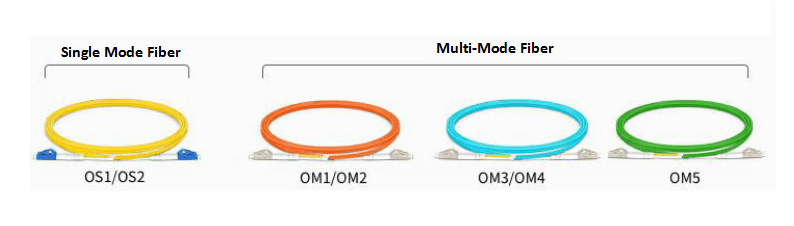
Single mode fiber optic cables use “yellow” as jacket color.
There are two types Single Mode fiber optic cables. These are:
OS1 (Optical Single Mode 1) is a single mode fiber optic cable which has tight-buffered structure. This type of fiber optic cable is mainly used indoor like datacenters. The maximum distance for OS1 is 10 km. It supports Gigabit and 10G Ethernet links. The price of OS1 fiber optic cables is low. The jacket color of OS1 Cable is yellow.
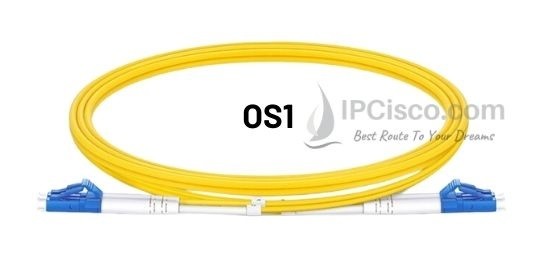
OS1 Single-Mode Fiber Cable
OS2 (Optical Single Mode 2) is the other single mode fiber optic cable. It has toose-tube structure. OS2 cables are uses at outdoor like streets, underground etc. The maximum distance for this type of cable is 200 km. OS2 cables supports Gigabit and 10G Ethernet links. It also supports 40G and 100G Ethernet links. On attenuation OS2 outperforms OS1. The price of OS2 is higher than OS1. The jacket color of OS2 Cable is yellow.
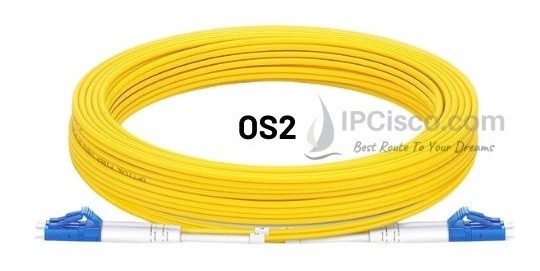
OS2 Single-Mode Fiber Cable
Multimode Fiber Optic Cables have a wide core diameter. It allows multiple angles of light waves. These types of fiber optic cables are mainly used for short distance. This distance can be up to 2km.
Multimode fiber optic cables have high bandwidth. They have high cable cost. But electronic cost is low for multimode fiber optic cables.
Multimode fiber optic cables use led or laser to transfer the data.
It is easy to terminate a multimode fiber optic cable if we compare it with single mode fiber optic termination.
Multimode fiber optic cables use different jacket colors like orange, aqua, green etc.
There are six types of Multimode Fiber cable. These multimode fiber optic types are:
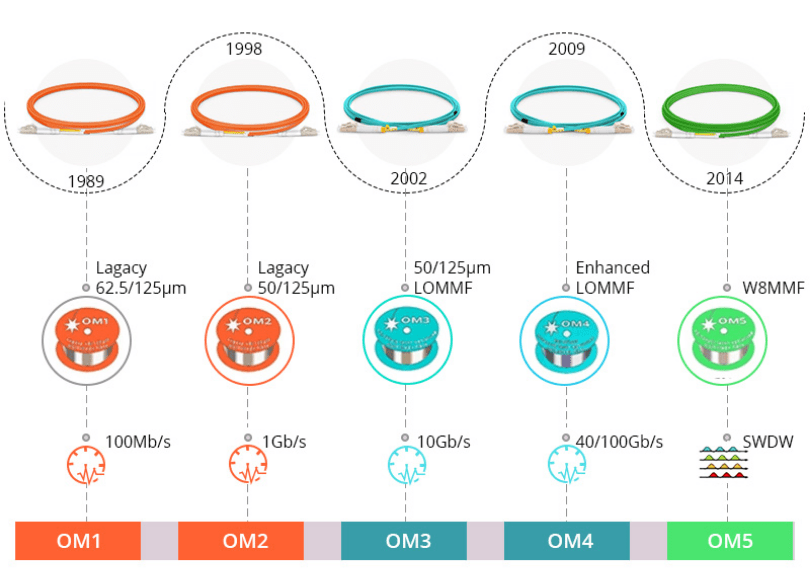
Multimode Fiber Cable Types (FDDI-Grade to OM5)
FDDI-Grade is the first one. It has orange jacket. The core size of this cable is 62.5 µm. It supports 10 Gigabit Ethernet up to 26 meters. It is widely deployed for LAN use. It is very old cable type. The physical view of this cable is also different.
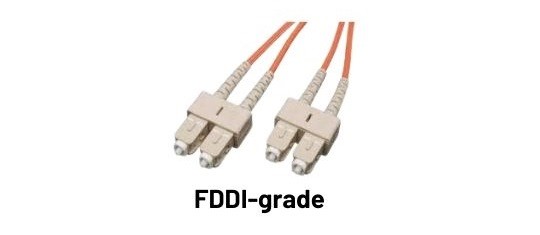
FDDI-Grade Multimode Fiber
OM1 (Optical Multimode 1) has also orange jacket. It uses a LED light source. The size of the core is again 62.5 µm. OM1 supports 10 Gigabit Ethernet up to 33 meters. It is commonly used for 100 Megabit Ethernet.
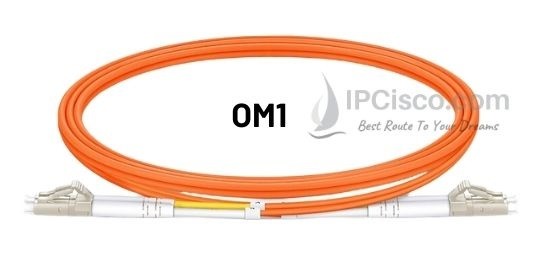
OM1 Multimode Fiber Cable
OM2 (Optical Multimode 2) has orange jacket too. It uses a LED light source. Here there is a smaller core. The size of the core is 50 µm. It supports 10 Gigabit Ethernet up to 82 meters. It is commonly used for 1 Gigabit Ethernet.
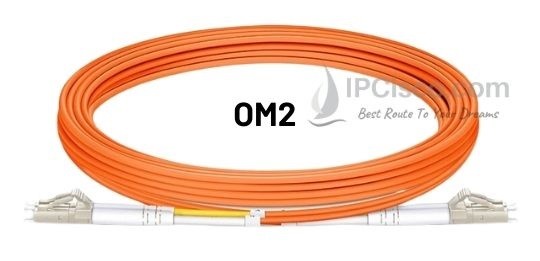
OM2 Multimode Fiber Cable
OM3 (Optical Multimode 3) is a different jacket color. Its jacket color is aqua. It uses a laser light source. The core size is similar to OM2. It is 50 µm. OM3 supports 10 Gigabit Ethernet up to 300 meters. It also supports 40 Gigabit & 100 Gigabit Ethernet up to 100 meters. It is commonly used for 10 Gigabit Ethernet.
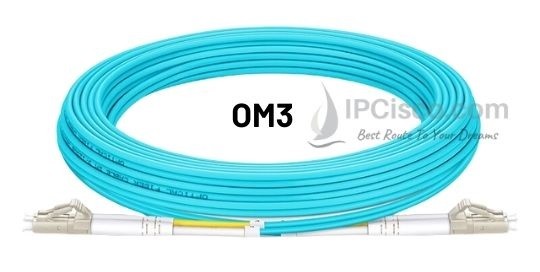
OM3 Multimode Fiber Cable
OM4 (Optical Multimode 4) has aqua jacket too. It is developed for VSCEL laser transmission. Its core size is 50 µm again. It supports 10 Gigabit Ethernet up to 550 meters and, 40 Gigabit & 100 Gigabit Ethernet up to 150 meters with MPO.
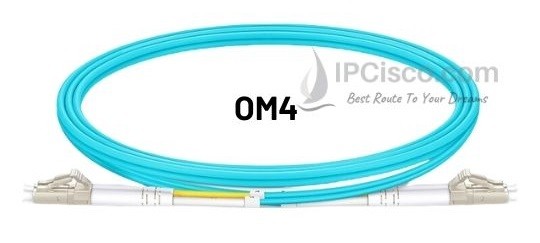
OM4 Multimode Fiber Cable
OM5 (Optical Multimode 5) is the latest multimode fiber technology for today. Here, the jacket color is changing again. OM5 has lime green jacket. It has 50 µm core size. OM5 is also known as WBMMF (Wideband Multimode Fiber). It supports at least 4 WDM channels at 28Gbps per channel through the 850-953 nm window.
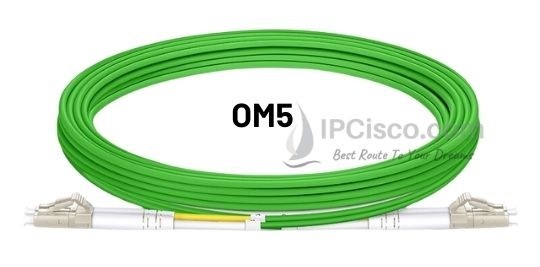
OM5 Wideband Multimode Fiber Cable
SFP is the abbreviation used for Small Form – Factor Pluggable. An SFP is a Hot-pluggable network interface module. This means that, you can connect these modules to the network device without turning of the device. There are various SFP types used in different devices and networks. And most of them are used for fiber optic cables.
Here, we have a fiber optic cable comparison table. With this table, you can compare the most common fiber optic cable types, including OS1, OS2, OM1, OM2, OM3, OM4 and OM5. The table below summarizes their core size, transmission distance, bandwidth and common networking applications to help you quickly understand the differences.
| Fiber Type | Mode | Core Size | Typical Distance | Common Use |
| OS1 | Single-Mode | 9 µm | Up to 10 km | Indoor backbones and campus networks |
| OS2 | Single-Mode | 9 µm | 40 km or more | Long-distance telecom and ISP networks |
| OM1 | Multimode | 62.5 µm | Up to 275 m at 1 Gbps | Legacy enterprise networks |
| OM2 | Multimode | 50 µm | Up to 550 m at 1 Gbps | Short enterprise links |
| OM3 | Multimode | 50 µm | Up to 300 m at 10 Gbps | Enterprise and data center networks |
| OM4 | Multimode | 50 µm | Up to 400 m at 10 Gbps | High-speed data centers |
| OM5 | Wideband Multimode | 50 µm | Depends on speed and transceiver | SWDM and modern data centers |
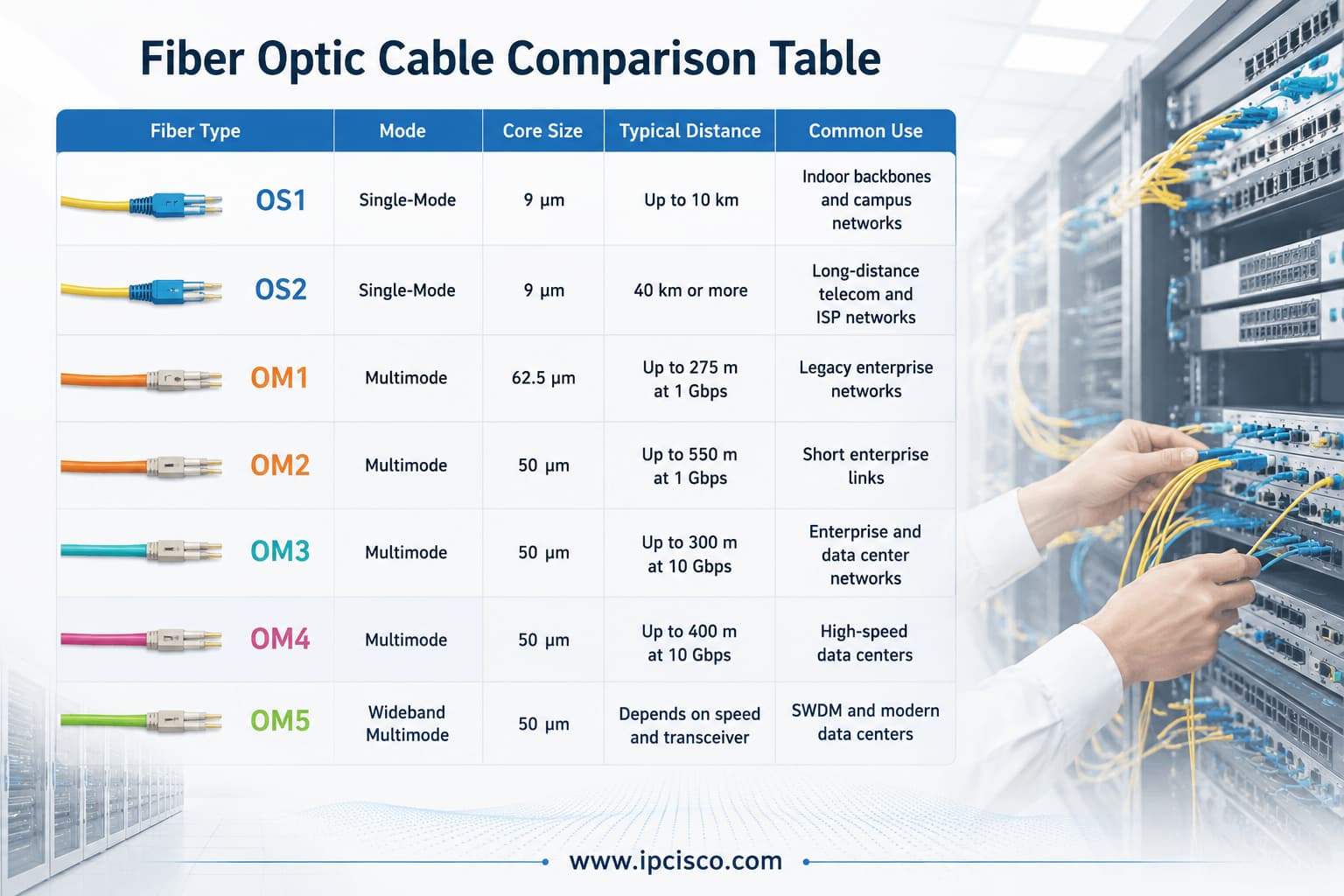
Fiber Optic Cable Comparison Table
Choosing the right fiber optic cable depends on factors such as transmission distance, bandwidth requirements, network environment and application. The fiber optic cable table below recommends the most suitable fiber type for common enterprise, campus, telecommunications and data center deployments.
| If You Need… | Recommended Fiber | Why? |
| Long-Distance Telecom or ISP Link | OS2 | Low attenuation and support for long transmission distances. |
| Indoor Single-Mode Backbone | OS1 or OS2 | Suitable for building and campus backbone connections. |
| Legacy Multimode Network | OM1 or OM2 | Compatible with older enterprise fiber installations. |
| 10 Gbps Enterprise Link | OM3 | Provides reliable 10 Gigabit Ethernet over moderate distances. |
| High-Speed Data Center Network | OM4 | Supports longer high-speed multimode links than OM3. |
| SWDM-Based Data Center Deployment | OM5 | Supports multiple shortwave wavelengths over one fiber. |
| Future Long-Distance Network | OS2 | Offers the best scalability for distance and bandwidth. |
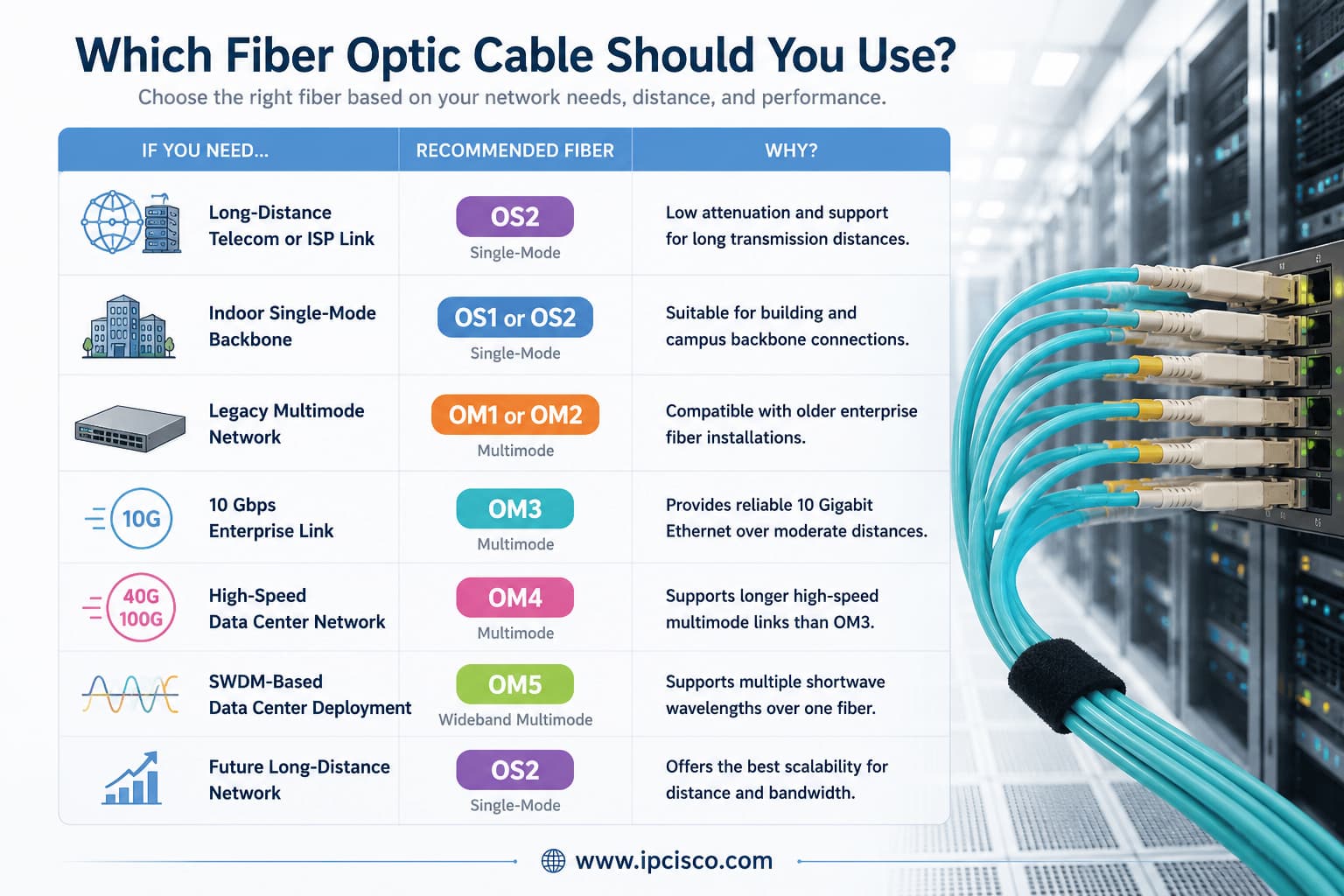
Which Fiber Optic Cable Should You Use?
Are you not sure which fiber optic cable is right for your network? Follow the simple decision guide below to select the most suitable fiber type based on transmission distance, network speed and deployment environment.
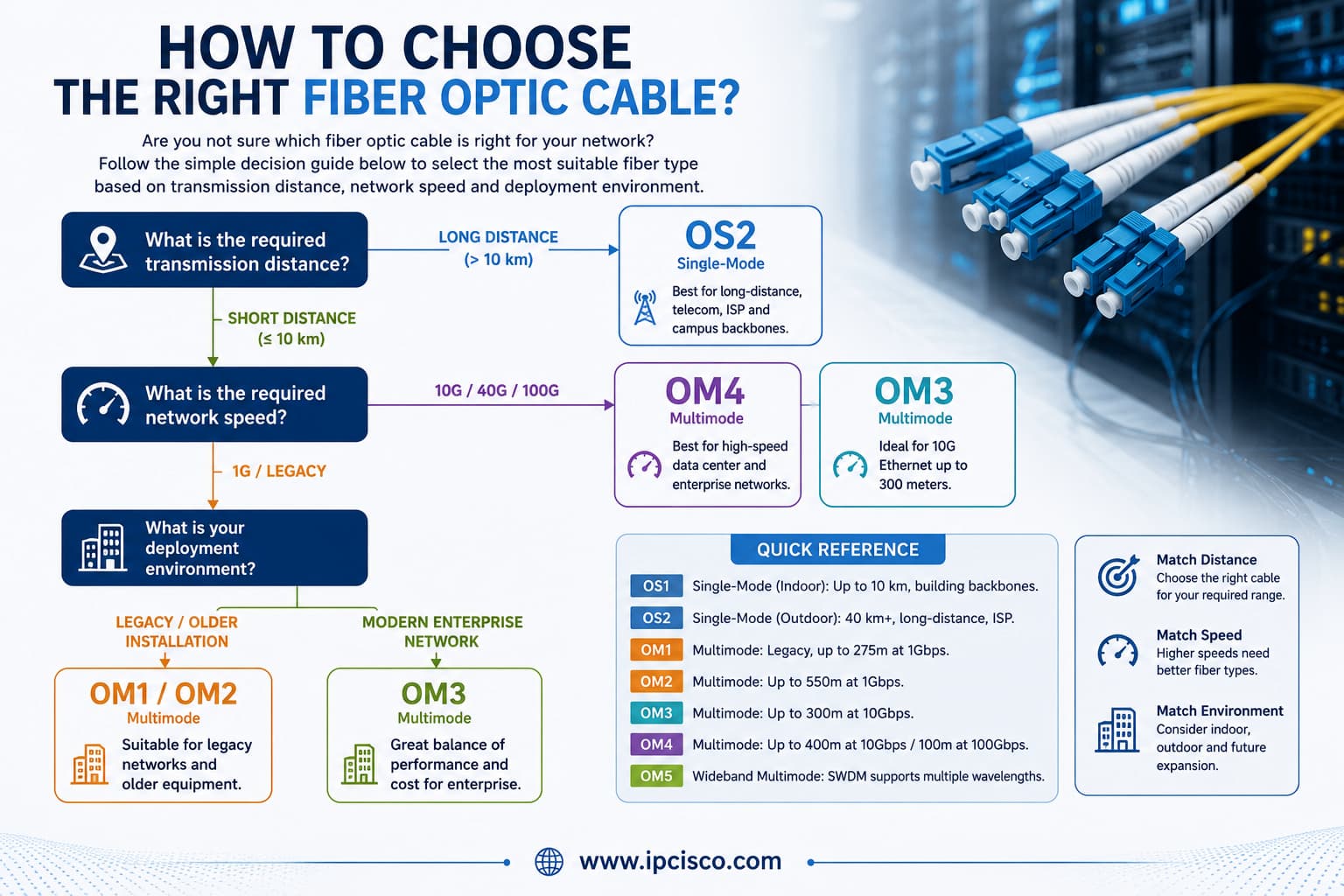
How to Choose the Right Fiber Optic Cable
This Fiber Optic Cable Cheat Sheet summarizes the most common single-mode and multimode fiber types, including OS1, OS2, OM1, OM2, OM3, OM4 and OM5. It provides a quick reference to core size, transmission distance, bandwidth and common applications. This is also a good reference for network technicians, network engineers and network students preparing for CCNA, CCNP, CCIE, Network+ and other network engineering certificitons.
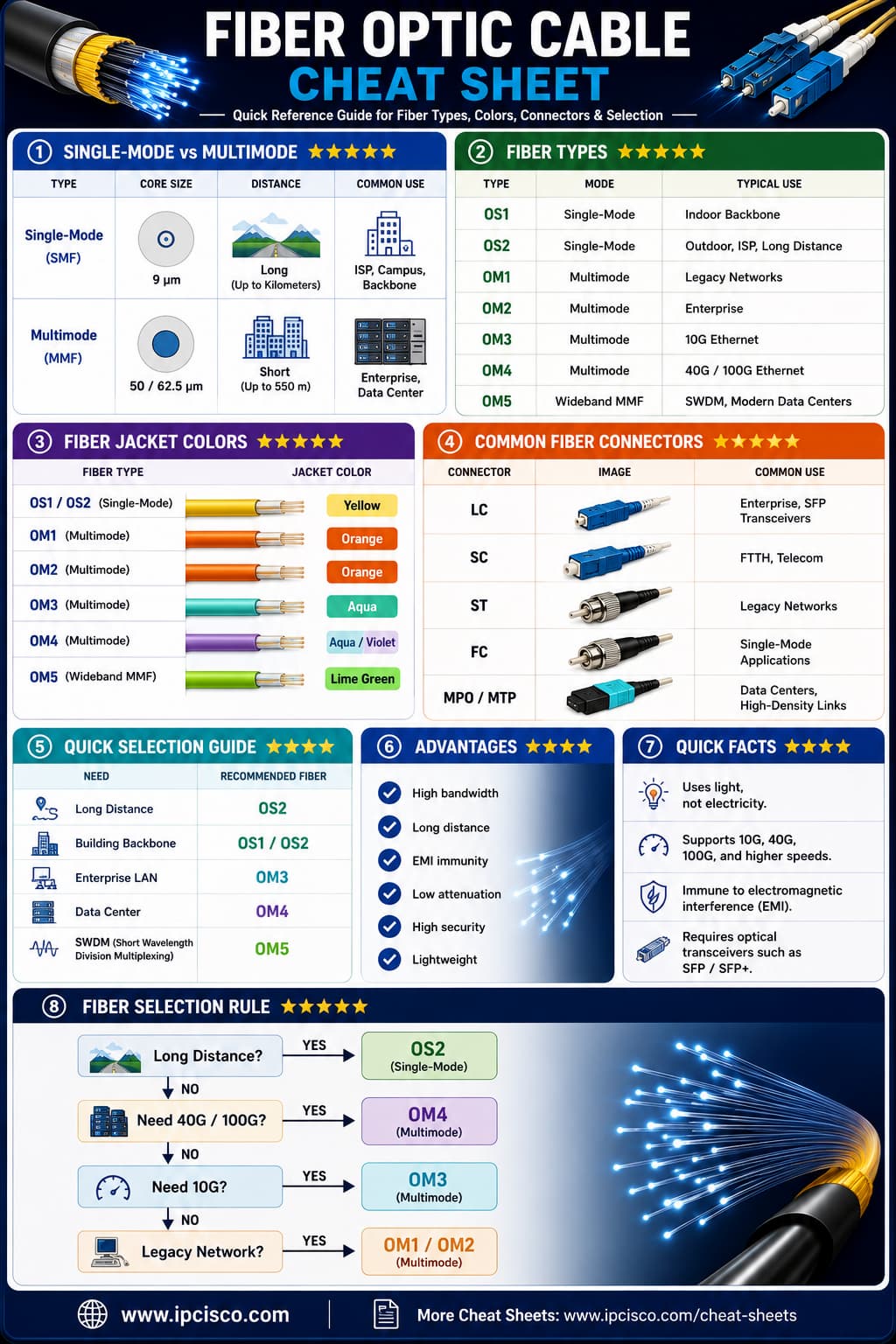
Fiber Optic Cable Cheat Sheet
Single-mode fiber (SMF) has a smaller core (around 9 µm) and carries a single light path, making it ideal for long-distance, high-bandwidth communication. Multimode fiber (MMF) has a larger core (50 µm or 62.5 µm), allowing multiple light paths and making it better suited for shorter distances such as enterprise networks and data centers.
OS1 and OS2 are both single-mode fiber types. OS1 is mainly designed for indoor installations, while OS2 has lower attenuation and is suitable for both indoor and outdoor deployments over much longer distances. OS2 is the preferred choice for modern backbone and long-haul fiber networks.
OM3, OM4 and OM5 are multimode fiber standards designed for high-speed Ethernet. Each of them are used for different purposes. OM3 supports 10 Gigabit Ethernet over moderate distances, OM4 extends transmission distance for 10G, 40G and 100G applications, while OM5 supports Shortwave Wavelength Division Multiplexing (SWDM) for higher-capacity data center networks.
The maximum transmission distance depends on the fiber type and network technology. Multimode fiber typically supports distances from a few hundred meters to around one kilometer. On the other hand, single-mode fiber can transmit data over several kilometers and even hundreds of kilometers with appropriate optical equipment. You should select your fiber type, according to your need and the distance.
Yes, but only within the manufacturer’s recommended minimum bend radius. Excessive bending can increase signal attenuation or permanently damage the optical fiber. This can reduce network performance and reliability.
Fiber optic cables transmit data using light instead of copper’s transmission which uses electrical signals. This allows significantly higher bandwidth, lower signal loss, longer transmission distances and complete immunity to electromagnetic interference (EMI). This advantages makes fiber optic ideal for modern high-speed networks.
No. Fiber optic cables transmit data as pulses of light rather than electrical signals. Because they do not conduct electricity, they are immune to electromagnetic interference and provide excellent electrical isolation in networking environments.
The LC (Lucent Connector) is the most commonly used fiber optic connector in modern networking. Its compact size, high port density and compatibility with SFP and SFP+ transceivers make it the preferred choice for enterprise networks, data centers and telecommunications. There are also other common connector types like SC, ST, FC and MPO/MTP.
Yes. Fiber optic cables can be spliced using either fusion splicing or mechanical splicing. Fusion splicing is the most common method for extending fiber links, repairing damaged cables or connecting long-distance fiber installations. Because, it provides lower signal loss and better long-term reliability.
Single-mode and multimode fibers can be identified by their cable markings and jacket colors. In many installations, yellow jackets indicate single-mode fiber, while orange, aqua or lime jackets are commonly used for multimode fiber. The fiber type is also printed on the cable as OS1/OS2 for single-mode or OM1–OM5 for multimode. You should verify the manufacturer’s labeling as best practice. Because, jacket colors may vary depending on local standards.
Fiber attenuation is the gradual reduction in optical signal strength as light travels through a fiber optic cable. It is typically measured in decibels per kilometer (dB/km). Lower attenuation means the signal can travel longer distances with less loss, making it one of the most important performance characteristics of fiber optic cables. Modern single-mode fibers generally have lower attenuation than multimode fibers, making them ideal for long-distance communication.
Signal loss is also known as attenuation in fiber optic cables. It is mainly caused by excessive cable bending, connector losses, splice losses, impurities in the fiber and dirty or damaged connectors. Using high-quality components, following the recommended bend radius and keeping connectors clean can significantly reduce signal loss and improve network performance.
Below, you can also watch Fiber Optic Video Lesson:

Gokhan Kosem is a Network Engineer, Instructor and the Founder of IPCisco.com with 15+ years of experience in Cisco, Nokia, Huawei, Juniper, Linux, Service Provider Networks, Routing and Switching technologies.
He has worked on the backbone networks of major service providers and network vendors including Nortel, Alcatel-Lucent (Nokia) and has extensive hands-on experience with Cisco, Huawei, Juniper and Nokia networking technologies.
He has trained thousands of networking students worldwide through IPCisco.com, Udemy, books, labs, quizzes, and educational content across multiple social media platforms.
IPCisco.com | Best Route to Your Dreams







Leave a Reply