
- COURSES
- SPECIALS
- BLOG
- MEMBERS
- SHOP
- BOOKSHELF
- ABOUT
- ENROLL HERE

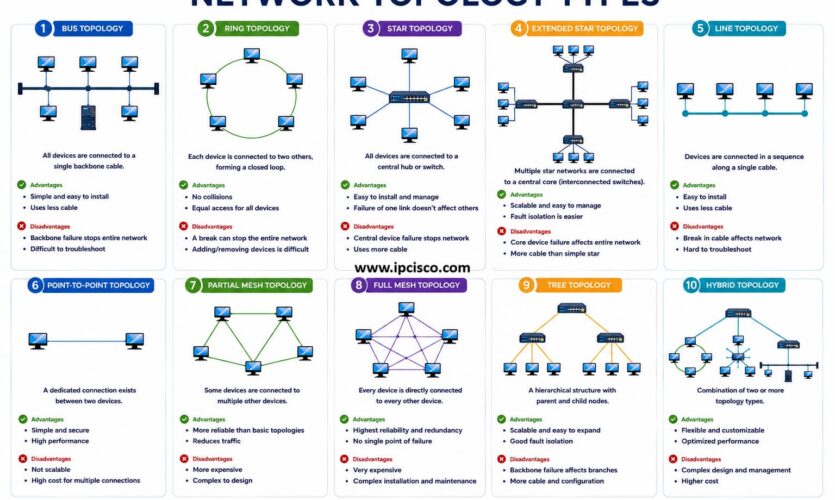
Table of Contents
Basically a network topology means that, connection style of the network nodes. To build a Network, we need a network topolog. There are different LAN Network Topologies that can be used for different network scenarios. Each network topology offers different advantages in terms of scalability, fault tolerance, cost and ease of management. Choosing the right topology is one of the most important decisions when designing reliable enterprise and data center networks. What are these Network Topologies?
These Network Topologies can be summarized like below :
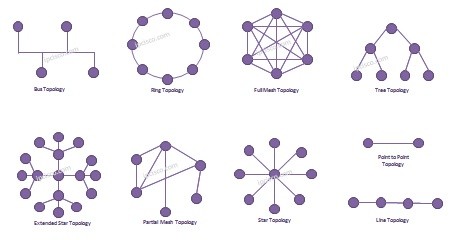
Common Network Topology Types
Each topology has unique characteristics, making it suitable for different network environments, from small office LANs to large enterprise and data center deployments.
Let’s check these topology types one by one.
You can test yourself with CCNA Practice Questions!
Bus Topology is the simplest LAN Network Topology. With Bus Topology, all the network nodes are connected to a common network media and only one node can receive and transmit data at a time.
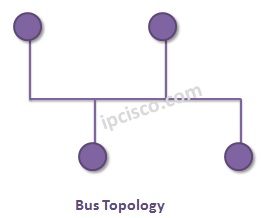
Bus Network Topology
Although Bus topology is rarely used in modern Ethernet networks, it remains an important concept for understanding the evolution of LAN technologies and CCNA networking fundamentals.
You can also watch Network Topologies Video Lesson below (Members Only)
Ring Topology is a little complex topology. All the nodes are connected on a medium and frames are travels through one direction. If a node wants to send data, then it adds to this frame. Ring topology can be used as two different rings. With two ring, each ring can transmit data in different directions. This provides also a redundancy mechanism.
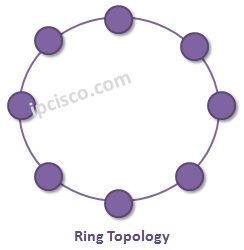
Ring Network Topology
Ring topology was widely used in technologies such as Token Ring and FDDI, although it has largely been replaced by Ethernet-based star networks.
Star Topology is the topology that all the other nodes are connected to a central node. This is a widely used topology but it has a disadvantage that if the central device fails, the other nodes can not communicate.
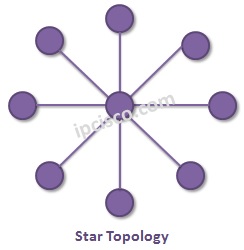
Star Network Topology
Today, Star topology is the standard physical topology for almost all modern Ethernet LANs because it is easy to expand, manage and troubleshoot.
There is also an extended version of Star Topology called Extended Star. In this topology, there are end nodes and sub end nodes. All the sub end nodes are connected to end nodes. And they are conected to the central node.
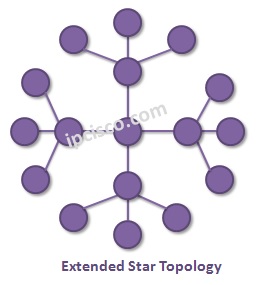
Extended Star Topology
Extended Star topology is commonly used in enterprise buildings, campuses and data centers where multiple access switches are connected to distribution or core switches.
You can test yourself with CCNA Practice Questions!
Line topology is the topology that all the nodes are connected orderly. Although rarely deployed as a dedicated LAN topology, line topology can be found in simple industrial, sensor and serial communication networks.
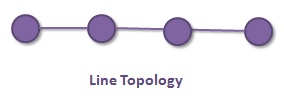
Line Network Topology
Poin-to-Point Topology is as its name imlies, the topology that connect node to the node. This is one connection and a very widely used topology type.
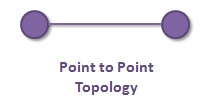
Point-to-Point Topology
Point-to-Point topology is one of the most common connection types in networking and is frequently used for WAN links, leased lines and router-to-router connections.
Partial Mesh Topology consist of mesh and point-to-point connections. In this topology, some nodes can be full mesh each other, others can be point to point.
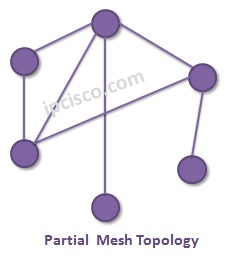
Partial Mesh Topology
Partial Mesh provides a balance between redundancy and cost by connecting only critical network devices with multiple paths.
What is Full Mesh Topology?
Full Mesh Topology is the most redundant topology. All the nodes are connected eachother in this topology. So, during a network failure in one link, the connection continu through other links. There must be N * (N-1)/2 connections for Full Mesh connections.
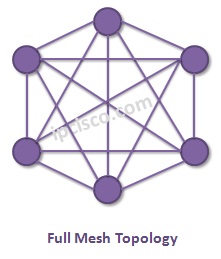
Full Mesh Topology
Because every device has a direct connection to every other device, Full Mesh offers the highest level of redundancy and fault tolerance among all network topology types.
Tree Topology, in other words Hierarhical Topology is consist of a central device and the sub central devices under it. All the Sub central devices are connected to central devices. And the other nodes are connected hierarchicaly below these devices as tree leaves.
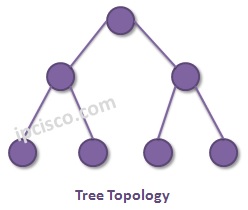
Tree Network Topology
Beside these topologies, we can also talk about an unvisible topology that is used by Wireless Networks. In such wireless networks, there is no need for physical cables. They communicate with Radio Frequencies (RF) and Infrared Waves (IR).
Tree topology is widely used in enterprise campus networks where access, distribution and core layers are organized in a hierarchical structure.
A hybrid network topology is a combination of two or more different network topology types to enhance performance, redundancy and scalability. Here the strengths of multiple topologies are integrated in a single topology. Data centers and large scale networks use this technology mostly. Modern enterprise networks often combine multiple topology types to improve performance, scalability, availability, and fault tolerance while optimizing deployment costs.
There are different hybrid network topologies. Below, you can find dome of these options:
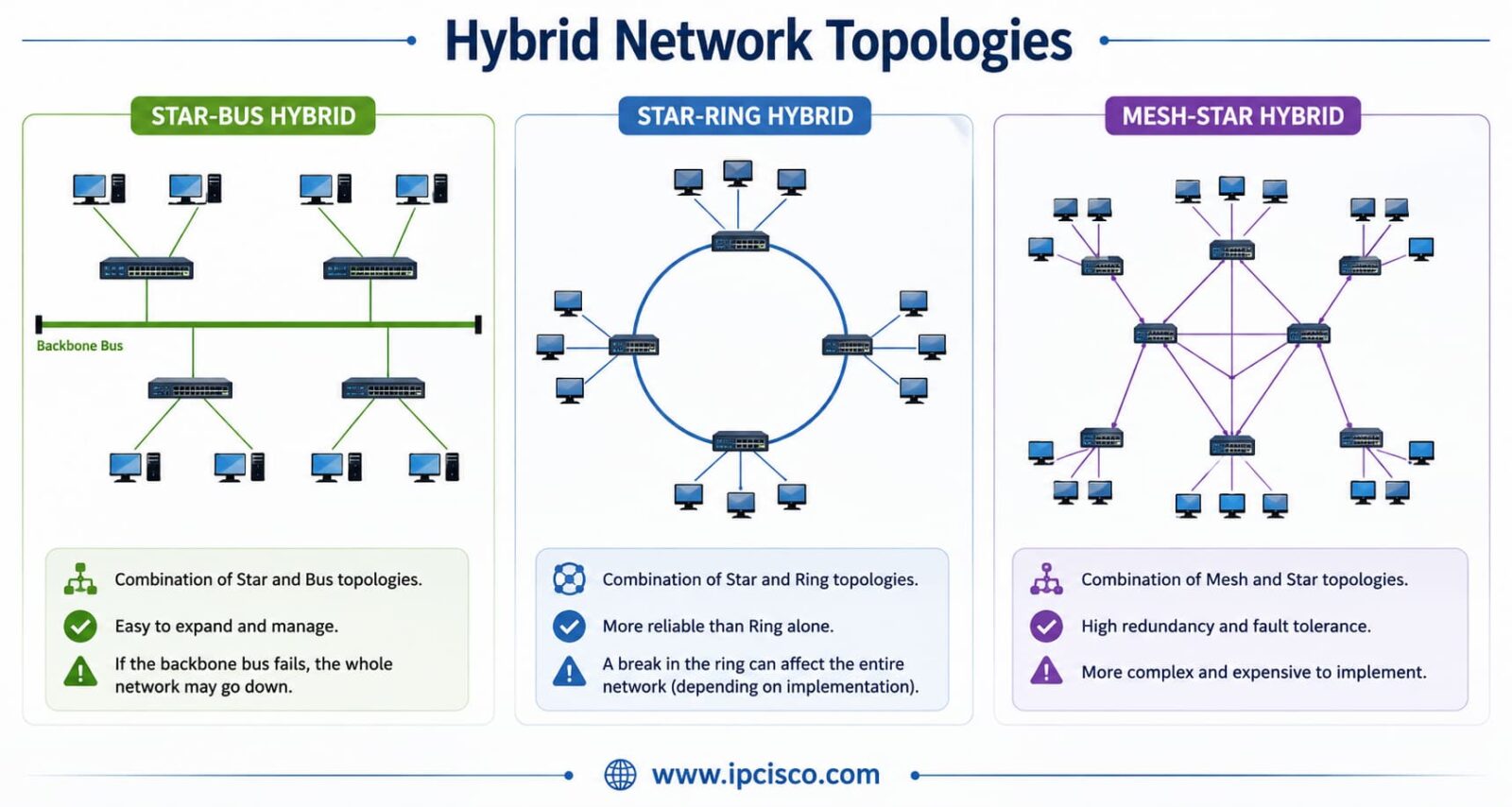
Common Hybrid Network Topologies
In Star-Bus Hybrid, multiple star networks connected via a central bus. Here each department has its own star setup which is connected to a main backbone.
In Star-Ring Hybrid, star topologies are connected in a ring. This solution provides better fault tolerance and communication between clusters.
In Mesh-Star Hybrid, critical devices use redundant mesh connections, less critical nodes use star topology. This is common in data centers and financial institutions that has critical traffic.
Different topologies has different advantages and disadvantages. Below, you can find a comparison table for different network topology types. In this table, we will compare start topology, mesh topology, bus topology, ring topology, hybrid topology and tree topology. Understanding the strengths and weaknesses of each topology helps network engineers select the most suitable design for different business and technical requirements.
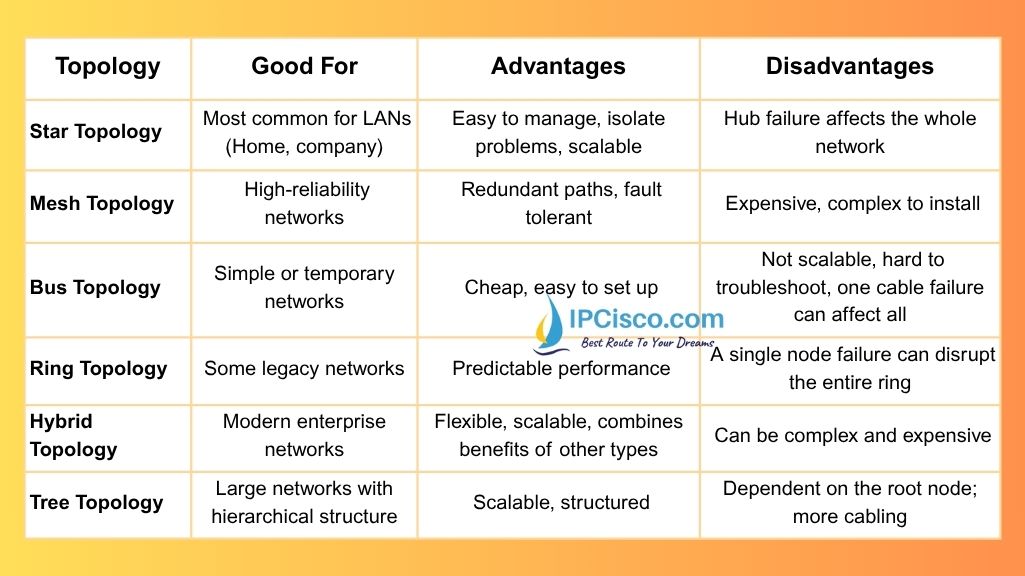
Basic Comprison Table for Network Topologies
Star topology is the most common choice for LANs. It is easy to manage, isolate problems and scalable. But if the main hub fails, whole network fails.
Mesh Topology is used in high-reliable networks especially for milltary networks. They are redundant and fault tolerant. But these network types are expensive and complex to install.
Bus topology is a temporary solution for temporary and simple networks. They are cheap and east to set up networks. They are not scalable, hard to troubleshoot, one cable failure can affect all the network, because there is only one common cable.
Ring topology is good for some legacy networks. Their performance is predictable. Here, a single node failure can disrupt the entire ring.
Hybrid Topology is good for modern enterprise networks. They are flexible, scalable, combines benefits of other types. These network types can be complex and expensive.
Tree Topology is good for large networks with hierarchical structure. They are scalable, structured. They are dependent on the root node and need more cabling.
In the below comparison table, we will compare the most common network topology types, including Bus, Ring, Star, Extended Star, Line, Point-to-Point, Partial Mesh, Full Mesh, Tree and Hybrid topologies. This network topology table will summarizes their structure, advantages, disadvantages, scalability, fault tolerance and common networking applications, helping you quickly compare each topology and choose the right one for your network.
| Topology | Scalability | Fault Tolerance | Cost | Common Use |
| Bus | Low | Low | Low | Small / Legacy LANs |
| Ring | Medium | Medium | Medium | Legacy Networks |
| Star | High | Medium | Medium | Enterprise LANs |
| Extended Star | Very High | High | Medium | Campus Networks |
| Line | Low | Low | Low | Simple Networks |
| Point-to-Point | Low | High | Low | WAN Links |
| Partial Mesh | High | High | High | Enterprise Networks |
| Full Mesh | Medium | Very High | Very High | Mission-Critical Networks |
| Tree | Very High | Medium | Medium | Large Organizations |
| Hybrid | Very High | High | High | Modern Enterprise Networks |
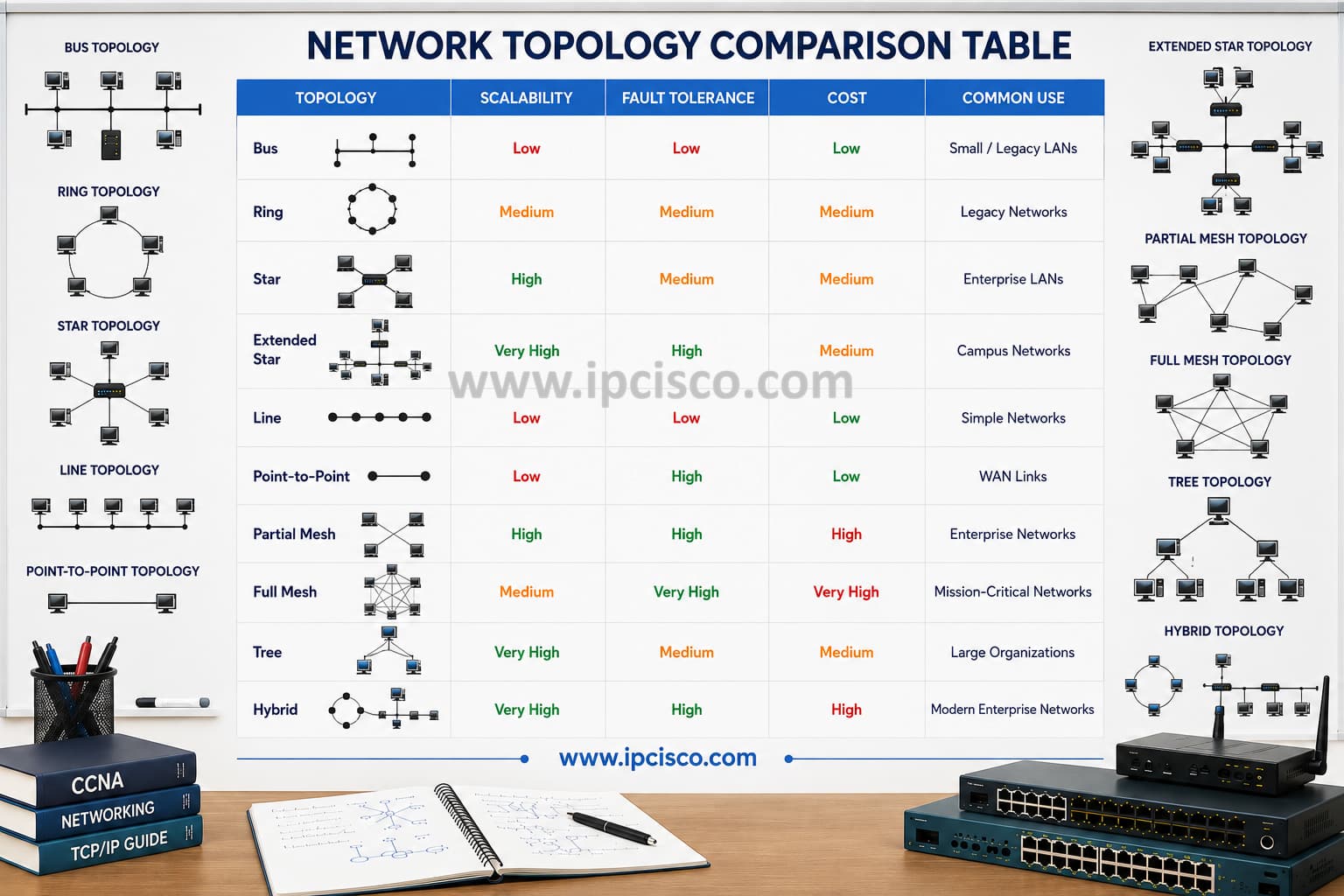
Network Topology Comparison Table
Choosing the right network topology depends on your network size, scalability requirements, redundancy needs, budget and ease of management. The table below recommends the most suitable network topology for common enterprise, campus, branch office and data center deployments.
| If You Need… | Recommended Topology | Why? |
| Simple and Low-Cost Network | Bus | Easy to deploy with minimal hardware. |
| Small Office LAN | Star | Easy to manage and troubleshoot. |
| Large Enterprise or Campus Network | Extended Star | Highly scalable and easy to expand. |
| Direct Device-to-Device Connection | Point-to-Point | Simple, fast, and reliable communication. |
| Highly Available Enterprise Network | Partial Mesh | Provides redundancy without the cost of full mesh. |
| Maximum Redundancy | Full Mesh | No single point of failure. |
| Hierarchical Organization | Tree | Ideal for structured, multi-level networks. |
| Modern Data Center or Enterprise | Hybrid | Combines the strengths of multiple topologies. |
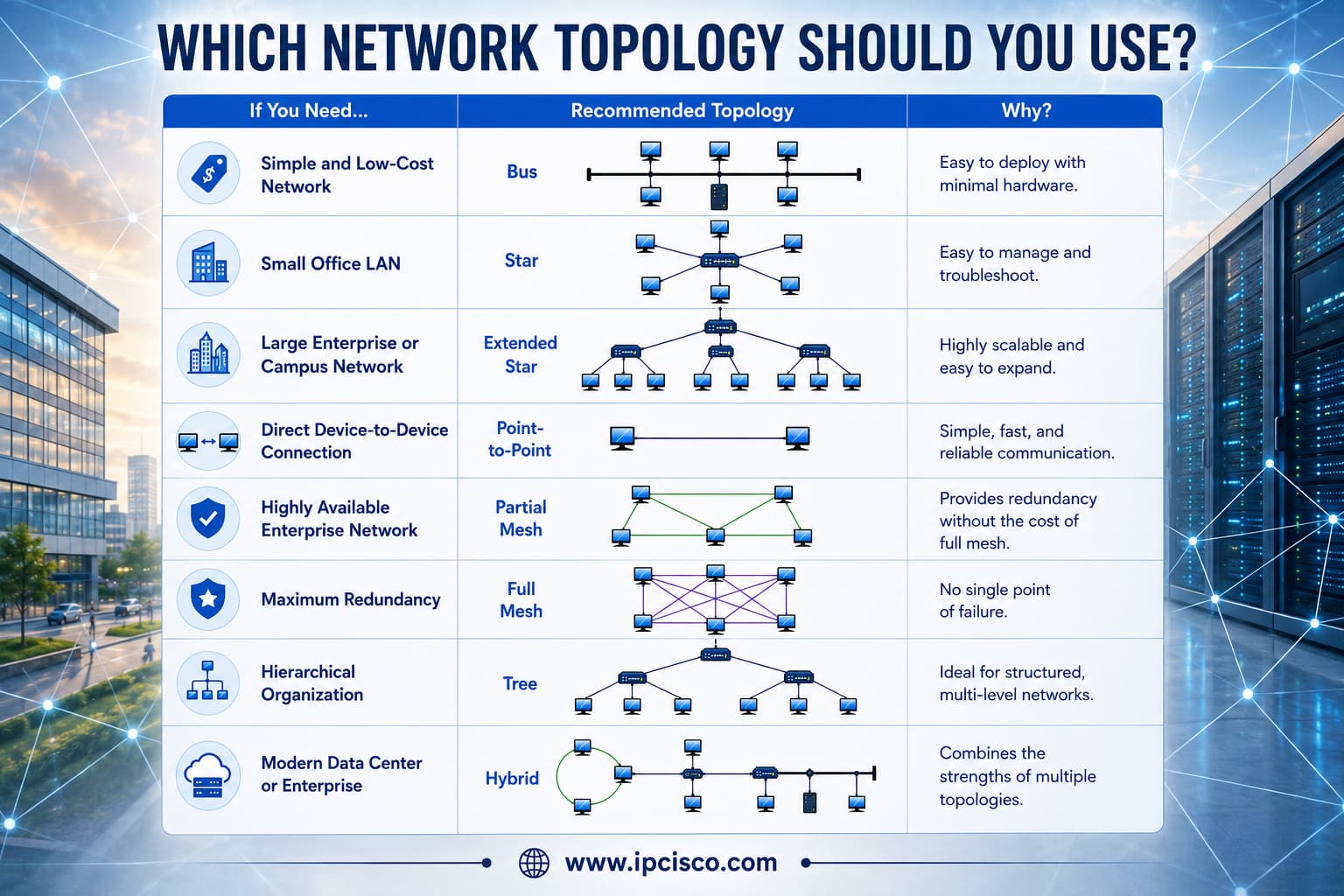
Which Network Topology Should You Use?
Are you not sure which network topology is best for your environment? Follow the simple decision guide below to choose the most suitable network topology based on network size, redundancy requirements, scalability and deployment scenario.
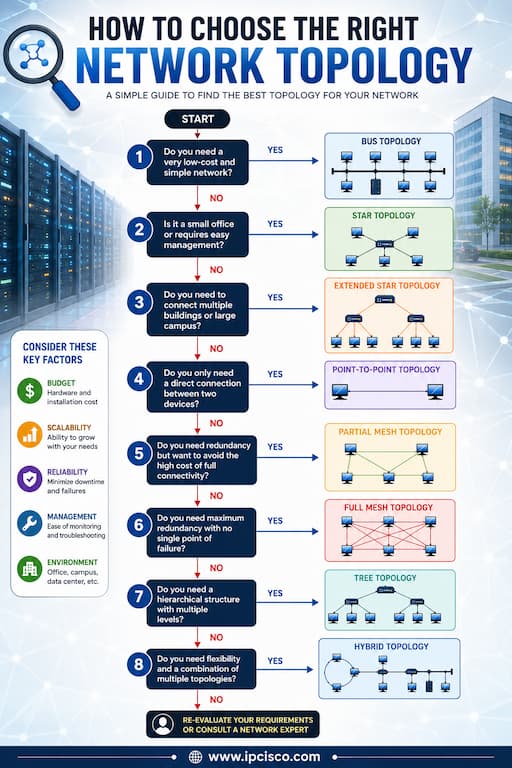
How to Choose the Right Network Topology?
This Network Topology Cheat Sheet summarizes the most common network topology types, including Bus, Ring, Star, Extended Star, Line, Point-to-Point, Partial Mesh, Full Mesh, Tree and Hybrid topologies. It provides a quick reference especially for network certificaiton studies like CCNA, CCNP and CCIE. You can Download this Cheat Sheet with High Quality on Cheat Sheets page.
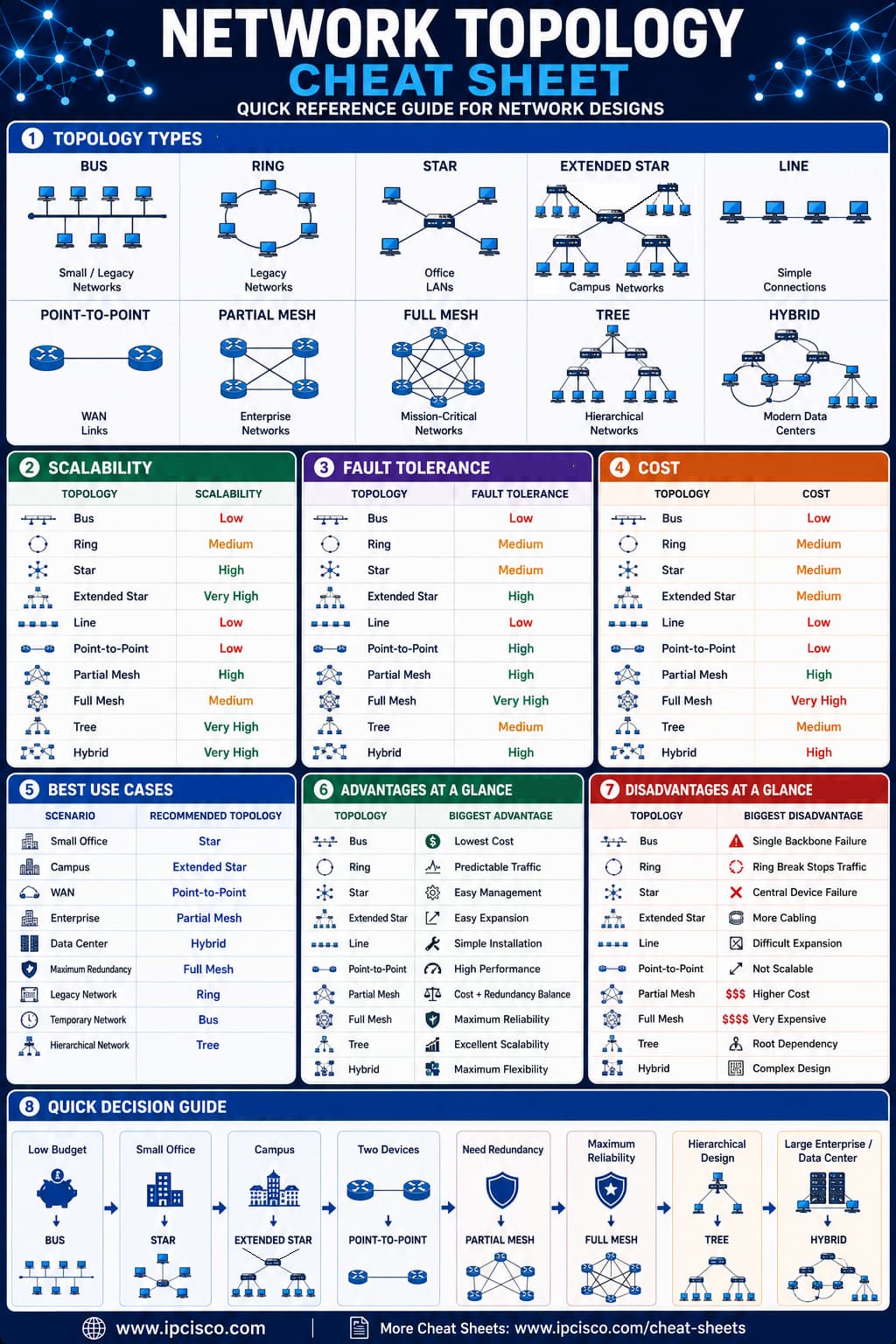
Network Topology Cheat Sheet
Star Topology is the best option for small and medium networks.
Hybrid Topology is the most flexible and scalable network type for large networks.
Full Mesh Topology is the network topology that provides the highest redundancy and fault tolerance.
In Bus Topology all the devices are connected to a single cable. The failure of this single cable affects whole network. It is a single point of failure.
Single Point of Failure (SPOF) is a component within a system whose failure causes the entire system to stop working, resulting in, downtime and data loss.
In a traditional ring topology, data moves in a single direction (unidirectional), passing through each node until it reaches the destination. However, in modern implementations like dual-ring or advanced ring networks, data can travel in both directions, improving redundancy and fault tolerance.
Star topology is the most popular LAN topology used today. In a star topology, every device connects to a central switch, making the network easy to install, troubleshoot, expand and manage. Almost all modern Ethernet LANs in homes, offices, campuses, and enterprises use a physical star topology.
Extended Star, Tree and Hybrid topologies are considered the most scalable network topologies. They allow new switches, devices and network segments to be added easily without significantly affecting the existing network infrastructure.
No. Ethernet is a networking technology and protocol, not a topology. Ethernet defines how data is transmitted over a network, while a topology describes how network devices are physically or logically connected. Modern Ethernet networks typically use a physical Star topology.
No. Wi-Fi is a wireless networking technology, not a topology. Wireless networks generally use an infrastructure model where wireless clients connect to an access point, which resembles a logical Star topology.
There is no single best topology for every large business. Most enterprises use Extended Star, Tree or Hybrid topologies because they provide excellent scalability, easier management, redundancy and support for campus and multi-building networks. Critical network segments may also use Partial Mesh or Full Mesh connections to improve fault tolerance.

Gokhan Kosem is a Network Engineer, Instructor and the Founder of IPCisco.com with 15+ years of experience in Cisco, Nokia, Huawei, Juniper, Linux, Service Provider Networks, Routing and Switching technologies.
He has worked on the backbone networks of major service providers and network vendors including Nortel, Alcatel-Lucent (Nokia) and has extensive hands-on experience with Cisco, Huawei, Juniper and Nokia networking technologies.
He has trained thousands of networking students worldwide through IPCisco.com, Udemy, books, labs, quizzes, and educational content across multiple social media platforms.
IPCisco.com | Best Route to Your Dreams






Leave a Reply