
- COURSES
- SPECIALS
- BLOG
- MEMBERS
- SHOP
- ABOUT
- ENROLL HERE


Table of Contents
Multifactor Authentication (MFA) is a security mechanism that requires users to verify their identity using two or more authentication factors. These factors can include passwords, biometrics, mobile devices, or security tokens. MFA improves cyber security by reducing unauthorized access risks and adding additional protection layers. As you know password are one of the most used security mechanisms to secure a device. We use different types of password to secure our systems. But passwords are vulnerable to attacks in todays network world. There must be additional security mechanisms. Multifactor Authentication is used for this purpose.
There are different mechanisms used for Multifactor Authentication. And Multifactor Authentication combines two or more of these mechanisms. These mechanims are given below:
With Multifactor authentication methods, different platforms involve to this network security job. For example, mobile phones or emails can be used for this authentication. A text message or an email can be sent to the user whenever he tries to login to the device. With this second step, emails and message can contain the access code. This mechanism is widely used in many areas today.
Beside using additional device, our body can also be used to identify and authenticate us. As you know, human body has identical parts like voice, fingerprints, retinas etc. By checking such biometric information, users can authenticate.
To Test Yourself , You Can Visit All Network Quizes and CCNA Practice Tests.
Multifactor Authentication is an additional barrier towards any attacker. With the traditional password security mechanism are not enough to secure our networks in today’s world. There are different vulnerabilities of this password protection.
As you know user information is stored in authentication databases. In other words, there are username and password lists in authentication servers. Storing all this information is not safe because if someone can reach these credentials, they can easily use these user credentials and access the systems. This is one of the vulnerabilities of this traditional password protection.

Another vulnerability of password protection is about password strings. Before, we were using weak passwords to access the network devices. Then, we have started to use strong passwords. These strong passwords can be enough to avoid any brute force attacks. But CPU capacities are increasing rapidly and this gives more capacity to brute force attacks. So, attackers can try millions of passwords per second.
Multifactor Authentication helps us to overcome these weaknesses. We can add additional security barriers beside password protection and by doing this, we can defend our network devices better.
Multifactor Authentication Factor is the category of the credentials that can be checked during authentication. So, what are the Multifactor Authentication Factors?
These Factors are given below:
Knowledge Factors are the factors related with user knowledge. This can be user password, security questions, security shape etc.
Possession Factors are the factors related with additional platforms. This can be a smart phone, your email, SMS etc. A second code is sent to one of these platforms.
Inherence Factors are the factors related with the body. This can be fingerprints, retina, iris, voice etc. With these identical parts, user can authenticate.
Location Factors are the factors related with your location. Location is determined by GPS. This allows authentication in specific locations.
Time Factors are the factors related with the access time. This allows authentication in specific times.
Many people use MFA and 2FA interchangeably, but they are not exactly the same thing. Two-Factor Authentication (2FA) is a security method that uses exactly two authentication factors during the login process. For example, entering a password and then confirming a code sent to your mobile phone is a common 2FA example.
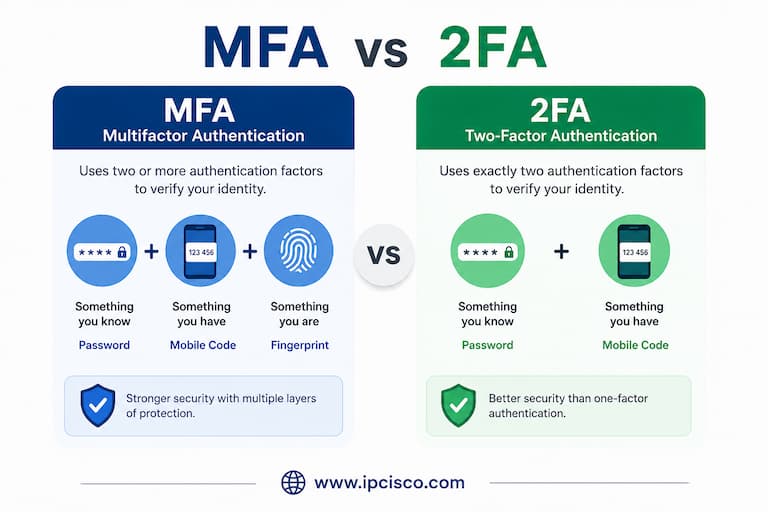
Multifactor Authentication (MFA) versus Two-Factor Authentication (2FA)
On the other hand, Multifactor Authentication (MFA), is a broader authentication approach. MFA can use two or more authentication factors to verify the identity of the user. In other words, 2FA is actually a subset of MFA. Today, both MFA and 2FA are widely used to improve cyber security and protect systems against unauthorized access.
Multifactor Authentication (MFA) is a security mechanism that requires users to verify their identity using two or more authentication factors. These factors can include passwords, mobile devices, biometric verification or security tokens.
MFA is important because passwords alone are no longer sufficient against modern cyber attacks. Multifactor Authentication adds additional security layers and helps prevent unauthorized access.
The main Multifactor Authentication factors are given below:
Two-Factor Authentication (2FA) uses exactly two authentication methods, while Multifactor Authentication (MFA) can use two or more authentication factors. In other words, 2FA is a subset of MFA.
Yes, Multifactor Authentication significantly improves security by adding extra verification steps. Even if a password is stolen, attackers usually cannot access the system without the additional authentication factor.
Common MFA examples are given below:
MFA is commonly used in Enterprise networks, VPN connections, Cloud platforms, Online banking, Email services, Social media accounts and Cyber security systems.






Good explaining
Thank you Amine:)