
- COURSES
- SPECIALS
- BLOG
- MEMBERS
- SHOP
- BOOKSHELF
- ABOUT
- ENROLL HERE

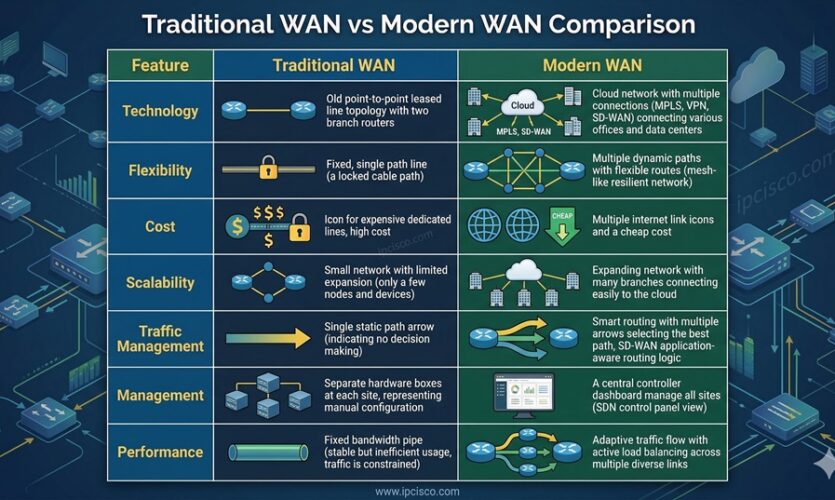
Table of Contents
WAN Technology (Wide Area Network) is the network that connects the geographical far areas. It can be used for a client to connect to the corporate network, connections between the branch offices of a company and similar wide area connections etc. There are other smaller network types like MAN, CAN, LAN, PAN and BAN. We will talk about these technologies in the other lessons detailly. Here, we will focsu on what is WAN and what is basic WAN technolocgies.
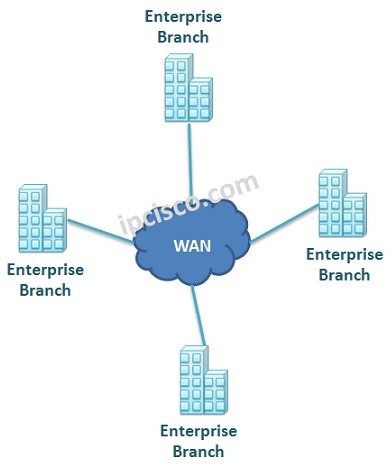
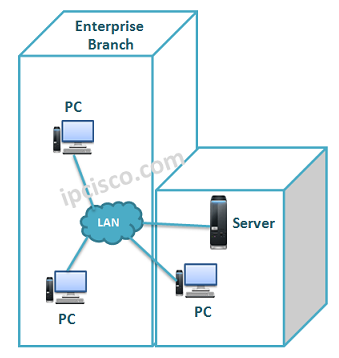
As a reminder, Local Area Network (LAN) is the smaller network. And we can simply say that, each Enterprise Branch has one more Local Area Networks (LAN).
WAN Technology and the related protocols operates at the bottom two layer (Physical and Data-Link) of OSI Model. The Physical Layer determines the connections, The Data-Link Layer provides the Encapsulated transmission. The protocols used in Data-Link for WAN are HDLC, PPP,Frame-Relay, ATM etc. We will talke about these protocols detailly in other lessons.
Serial WAN communication is divided into two groups. These are :
Syncronous Communication is the communication that uses shared clocks (timing). Sender and receiver are syncronized with this clock. It is faster and less overheaded transfer method. A block of characters are sent at a time.
Asynronous Communication are the communication that do not use timing. Sender and Receiver is not synronized. It uses uses start and stop bits for each data unit. One character is sent at a time.
Serial interfaces can be DTE (Data Terminal Equipment) or DCE (Data Communications Equipment). DCE provides clocking and converts user data into the service provider’s format. CSU/DSU is an exmple of DCE. DTE needs a DCE for clocking.
There are several WAN Protocols that are used between different locations of different networks. These protocols are:
HDLC (High-Level Data Link Control) is a layer 2 WAN Encapsulation Protocol that is used on syncronous data links. It is the simplest WAN Protocol that can connect your remote offices over leased lines. It has both industry standard and Cisco proprietary version.
PPP (Point to Point Protocol) is also a WAN Encapsulation Protocol that is based on HDLC but we can say that PPP is the enhanced version of HDLC. There are many additional features in PPP like Authentication, Multilink support, Error Detection, Quality Check.
Frame Relay is another L2 Protocol. It is based on X.25 and provide Virtual Circuit based conenctions. Frame Relay was popular before, but nowadays it is rarely used.
ATM (Asyncronous Transfer Mode) is a cell based Layer 2 WAN Protocol. It is used with hicgh speed transmission media like T3,E3 and SONET.
In other lessons, we will also talk about these WAN Protocols more.
WANs (Wide Area Network) has three common different types of services. These WAN Services are:
These WAN Services provide different advantages to the customer. Let’s cehck these WAN service types one by one.
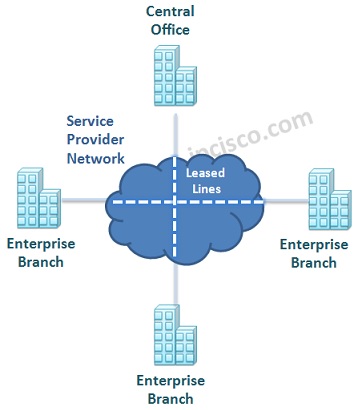
Leased Lines are the point to point deticated lines that is provided by a service provider to the customer. With this lines, customer has its own lines and they can conenct their networks with this leased lines . But this is a little expensive and costly for customer.
Circuit-Switched Networks provide a dedicated circuit path to the customer. PSTN and ISDN can be an example of Circuit-Switched Networks.

Packet-Switched Networks a dedicated Virtual Circuit path to the customer. IP/MPLS can be a very good exampe for Packet-Switched Networks.

Here, we have talked about WAN technology and the WAN protocols.
We have talked about legacy WAN protocols and technologies. Now, let’s focus on mdoern WAN technoogies and concepets mostly used in today’s networks. These modern WAN technologies are MPLS (Multiprotocol Label Switching), VPN (Virtual Private Network) and SD-WAN (Software-Defined Wide Area Network). Let’s learn what are these modern wan technologies one by one.
MPLS (Multiprotocol Label Switching) is a WAN technology that forwards data using labels instead of traditional IP routing. MPLS is a layer 2,5 protocol which works between layer 2 and layer 3 of OSI model. With MPLS, we can use MPLS Traffic Engineering for better performance, critical applications. It is a technology that is used by Internet Service Providers (ISPs) to provide reliable, low-latency and high-priority network services.
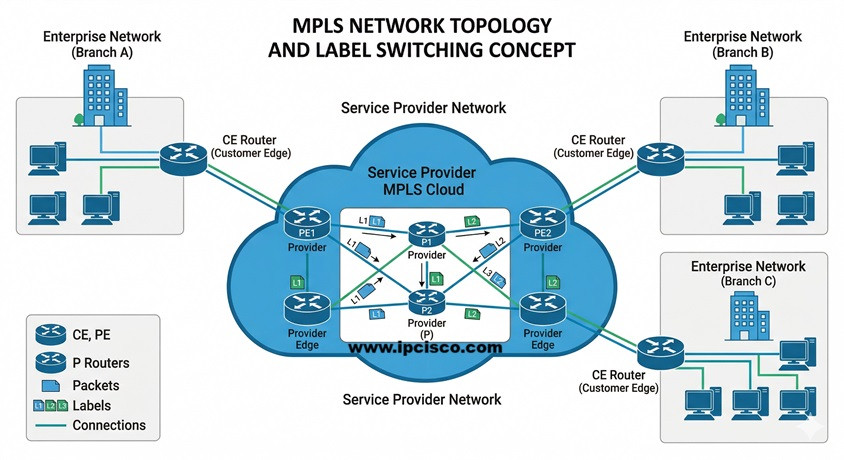
Basic MPLS Topology Example
VPN (Virtual Private Network) is a technology that creates a secure, encrypted tunnel over the internet to connect users or networks. VPN is commonly used for remote access and site-to-site connectivity which ensure data privacy and security. There are different VPN types. Popular VPN types are IPSec VPN and SSL VPN. Both of these VPN types are widely used in modern network infrastructures. To check other VPN types you can check VPN Types Lesson.
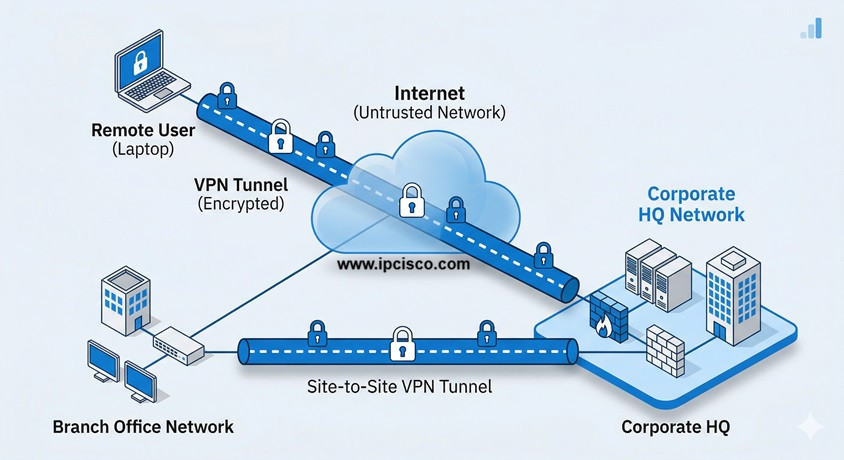
Basic VPN Topology Example
SD-WAN (Software-Defined Wide Area Network) is a modern WAN solution that uses software to intelligently manage and route traffic across multiple connections such as MPLS, broadband and LTE (Long Term Evolution). SD-WAN provides application-aware routing, centralized management and cost optimization, making it a preferred choice for organizations looking for flexibility and scalability in their networks.
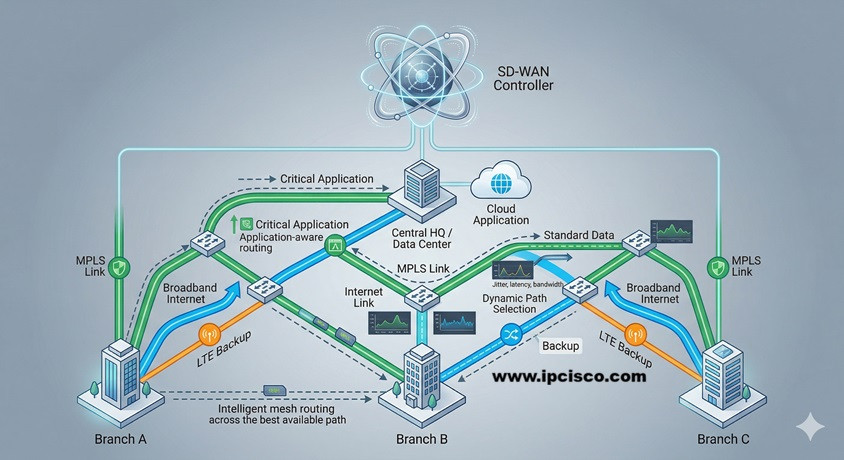
Basic SD-WAN Topology Example
Traditional (legacy) WAN technologies and modern WAN technologies has some common differences. Here, we will focus on these differences. First of all, traditional WAN architectures rely on fixed, hardware-based technologies such as leased lines, Frame Relay and ATM. Here, the traffic is often carried over dedicated or rigidly managed paths. These legacy networks are typically expensive, less flexible and harder to scale as organizations grow.
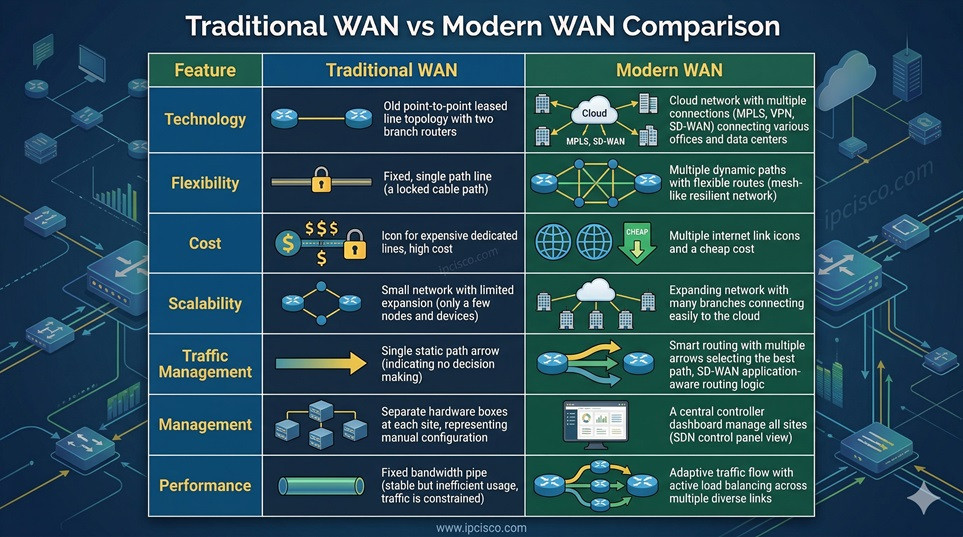
Traditional WAN Versus Modern WAN
On the other hand, Modern WAN Solutions like MPLS, VPN and SD-WAN are designed to be more flexible, cost-efficient and application-aware. They leverage multiple transport options such as broadband, fiber and LTE, while enabling centralized control and intelligent traffic routing.
Taking all things into account, currently used Modern WANs provide better performance, improved scalability and easier management compared to traditional WAN infrastructures.
Below, you can find a detailed Comparison Table for Traditional WAN and Modern WAN.
| Feature | Traditional WAN | Modern WAN |
|---|---|---|
| Technology | Leased Lines, Frame Relay, ATM, HDLC | MPLS, VPN, SD-WAN, Broadband, LTE |
| Flexibility | Low flexibility, rigid structure | Highly flexible and software-defined |
| Cost | High cost due to dedicated links | More cost-efficient using internet links |
| Scalability | Difficult and slow to scale | Easy and fast to scale |
| Traffic Management | Static routing, limited optimization | Dynamic, application-aware routing |
| Management | Decentralized and hardware-based | Centralized, software-defined control |
| Performance | Predictable but inefficient utilization | Optimized and adaptive performance |
LAN (Local Area Network) covers a small area like a home or office only. On the other hand, WAN (Wide Area Network) connects multiple LANs over long distances and geographiacl areas using ISPs (Internet Service Providers).
There are various WAN technologies. The Common WAN technologies include Leased Lines, PPP, HDLC, Frame Relay, ATM, MPLS and VPNs.
PPP (Point-to-Point Protocol) is used to establish direct connections between two nodes and supports authentication, compression and error detection.
HDLC (High-Level Data Link Control) is a simple and efficient Layer 2 protocol used for point-to-point communication without authentication.
Circuit switching uses a dedicated path for the entire session, while packet switching sends data in small packets over shared paths.
Frame Relay is a WAN technology that uses virtual circuits to send data efficiently over shared networks. It is an old technology.
ATM (Asynchronous Transfer Mode) is a WAN techonology which uses fixed-size cells (53 bytes) to deliver high-speed and predictable data transmission.
Older (legacy) WAN technologies include HDLC, Frame Relay, ATM and Circuit-Switched networks. These are mostly replaced today due to limited scalability and efficiency.
Modern WAN technologies include MPLS, VPN (IPSec/SSL), Broadband (DSL, Fiber) and SD-WAN. These provide better flexibility, scalability, and cost efficiency.
PPP (Point-to-Point) is considered older WAN technology but it is still relevant. It is used in some ISP connections (like DSL) because it supports authentication and reliability.
Older WAN technologies are less preferred because they are expensive, less flexible, not scalable and they are not optimized for modern IP-based networks.
Technologies like SD-WAN and MPLS combined with Internet-based VPNs are replacing traditional WAN solutions, offering better performance and lower cost.

Gokhan Kosem is a Network Engineer, Instructor and the Founder of IPCisco.com with 15+ years of experience in Cisco, Nokia, Huawei, Juniper, Linux, Service Provider Networks, Routing and Switching technologies.
He has worked on the backbone networks of major service providers and network vendors including Nortel, Alcatel-Lucent (Nokia) and has extensive hands-on experience with Cisco, Huawei, Juniper and Nokia networking technologies.
He has trained thousands of networking students worldwide through IPCisco.com, Udemy, books, labs, quizzes, and educational content across multiple social media platforms.
IPCisco.com | Best Route to Your Dreams




Leave a Reply